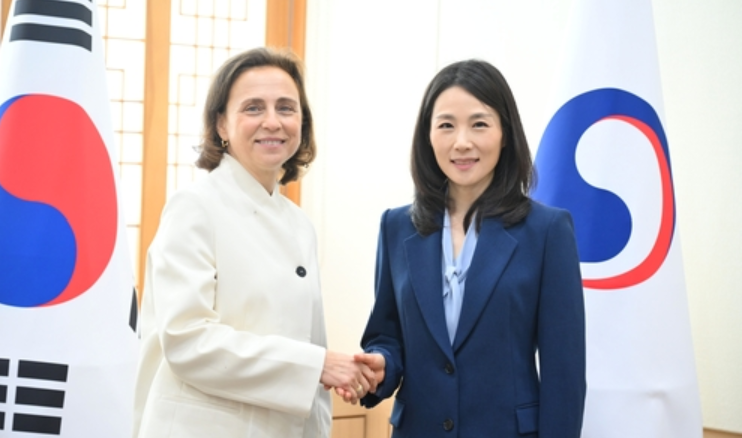
South Korea and the EU agreed to strengthen cooperation on supply chain stability and critical mineral security during talks between Kim Jin-a, Second Vice Minister of Foreign Affairs, and Belen Martinez Carbonell, EEAS Secretary-General. They affirmed plans for the Second Korea-EU Security and Defense Dialogue in May, targeting outcomes in defense industry, maritime security, and cybersecurity. Both sides stressed maintaining regular dialogue channels and close coordination on regional issues including Ukraine and the Middle East. The move aligns with broader global efforts to diversify critical mineral supply chains amid geopolitical volatility.
According to en.sedaily.com, South Korea and the European Union agreed to expand bilateral cooperation on supply chain stability and securing critical minerals during high-level talks in Seoul.
High-Level Dialogue on Economic Security
Kim Jin-a, Second Vice Minister of Foreign Affairs of South Korea, met with Belen Martinez Carbonell, Secretary-General of the European External Action Service (EEAS), on Tuesday in Seoul. The meeting focused on deepening coordination in economic security domains — specifically supply chain stabilization and critical mineral procurement. This engagement forms part of a broader effort to institutionalize dialogue between the two partners amid intensifying global supply chain pressures.
Upcoming Security and Defense Dialogue
The two sides confirmed preparations for the Second Korea-EU Security and Defense Dialogue, scheduled for May. Kim Jin-a underscored the growing importance of security cooperation between Korea and the EU, and expressed hope that the upcoming dialogue would yield substantive outcomes across key strategic areas: the defense industry, maritime security, and cybersecurity.
Shared Priorities and Regional Coordination
Martinez Carbonell acknowledged the expanding scope of Korea-EU collaboration in economic security, highlighting concrete progress in supply chain stability and critical mineral sourcing. She emphasized the need to sustain regular dialogue channels to develop actionable cooperation agendas.
“Bilateral cooperation has been expanding in economic security areas including supply chain stability and critical mineral procurement.” — Belen Martinez Carbonell, Secretary-General of the European External Action Service (EEAS)
“She expressed hope that the Second Korea-EU Security and Defense Dialogue, scheduled for May, would produce substantive cooperation outcomes in key strategic areas including the defense industry, maritime security and cybersecurity.” — en.sedaily.com
Beyond economic security, the officials held in-depth exchanges on major regional developments, including the situations in the Middle East and Ukraine. They affirmed a shared commitment to maintain close communication and coordination at all levels in response to the rapidly changing international landscape.
Context for Supply Chain Professionals
This agreement arrives amid heightened global scrutiny of critical mineral dependencies: the EU’s Critical Raw Materials Act (2023) targets at least 10% domestic extraction, 40% processing, and 15% recycling of strategic materials by 2030, while South Korea’s 2023 National Strategy for Critical Minerals identifies 22 priority materials — including lithium, cobalt, and rare earth elements — essential for batteries, semiconductors, and defense systems. Both regions rely heavily on third-country suppliers, with over 60% of global graphite and 90% of refined rare earths originating from China (USGS 2023). Recent parallel initiatives reinforce this trend: the EU-Japan Partnership on Critical Raw Materials (announced March 2024) and the U.S.-EU Trade and Technology Council’s Working Group on Secure Semiconductor Supply Chains (active since 2021) signal coordinated multilateral efforts to diversify sourcing and de-risk logistics networks. For supply chain professionals, this means increased cross-regional alignment on due diligence standards, traceability requirements, and joint investment in alternative refining capacity — particularly for battery-grade nickel, cobalt, and lithium hydroxide. Logistics planners should anticipate expanded data-sharing frameworks and potential harmonization of customs pre-clearance protocols for critical inputs under new Korea-EU technical working groups expected to launch following the May dialogue.
Source: en.sedaily.com
Compiled from international media by the SCI.AI editorial team.