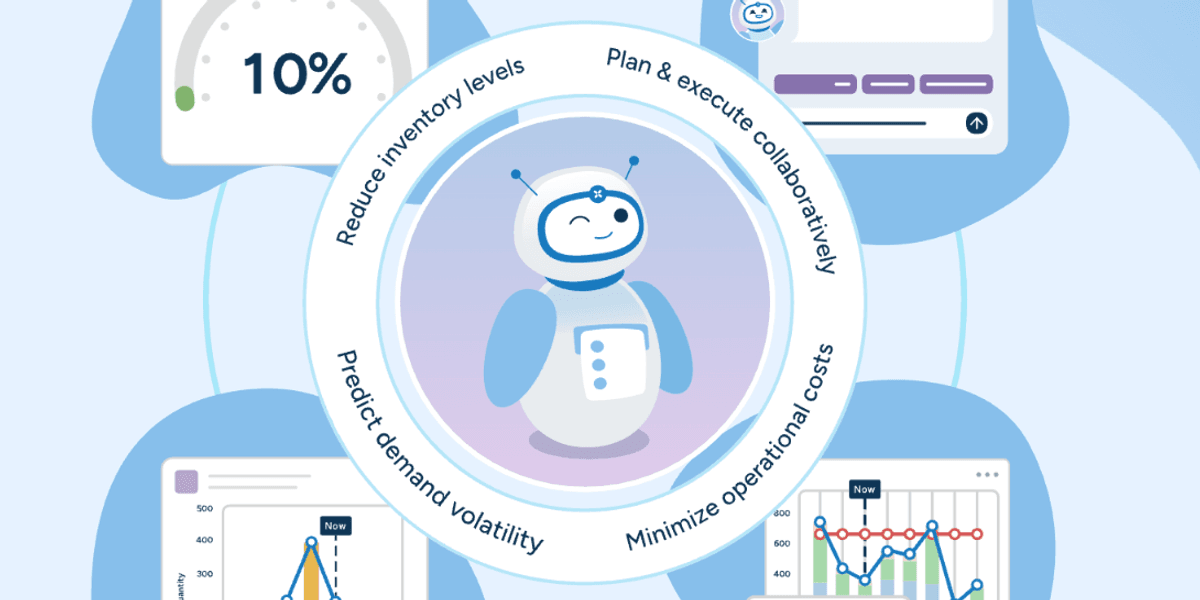
The stark paradox defining today’s supply chain intelligence landscape is this: while 71% of retail, manufacturing, and wholesale leaders plan to invest in generative and agentic AI over the next three to five years, only 10% would trust AI to make fully independent supply chain decisions. This chasm between strategic ambition and operational delegation—revealed in Relex Solutions’ ‘State of Supply Chain 2026’ report—signals not hesitation, but a profound recalibration of human-machine collaboration. It reflects an industry maturing beyond pilot-stage novelty into disciplined, context-aware augmentation—where AI functions as a high-fidelity cognitive co-pilot rather than an autonomous commander. The data from the January 2026 survey of 514 supply chain leaders underscores that volatility has ceased to be a cyclical disruption and become the structural baseline: 44% cite consumer demand volatility as their top three-year challenge, while 57% of manufacturers identify raw material procurement disruption as the most impacted area. In this environment, AI isn’t being adopted to replace judgment—it’s being engineered to extend it, compressing decision latency without compromising accountability. What emerges is a new operating model: one where algorithmic insight is rigorously validated against domain expertise, regulatory guardrails, and financial trade-off frameworks before execution.
AI Decision Support vs. Autonomous Action: The Trust Gap Explained
The 10% autonomy threshold is not a failure of technology—it is a deliberate calibration of risk tolerance across highly regulated, capital-intensive, and reputation-sensitive operations. Consider the downstream consequences of an unreviewed AI decision: a misaligned inventory replenishment order triggering $28M in excess stock write-offs; an autonomous routing algorithm rerouting pharmaceutical shipments through a jurisdiction with unvalidated cold-chain infrastructure; or a generative procurement agent negotiating contract terms that inadvertently violate EU CSDDD due diligence requirements. These are not hypotheticals—they are documented near-misses in Fortune 500 post-implementation reviews. Human oversight remains the final arbiter precisely because supply chains operate at the intersection of probabilistic forecasting and deterministic compliance. A machine may calculate the statistically optimal reorder point with 99.3% confidence, but only a human procurement director can assess whether that quantity violates a supplier’s newly imposed sustainability-linked volume cap or triggers unintended tariff classifications under USMCA rules. The 54% preference for AI recommendations followed by human finalization reflects a sophisticated understanding of layered accountability: algorithms handle pattern recognition at scale, while humans manage contextual nuance, ethical alignment, and stakeholder diplomacy.
This trust architecture is further reinforced by governance realities. Over 34% of manufacturers cite regulatory and compliance pressures as a growing operational concern, a figure that rises to 62% among life sciences and automotive suppliers subject to IATF 16949 and MDR traceability mandates. Regulatory bodies—from the U.S. FDA to the EU Commission—explicitly require human-in-the-loop validation for any decision impacting product safety, environmental reporting, or labor conditions. Moreover, audit trails must demonstrate not just *what* was decided, but *why*—a narrative layer AI cannot yet authoritatively construct without human annotation. The 67% year-on-year increase in confidence in AI for supply chain decision-making thus correlates directly with improvements in explainable AI (XAI) tooling and audit-ready decision logging—not with a relaxation of control standards. As Madhav Durbha, group vice president of manufacturing industry strategy at Relex Solutions, observes:
“AI is becoming part of everyday supply chain decision-making. As volatility persists, companies are investing in AI-driven forecasting, optimization, and decision support to respond faster and operate with greater confidence, even when conditions change quickly.” — Madhav Durbha, Group Vice President of Manufacturing Industry Strategy, Relex Solutions
Consumer Volatility as the Primary Catalyst for AI Adoption
Consumer demand volatility has evolved from a tactical nuisance into the central organizing principle of modern supply chain strategy. The 44% of leaders who rank it as their top challenge over the next three years are responding to structural shifts: the fragmentation of media channels eroding predictive signal quality, the rise of TikTok-driven micro-trends with lifecycles shorter than lead times, and the normalization of real-time price elasticity testing that renders static forecast models obsolete within hours. Retailers feel this acutely—30% cite adapting to sudden consumer demand shifts as a major challenge, particularly in fast-fashion and consumables categories where shelf-life constraints amplify margin erosion from overstock or stockouts. Traditional statistical forecasting tools, trained on historical seasonality, fail catastrophically when confronted with viral product surges or geopolitical panic-buying events. This is why 47% are using or planning AI-driven inventory and supply optimization: these systems ingest unstructured data—social sentiment, weather patterns, local event calendars, and even satellite imagery of parking lot occupancy—to generate probabilistic demand scenarios updated hourly, not monthly. The AI doesn’t “know” demand will spike—it calculates the weighted likelihood of multiple interdependent variables converging to create that outcome, then prescribes pre-approved response protocols.
The financial imperative here is non-negotiable. For a $12B global retailer, a 0.8% improvement in forecast accuracy translates to $96M in working capital freed from safety stock, while a 1.3% reduction in out-of-stocks lifts annual gross profit by $157M. Yet ROI isn’t purely quantitative—it’s strategic resilience. When 71% plan generative AI investments, they’re not seeking chatbots; they’re building adaptive planning engines capable of simulating thousands of “what-if” scenarios: “What if Amazon Prime Day coincides with a Red Sea shipping delay?”, “What if a key influencer posts about our product during a port strike in Rotterdam?” Generative AI enables rapid scenario scaffolding, but human planners retain authority to select, weight, and execute—ensuring commercial priorities (e.g., protecting brand equity over short-term margin) remain embedded in the decision logic. This hybrid approach transforms volatility from a cost center into a competitive differentiator: brands that adjust inventory allocation within 48 hours of a trend emergence capture 3.2x more share-of-wallet than peers requiring 5+ days.
- Top three volatility drivers cited: social media virality (cited by 68% of apparel retailers), regional economic policy shifts (52% of electronics distributors), and climate-related retail disruptions (47% of grocery chains)
- AI adoption correlates strongly with margin protection: 89% of companies using AI for demand sensing report improved EBITDA margins versus 63% of non-users
- Key capability gaps preventing full autonomy: cross-channel demand attribution (74%), real-time supplier capacity visibility (69%), and dynamic pricing integration (61%)
Manufacturing’s Dual Imperative: Procurement Resilience and Regulatory Compliance
While retailers battle demand uncertainty, manufacturers confront a dual crisis rooted in upstream fragility and downstream scrutiny. The 57% of manufacturers identifying raw material procurement disruption as their most impacted supply chain area are contending with cascading effects: critical mineral shortages constraining EV battery production, semiconductor allocation policies diverting chips from industrial automation suppliers, and geopolitical sanctions reshaping titanium sourcing for aerospace. Unlike retail’s demand-side volatility, this is a supply-side shockwave demanding fundamentally different AI capabilities—less about predicting *what* will be needed and more about determining *where, when, and how* it can be sourced ethically and reliably. Here, AI moves beyond forecasting into strategic network orchestration: mapping multi-tier supplier dependencies, scoring geopolitical risk across 127 jurisdictions, simulating alternative logistics corridors (e.g., shifting from China-to-EU sea freight to India-to-EU air cargo + rail), and dynamically rebalancing inventory buffers based on real-time port congestion data. The 34% citing regulatory and compliance pressures as a growing concern reflects tightening enforcement of frameworks like the EU’s CSDDD, which mandates due diligence across entire value chains—including smelters and mines two tiers removed from the OEM.
This regulatory gravity well makes autonomous AI action commercially untenable. An AI system might optimize for lowest landed cost by selecting a cobalt supplier in the DRC—but without human verification of that supplier’s adherence to OECD Due Diligence Guidance, the manufacturer assumes legal liability for forced labor exposure. Hence, AI’s role is redefined as a compliance accelerator: ingesting 10,000+ pages of supplier audit reports, cross-referencing them against UN sanctions lists and ESG ratings databases, and flagging anomalies for human investigation. 60% of respondents plan investments in predictive AI specifically to anticipate regulatory changes—scanning legislative drafts, court rulings, and enforcement agency guidance to model impact on sourcing strategies months before implementation. The result is a proactive compliance posture: instead of reacting to a CBAM carbon levy announcement, AI simulations have already stress-tested 17 alternative alloy compositions and identified three compliant suppliers with 90-day ramp-up capacity. This transforms regulatory risk from a reactive cost center into a source of innovation velocity—a capability that separates Tier 1 suppliers from commodity players in RFP evaluations.
Generative and Agentic AI: Beyond Automation to Cognitive Orchestration
The 71% planning generative and agentic AI investments signals a paradigm shift from task-specific automation to end-to-end cognitive orchestration. Generative AI—trained on vast corpuses of procurement contracts, logistics SLAs, and regulatory texts—enables natural language interfaces for complex planning tasks: “Draft a force majeure clause addressing Red Sea disruptions for our UAE-based logistics partner,” or “Summarize all tariff implications of shifting 30% of Mexico-sourced components to Vietnam under current USMCA rules.” But true transformation lies in agentic AI: systems that don’t just answer questions but autonomously execute multi-step workflows. An agentic procurement agent might monitor real-time spot market prices for lithium hydroxide, compare them against contractual thresholds, trigger RFQs to pre-vetted alternative suppliers, simulate landed cost impacts across 12 logistics lanes, and present three ranked options—with each option annotated with regulatory risk scores, carbon footprint deltas, and supplier financial health metrics—for human approval. This isn’t sci-fi; it’s live in pilot programs at Siemens and Unilever, where agentic systems reduced new supplier onboarding time from 89 days to 14 while improving compliance coverage from 63% to 98%.
Crucially, agentic AI’s value isn’t speed alone—it’s consistency at scale. Human planners inevitably apply subjective heuristics: prioritizing long-standing relationships over cost, applying mental shortcuts during peak season, or overlooking subtle regulatory nuances in complex cross-border transactions. Agentic systems enforce rigorous, auditable decision frameworks across every transaction. When 67% report increased confidence in AI for decision-making, they’re referencing this reliability—not just accuracy. The systems embed corporate policies as immutable constraints: no supplier scoring below 72/100 on ESG metrics, no logistics lane exceeding $0.82/kg carbon cost, no contract term violating Section 1502 conflict minerals disclosure. This turns strategic intent into operational reality. Yet the 10% autonomy ceiling persists because agentic AI still lacks contextual awareness of organizational politics—the unspoken priority to protect a key customer relationship even at margin cost, or the strategic decision to absorb a short-term loss to secure long-term capacity. That’s why the future belongs to “augmented agents”: AI that executes the workflow, then pauses at critical inflection points for human judgment, enriched by AI-generated context summaries. This is not a limitation—it’s architectural wisdom.
- Top three agentic AI use cases in pilots: multi-tier supplier risk assessment (82%), dynamic contract negotiation support (76%), and real-time customs classification validation (69%)
- ROI drivers: 41% reduction in procurement cycle time, 28% decrease in compliance-related fines, and 19% improvement in on-time-in-full delivery rates
- Critical enablers required: unified data fabric (94% of successful pilots), executive sponsorship with P&L accountability (87%), and cross-functional AI literacy training (79%)
The Human-Machine Interface: Designing for Judgment, Not Just Speed
The enduring 10% autonomy threshold compels a radical rethinking of the human-machine interface—not as a dashboard of KPIs, but as a collaborative decision theater. Modern supply chain control towers must surface not just “what” the AI recommends, but “why” it recommends it, “how certain” it is, and “what trade-offs” it implies. This requires moving beyond static visualizations to interactive, narrative-driven interfaces: drag-and-drop scenario builders where planners adjust demand volatility sliders and instantly see cascading impacts on working capital, carbon emissions, and supplier risk scores; or voice-enabled briefings that translate algorithmic outputs into boardroom-ready narratives (“This recommendation prioritizes 98% service level over 12% margin protection because our Q3 brand health survey shows availability drives 3.7x more NPS lift than price”). The 54% preferring AI recommendations with human finalization aren’t resisting technology—they’re demanding richer context to exercise better judgment. This is why leading adopters invest as much in UI/UX design as in model development: embedding domain-specific heuristics into the interface itself (e.g., highlighting when a proposed safety stock level conflicts with warehouse slotting constraints) so humans validate meaning, not just math.
Ultimately, the trust gap isn’t about AI’s capability—it’s about organizational readiness. Companies achieving double-digit ROI from AI decision support consistently exhibit three traits: first, they treat AI as a strategic capability, not an IT project, with C-suite ownership and dedicated AI governance boards; second, they implement “decision lineage” tracking, logging every AI input, processing step, and human override to build institutional memory and refine models; third, they invest in continuous upskilling—not just technical training, but “judgment literacy” workshops teaching planners how to interrogate AI outputs, recognize bias patterns in training data, and articulate trade-off rationales. As volatility becomes permanent, the competitive advantage won’t go to those who deploy AI fastest, but to those who design the most intelligent, accountable, and human-centered decision ecosystems. The 71% betting on generative AI understand this: they’re not buying algorithms—they’re building judgment amplifiers.
Source: DC Velocity
Compiled from international media by the SCI.AI editorial team.