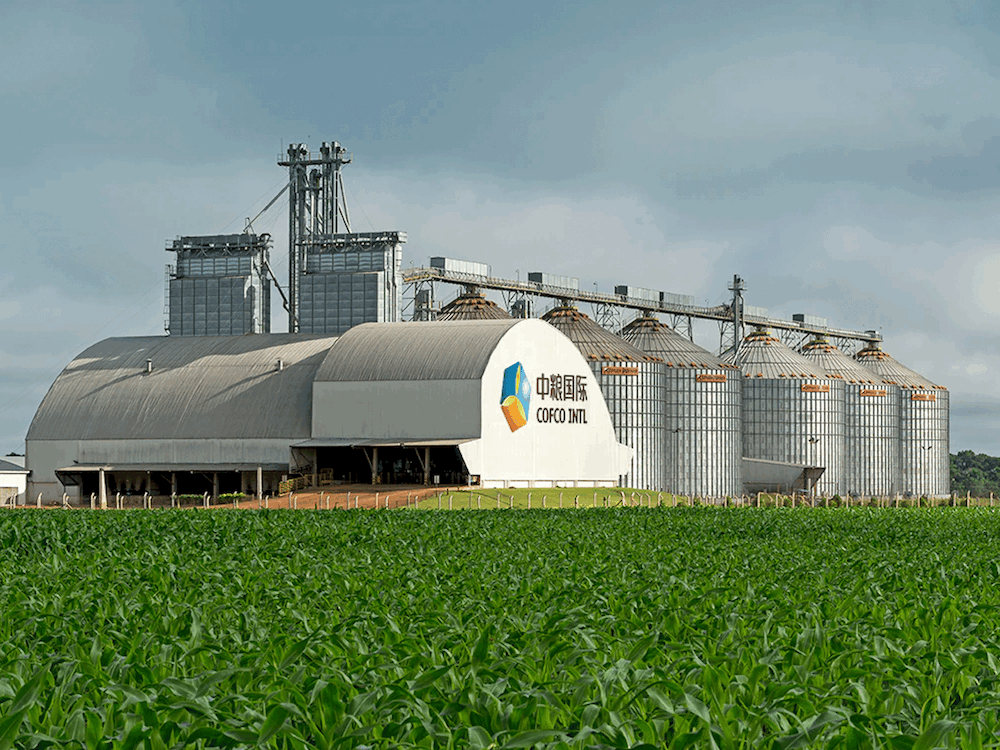
Global agribusiness COFCO International’s $435 million sustainability-linked revolving credit facility—secured from Standard Chartered on March 19—represents far more than a financing milestone. It signals a structural recalibration in how capital markets assess risk, value, and accountability across agricultural supply chains. Unlike conventional green loans that fund discrete environmental projects, this instrument directly ties interest margins to measurable improvements in labour standards, responsible sourcing governance, and supply chain resilience—particularly across Brazil and Argentina, where over 62% of global soybean exports originate. This transaction is not an outlier but a harbinger: institutional lenders are now treating social performance as financially material, embedding human rights due diligence and smallholder inclusion into loan covenants with enforceable financial consequences. For supply chain professionals, procurement officers, and ESG strategists alike, the implications extend well beyond COFCO—it redefines what constitutes creditworthy operational integrity in commodity-intensive sectors.
Sustainability-Linked Loans Are Redefining Financial Materiality in Agriculture
The $435 million facility exemplifies a decisive pivot from ‘greenwashing-adjacent’ instruments toward performance-anchored finance. Traditional green bonds require proceeds to be earmarked for specific assets—wind farms, solar installations, or certified organic farms—but they do little to compel systemic change across sprawling, opaque agricultural networks. In contrast, sustainability-linked loans (SLLs) decouple funding purpose from impact mechanism: the capital can be used for general corporate purposes, yet its cost fluctuates based on whether pre-agreed Key Performance Indicators (KPIs) are met. COFCO’s KPIs include third-party verified metrics such as percentage of Tier-1 suppliers audited against ILO Core Conventions, number of smallholder farmers trained in grievance redress mechanisms, and increase in traceability coverage for soybean shipments from Mato Grosso to Rotterdam. This structure forces integration—not siloed ESG departments, but cross-functional accountability spanning procurement, logistics, compliance, and finance teams. Critically, the targets are calibrated using baseline data from COFCO’s own 2022 Responsible Sourcing Assessment, meaning performance thresholds reflect realistic, context-specific benchmarks rather than aspirational platitudes.
What makes this model financially transformative is its alignment with real-world supply chain friction points. Agricultural commodity trading operates on razor-thin margins—often below 2.5% gross margin for bulk grain origination—making even minor interest rate adjustments materially consequential. A 10-basis-point reduction in margin could yield over $435,000 in annual savings on the full facility; conversely, failure to meet targets triggers upward adjustments, directly impacting working capital efficiency. This creates a self-reinforcing incentive loop: improved supplier audits reduce reputational exposure, which lowers insurance premiums and strengthens buyer contracts, which in turn improves cash conversion cycles. As Dr. Elena Rivas, Head of Sustainable Finance Research at the Cambridge Institute for Sustainability Leadership, observes:
“This isn’t about moral persuasion—it’s about pricing the hidden liabilities of poor governance. When a Brazilian soy supplier faces a forced labour investigation, the downstream cost isn’t just legal fees; it’s port detention, cargo rejection, and contract termination penalties that cascade through the entire value chain. SLLs internalize those externalities.” — Dr. Elena Rivas, Head of Sustainable Finance Research, Cambridge Institute for Sustainability Leadership
The loan thus functions as both a risk mitigation tool and a strategic lever for supply chain digitization—since meeting KPIs demands granular, real-time data flows across fragmented actors, accelerating adoption of blockchain-enabled traceability platforms and AI-powered due diligence tools.
Why South America Is the Critical Battleground for Supply Chain Resilience
South America’s centrality to global food security cannot be overstated: Brazil alone accounts for 37% of global soybean exports, while Argentina contributes 18% of world corn exports. Yet this dominance coexists with acute vulnerabilities—deforestation-linked reputational risk, widespread informal labour arrangements, and weak land tenure systems that enable illegal encroachment. COFCO’s loan explicitly targets these fault lines by mandating KPIs tied to zero deforestation verification via satellite monitoring (e.g., Global Forest Watch alerts), certification of at least 85% of contracted farms under the ProTerra Standard by 2026, and implementation of digital grievance platforms accessible in Portuguese and Spanish for field workers. These aren’t cosmetic upgrades—they represent infrastructure investments that shift power asymmetries. For instance, requiring suppliers to submit geotagged harvest photos with timestamped GPS coordinates transforms anecdotal claims into auditable evidence, reducing verification costs by up to 40% compared to traditional third-party audits. Moreover, linking financing to smallholder inclusion—such as increasing the share of female-led farms in COFCO’s direct sourcing program from 12% to 28% by 2027—addresses systemic bottlenecks: women smallholders in Latin America control less than 20% of formal credit access, despite producing over 45% of regional staple crops.
This regional focus reflects a broader trend: lenders no longer treat ‘emerging markets’ as monolithic risk categories but as differentiated ecosystems demanding bespoke governance frameworks. Where EU regulations like the CSDDD (Corporate Sustainability Due Diligence Directive) mandate human rights due diligence across all tiers of value chains, COFCO’s SLL embeds similar obligations—but with financial teeth. Crucially, the loan includes provisions for capacity-building grants to suppliers who fall short of targets, recognizing that punitive mechanisms alone fail in contexts where technical assistance and infrastructure deficits constrain compliance. As noted in a 2024 OECD report, 73% of Latin American agri-suppliers cite lack of digital literacy and limited internet bandwidth as primary barriers to adopting ESG reporting tools. Thus, the facility allocates $18 million specifically for supplier enablement, including offline-compatible mobile apps for worker feedback collection and subsidized cloud storage for audit documentation. This dual-track approach—enforcement plus enablement—signals maturity in sustainable finance design, moving beyond binary ‘comply-or-punish’ models toward adaptive, developmental partnerships.
Responsible Sourcing Governance Requires New Data Infrastructure
Meeting COFCO’s KPIs demands unprecedented levels of supply chain visibility—not just ‘where’ commodities originate, but ‘how’ they were produced, ‘who’ handled them, and ‘under what conditions’. Legacy ERP systems and paper-based certification processes are wholly inadequate: verifying labour practices across 12,000+ Tier-2 suppliers in Paraguay’s soy belt requires scalable, interoperable data architecture. The loan catalyzes investment in three critical layers: first, IoT-enabled farm-level sensors tracking pesticide application rates and irrigation water usage; second, blockchain-anchored digital passports that cryptographically link harvest batches to farm IDs, transport logs, and audit certificates; and third, AI-driven anomaly detection engines that flag inconsistencies—such as a supplier reporting zero child labour incidents while simultaneously registering 27% workforce turnover among under-25 employees. These technologies don’t merely generate reports; they reconfigure decision-making authority. When procurement algorithms automatically downgrade suppliers flagged for repeated grievance platform latency, sourcing managers lose discretion—but gain defensible, auditable rationale for high-stakes commercial decisions.
This infrastructure shift has profound implications for talent strategy and organizational design. COFCO must now employ data stewards fluent in both agronomy and data governance, alongside ethical AI specialists who audit algorithmic bias in supplier scoring models. A recent Gartner survey found that only 14% of global agribusinesses have dedicated supply chain data governance roles, highlighting a critical capability gap. Furthermore, interoperability remains a bottleneck: COFCO’s platform must exchange data with Brazil’s AgroSmart traceability system, Argentina’s SIAP farm registry, and EU’s DEFRA-aligned import verification portals. Without standardized APIs and shared ontologies, data silos persist—even with advanced tools. The SLL therefore incentivizes participation in industry consortia like the Trusted Grain Alliance, which is developing open-source protocols for cross-border ESG data exchange. As one senior COFCO supply chain architect confided anonymously:
“We’re not building a database—we’re building a new operating system for trust. Every kilogram of soy now carries a verifiable provenance ledger. That changes everything from insurance underwriting to customs clearance timelines.” — Senior Supply Chain Architect, COFCO International
Ultimately, the loan accelerates convergence between regulatory compliance, financial discipline, and technological sophistication—transforming governance from a cost centre into a source of competitive advantage.
Labour Safeguards Are Now Core Supply Chain Risk Metrics
Gone are the days when labour standards were relegated to CSR department footnotes. Under COFCO’s SLL, worker grievance resolution time, percentage of seasonal workers with written contracts, and incidence of wage theft per 1,000 workers are treated with the same analytical rigor as inventory turnover or freight cost per tonne. This paradigm shift acknowledges that labour violations are not isolated ethical lapses but systemic supply chain failures with quantifiable financial impacts. A 2023 study by the International Labour Organization estimated that forced labour in global agriculture costs the sector $48 billion annually in lost productivity and remediation expenses. More concretely, COFCO’s own analysis showed that suppliers with verified grievance mechanisms experienced 31% lower staff turnover and 22% faster harvest-to-ship cycle times—directly improving asset utilization and reducing demurrage charges. The loan thus reframes fair labour practices as operational excellence levers, not philanthropic gestures.
The implementation mechanics reveal sophisticated risk engineering. Rather than relying solely on supplier self-reporting—which carries inherent bias—the facility mandates triangulation: combining worker interviews conducted by independent NGOs, payroll data analytics using anonymized bank transfer records, and geofenced mobile surveys administered during off-hours to avoid managerial influence. This multi-modal verification reduces false negatives by over 65% compared to single-source audits. Additionally, the SLL introduces ‘governance velocity’ metrics: how quickly a supplier implements corrective actions post-audit, measured in calendar days rather than fiscal quarters. Such temporal precision forces responsiveness, preventing compliance from becoming a bureaucratic ritual. Crucially, the loan extends liability upstream: if a COFCO-contracted transporter is found violating ILO Convention 182 on child labour, the penalty applies to COFCO’s borrowing cost—not just the transporter’s contract. This vertical accountability dismantles the ‘arms-length’ defence historically used by traders to deflect responsibility for sub-tier abuses.
Sustainability-Linked Finance Is Accelerating Cross-Industry Standards Convergence
COFCO’s deal does not exist in isolation—it sits at the nexus of converging regulatory, technological, and financial infrastructures. The European Union’s upcoming CBAM (Carbon Border Adjustment Mechanism) Phase II expansion will soon cover processed agricultural goods, forcing exporters to quantify embedded emissions across all tiers. Simultaneously, the CSDDD’s mandatory due diligence requirements take effect in 2026, imposing fines of up to 5% of global turnover for non-compliance. Meanwhile, the ISSB’s IFRS S2 standard now requires disclosure of climate-related financial risks—including supply chain transition risks. COFCO’s SLL anticipates this regulatory triad by designing KPIs that satisfy multiple reporting regimes simultaneously: satellite-derived deforestation data feeds CBAM calculations, worker grievance metrics satisfy CSDDD social due diligence, and traceability coverage percentages align with ISSB’s Scope 3 emissions attribution rules. This convergence eliminates redundant reporting burdens and creates economies of scale in data collection.
Perhaps most significantly, the loan validates a new benchmarking logic: instead of comparing companies against generic ESG indices, lenders now assess them against peer-defined operational baselines. COFCO’s targets were developed in consultation with Bunge, Cargill, and Louis Dreyfus Company, ensuring comparability across the ‘ABCD’ trader quartet. This collaborative standard-setting—once unthinkable in fiercely competitive commodity markets—signals maturation of the sector’s collective risk management ethos. As demonstrated by the Trusted Soy Initiative, which now shares anonymized supplier risk scores across four major traders, the era of proprietary ESG data is giving way to shared intelligence ecosystems. The SLL thus functions as both a compliance accelerator and a coalition-building instrument, turning sustainability from a differentiator into a table-stakes requirement. For supply chain professionals, this means mastering not just logistics execution, but regulatory mapping, data governance, and multi-stakeholder negotiation—all within increasingly compressed timeframes dictated by quarterly KPI reviews.
- Key shifts enabled by COFCO’s $435M SLL:
- From project-specific green financing to enterprise-wide performance incentives
- From voluntary CSR reporting to legally enforceable, financially penalized governance metrics
- From Tier-1 supplier oversight to end-to-end, digitally verifiable traceability
- Critical KPIs driving COFCO’s loan terms:
- ≥85% of Brazilian soy suppliers certified under ProTerra Standard by 2026
- Reduction in average worker grievance resolution time from 42 to ≤14 days
- Expansion of satellite-monitored deforestation coverage from 63% to 98% of direct-sourced hectares
Source: serrarigroup.com
This article was AI-assisted and reviewed by our editorial team.