Record-Breaking 2025: 136 Third-Party Breaches Shatter Previous Benchmarks
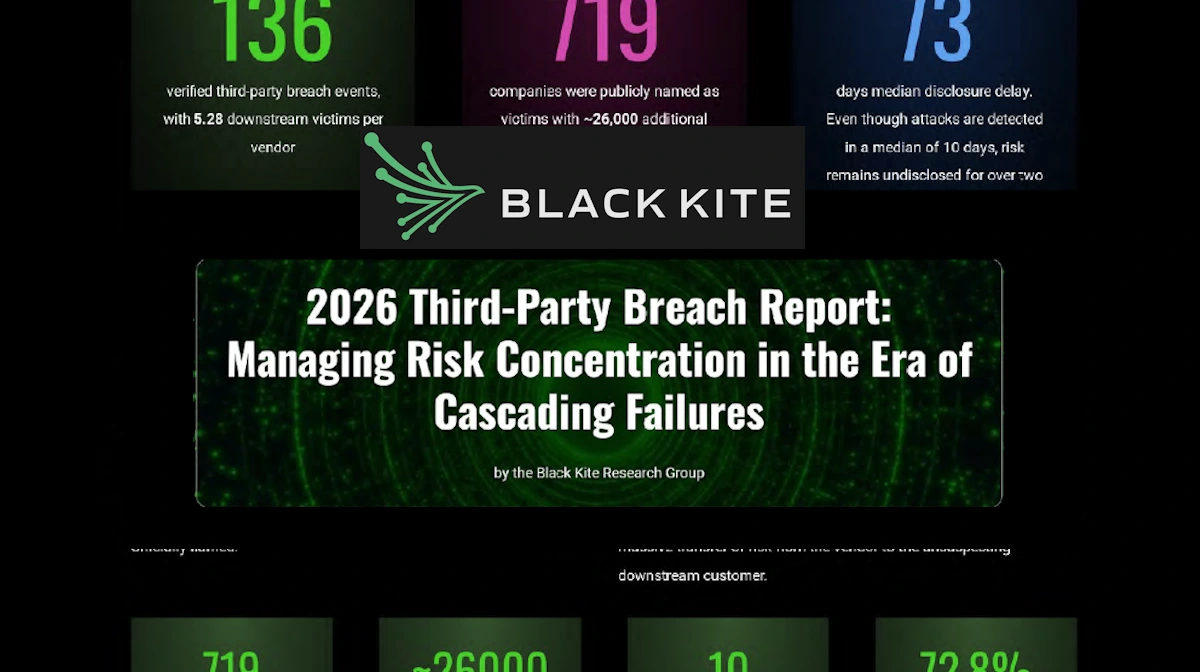
Black Kite’s seventh annual Third-Party Breach Report delivers a stark warning: third-party cyber incidents reached unprecedented scale in 2025, with 136 major breach events confirmed as the highest number ever recorded. This figure is not a model projection — it reflects empirical data drawn from continuous monitoring of nearly 200,000 organizations.
The industry breakdown reveals where exposure is most concentrated: Professional and Technical Services leads with 43,594 firms, followed by Manufacturing (30,371) and Finance (26,760), together accounting for over half of all monitored entities. These sectors form the core architecture of global vendor ecosystems, making their vulnerability profile critically important.
The significance of 136 events goes beyond raw count. What has changed is the blast radius. The report confirms that each breach now generates an average of 5.28 downstream victims — the highest level ever observed. For context: 2.46 in 2021, 4.73 in 2022, 3.09 in 2023, and 2.56 in 2024.
The 2025 figure represents a structural inflection point. Attackers have systematically shifted toward shared platforms and high-dependency vendors — single points of failure that, when compromised, trigger multi-company cascade effects across entire supply networks.
The Silent 26,000: Unnamed Victims Reveal a Systemic Visibility Crisis
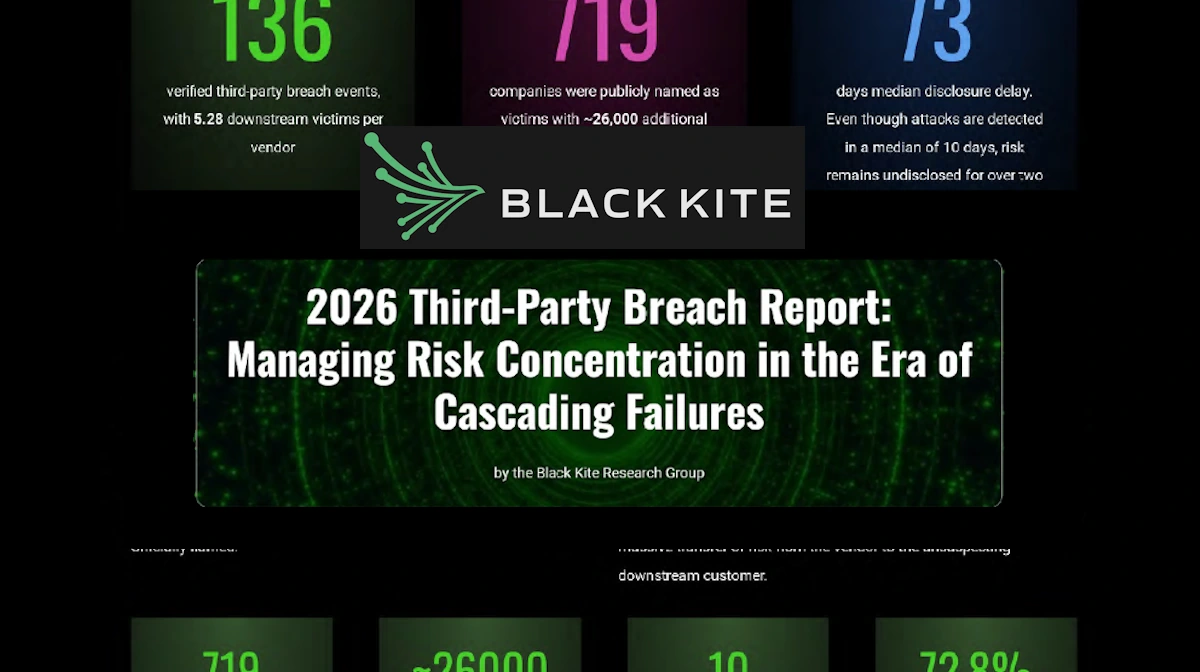
Of the 136 breach events in 2025, only 719 named victim companies were publicly disclosed. Behind that number lies a far larger shadow: approximately 26,000 additional downstream companies were affected across 27 separate incidents but were never publicly identified. Vendors disclosed downstream impact only in aggregate terms, obscuring accountability and preventing affected organizations from taking timely protective action. This is not a cosmetic reporting gap — it is a structural failure that fundamentally limits organizations’ ability to understand where risk enters their supply chains and how it propagates.
“Traditional third-party risk management is not keeping pace with the reality of today’s threats. Over the past year, these risks have transformed from a series of isolated accidents into a systematic crisis. Supply chains are most fragile at their highest points of connection.” — Ferhat Dikbiyik, Chief Research and Intelligence Officer, Black Kite
The 26,000 unnamed victims are not random small businesses. Black Kite data indicates they are largely concentrated in manufacturing, transportation, and public administration — sectors characterized by limited in-house security operations center (SOC) capacity and high reliance on upstream vendor notifications. When that notification arrives 73 days late, operational technology (OT) networks may already be compromised, persistent backdoors planted, and production data siphoned. The report reinforces that 62% of the most critical vendors — those carrying the highest business continuity weight — already have corporate credentials circulating in dark web stealer logs, enabling attackers to move laterally without any zero-day exploits.
Manufacturing Under the Microscope: RSI Scores Reveal Dangerous Concentration
The Ransomware Susceptibility Index (RSI) breakdown is particularly alarming for manufacturing supply chain operators. Black Kite found that 18% of manufacturing vendors fall in the 0.6–0.8 high-risk RSI band, with an additional 3% reaching the 0.8–1.0 maximum risk threshold — the highest concentration of extreme-risk vendors among all industries analyzed. These high-RSI vendors share a common profile: unpatched legacy operating systems, hardcoded database credentials, and PLC programming environments lacking physical IT/OT segmentation. The attack surface is not exotic or technically sophisticated; it is the predictable result of standardized industrial equipment deployed at scale with inconsistent patch discipline.
Across all industries, 54% of vendors have at least one critical vulnerability detected. Public Administration tops the vulnerability league at 68%, followed by Educational Services at 65% and Transportation at 62%. At the other end of the spectrum, Finance performs best with only 43% of vendors showing critical vulnerabilities, reflecting years of investment in continuous monitoring and layered defense strategies. Manufacturing, Agriculture, and Utilities cluster at 57% — solidly above the midpoint and significantly above the 43% Finance benchmark. The contrast is instructive: finance adopted continuous threat intelligence early; manufacturing still relies largely on periodic compliance audits that provide point-in-time snapshots rather than real-time visibility.
- Public Administration: 68% of vendors with critical vulnerabilities (highest)
- Educational Services: 65%
- Transportation: 62%
- Manufacturing / Agriculture / Utilities: 57%
- Finance: 43% — lowest, best performing sector
Attack Vector Evolution: Unauthorized Access Dominates at 47.06%
The 2025 attack method breakdown delivers a critical insight for vendor risk programs: unauthorized network access accounts for 47.06% of verified breaches, far outpacing ransomware (13.24%), stolen credentials (6.62%), unauthorized person incidents (5.88%), and software vulnerability exploitation (5.15%). This distribution reveals that ransomware is not the primary attack vector — it is typically the monetization stage that follows an initial unauthorized access phase. Attackers are increasingly patient, establishing persistent footholds through compromised vendor accounts before pivoting laterally toward high-value targets within the victim organization’s IT/OT environment.
The credential dimension is particularly revealing. With 62% of the most critical vendors having corporate credentials in stealer logs, the attack path rarely requires sophisticated exploit chains. A single phishing campaign that captures a shared-platform login credential can grant access to a vendor’s engineering document repository, customer BOM libraries, and production scheduling interfaces — all through legitimate authentication channels that bypass traditional perimeter defenses. Social engineering accounts for 2.21% of breaches, while phishing and malware each represent 3.68%, reinforcing that human-factor entry points remain persistently exploitable.
- Unauthorized network access: 47.06% (credential abuse and SSO vulnerabilities)
- Ransomware: 13.24% (typically post-lateral-movement monetization)
- Stolen credentials: 6.62%
- Unauthorized person: 5.88%
- Software vulnerability exploitation: 5.15% (concentrated in collaboration platform SSO)
- Malware and phishing: 3.68% each
The 73-Day Disclosure Gap: Why Detection Speed Alone Cannot Protect Supply Chains
One of the report’s most actionable findings involves timing. The average time from compromise to detection is 10 days — a figure that reflects meaningful progress in threat hunting and EDR capabilities. However, the average time from detection to public disclosure stretches to 73 days. That 63-day gap is the operational window during which attackers complete full kill chains: establishing persistence, conducting reconnaissance, executing lateral movement, exfiltrating sensitive data, and deploying ransomware payloads — all while downstream organizations remain unaware of their exposure status.
The detection delay picture is even more sobering when broken down by attack type. Advanced persistent threats (APTs) show an average detection window of 730 days — nearly two years — before discovery. Malware-related compromises average 628 days, unauthorized person incidents 383 days, and software vulnerability cases 335 days. These figures mean that a meaningful portion of manufacturing-sector organizations are currently operating MES systems and OT networks that may already be compromised and under active exfiltration — without any indicator of compromise visible through conventional monitoring channels. The 73-day disclosure delay is not a process inefficiency; it is a systematic risk multiplier that renders reactive vendor risk management obsolete.
Black Kite’s recommendation is unequivocal: organizations entering 2026 must shift from static questionnaires and periodic cyber ratings toward continuous intelligence and systemic visibility. Continuous monitoring focused on active threat signals — including stealer log credential exposure, SSL certificate anomalies, and DNS record changes — enables earlier intervention precisely because it does not wait for the vendor to self-report. This approach directly attacks the 73-day gap by surfacing breach signals days or weeks before formal disclosure, restoring the ability to act within the 10-day detection window rather than the 73-day disclosure window.
From “Weakest Link” to “Highest Connection Point”: Rethinking Third-Party Risk Architecture
The conceptual shift Dikbiyik articulates — from weakest link to highest connection point — has direct architectural implications for how organizations should structure their vendor risk programs. Black Kite’s four-part strategic framework begins with mapping concentration risk around what the report terms the “Elite 50”: the roughly 50 vendors whose compromise would generate cascading failures across the broadest range of business processes. The Elite 50 are not necessarily the largest suppliers by spend; they are the vendors who host core PLM data, provide unified identity authentication, or operate critical cloud infrastructure that multiple business units depend upon simultaneously.
The second strategic priority involves deploying the Ransomware Susceptibility Index as a hard procurement gate rather than a soft advisory metric. Manufacturing vendors scoring above 0.6 RSI should face mandatory remediation requirements before receiving system access tokens. Leading automotive OEMs have already embedded RSI API calls into new vendor onboarding workflows, rejecting access privileges for high-RSI candidates until technical remediation is confirmed. Third, identity exposure monitoring must become institutionalized: given that 62% of critical vendors already have credentials in stealer logs, mandatory API key rotation schedules, elimination of long-lived tokens, and hardware-based FIDO2 authentication requirements should be standard contractual terms in Tier-1 vendor agreements.
The fourth and most forward-looking recommendation involves integrating AI-driven threat modeling into vendor risk governance. By training generative AI models on historical vulnerability patterns across 200,000 monitored organizations, it becomes possible to predict which vulnerability combinations are most likely to be weaponized in the next six months — and to use simulated APT attack chains to pressure-test Elite 50 vendor response capabilities before a real incident occurs. This shift from reactive remediation to predictive defense represents the most fundamental evolution available to supply chain security programs in 2026, and it is precisely the kind of systemic approach the scale and severity of 2025’s breach data demands.
Source: industrialcyber.co
This article was AI-assisted and reviewed by our editorial team.