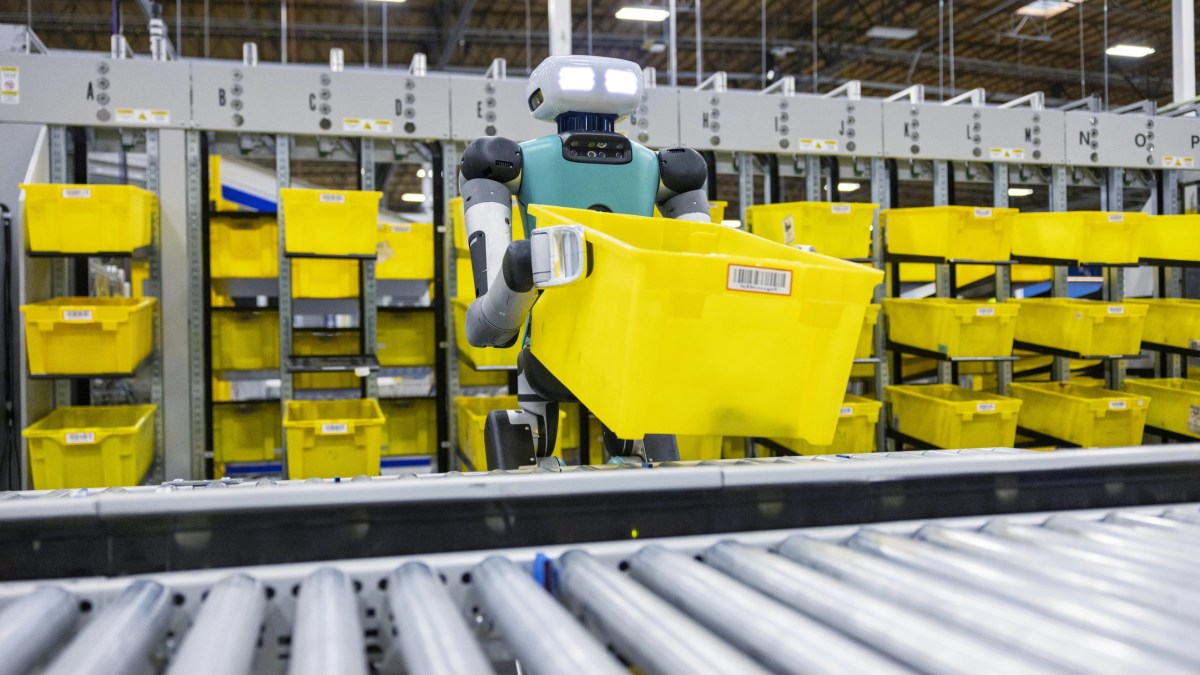
Commercial Milestone: Toyota Canada Goes Live with Digit Humanoid Robots
In February 2026, Toyota Motor Manufacturing Canada (TMMC) signed a commercial RaaS agreement with Agility Robotics to deploy seven Digit humanoid robots at its Woodstock, Ontario plant.
This follows a year-long validation pilot — making it one of the first confirmed cases of humanoid robots crossing from trial to binding commercial contract in an automotive plant.
TMMC President Tim Hollander stated that after evaluating multiple robots, Digit was selected to improve team member experience and operational efficiency. The robots unload totes of auto parts from an automated warehouse tugger, bridging two production lines.
Agility Robotics: From Oregon State University Lab to Global Factories
Agility Robotics was founded in 2015, spun out of Oregon State University. Over a decade, Digit became one of the few humanoid robots with documented commercial-scale deployments in real industrial settings.
Before Toyota Canada, Agility secured deployments with GXO Logistics, Schaeffler, and Amazon — spanning warehouse sorting, parts handling, and e-commerce fulfillment across multiple sectors.
Agility also operates Arc, a proprietary cloud fleet management platform for monitoring and optimizing robot fleets. Arc deepens customer integration and represents a long-term competitive moat beyond hardware.
Agility CTO Pras Velagapudi noted that deployment costs can exceed the robot’s own price. AI tooling is enabling faster configuration and lower integration costs — critical to scaling humanoid robots economically at scale.
“When tech companies spend real time in the field understanding real workflows… that is when we will see a huge uptick in adoption.” — Ram Devarajulu, VP at Cambridge Consultants, Humanoids Summit 2025
Why the RaaS Model Unlocks Humanoid Robot Adoption in Manufacturing
The Robots-as-a-Service (RaaS) framework is emerging as the primary commercial pathway for humanoid robots in manufacturing. It eliminates large upfront capital expenditures and transfers hardware risk to the vendor.
Toyota Canada followed the ideal RaaS path: a year-long pilot in a real production environment, then a commercial deal for seven units focused on a specific use case — unloading auto parts from warehouse tuggers.
This approach manages technology uncertainty while giving Agility time to optimize performance. It also allows TMMC to scale capacity based on production demand, avoiding sunk costs from underutilized assets.
From a supply chain perspective, RaaS flexibility matters increasingly in volatile demand cycles. Fixed automation — conveyors, AGVs — requires multi-year ROI horizons. Humanoid robots under RaaS offer a more adaptive profile for modern manufacturing environments.
Competitive Landscape: Who Else Is Deploying Humanoid Robots Industrially
Competitor Figure AI tested Figure 02 at a BMW factory for 10 months, reporting 90,000 parts unloaded — the largest publicly documented humanoid robot output in an automotive plant to date.
Other industrial humanoid programs include Apptronic, Unitree, Tesla, Boston Dynamics, 1X Technology, and Reflex Robotics. Most remain in pilot status. The Agility-Toyota Canada agreement stands out for reaching a signed commercial contract.
- Figure AI x BMW: 10-month test, 90,000 parts unloaded — largest reported industrial humanoid output
- Agility x GXO: Warehouse sorting in unstructured logistics environments
- Agility x Amazon: Hyperscale e-commerce fulfillment validation
- Agility x Schaeffler: Automotive parts manufacturing, analogous to Toyota case
- Agility x Toyota Canada: Commercial RaaS contract, 7 Digit robots on RAV4 production line
The Deployment Gap: Lab Capability vs. Factory Readiness
Humanoid robot media coverage often highlights dramatic demos — sprinting, backflips, complex manipulation. However, a major gap exists between controlled demonstrations and sustained factory operation over months.
Deployment costs include MES and WMS integration, charging and maintenance protocol design, worker training, and continuous algorithmic tuning. Agility’s CTO noted these costs can exceed the hardware price itself.
Cambridge Consultants VP Ram Devarajulu at the 2025 Humanoids Summit identified the core barrier: vendors must deeply understand real workflows — not just prove feasibility in labs — before adoption can scale.
Safety co-existence remains critical. Agility is developing a next-generation robot safe to work alongside humans. Current Digit units must operate in robot-only zones, limiting use cases. Solving this will unlock far broader manufacturing applications.
Supply Chain Implications: Humanoid Robots as a New Automation Variable in 2026
For supply chain strategists, the commercially validated humanoid robot is a new automation variable that did not exist two years ago. The RaaS model, proven at TMMC, provides a replicable template for industrial adoption without massive capital commitment.
The TMMC use case — unloading totes from warehouse tuggers to feed production lines — is highly generalizable across automotive, electronics, consumer goods, and pharmaceutical manufacturing, suggesting broad platform applicability for Agility’s Digit.
Operators evaluating humanoid robots in 2026 should budget integration costs at the same order of magnitude as hardware, plan for a minimum 6-12 month validation period, and prioritize repetitive material-transfer tasks in semi-structured environments.
As AI tooling matures and deployment costs fall, humanoid robot economics will improve steadily. Toyota Canada’s commercial deployment of 7 Digit robots in 2026 marks one of the earliest proof points of this industrial automation trajectory.
Source: techcrunch.com
This article was AI-assisted and reviewed by our editorial team.