Paradigm Shift in Supply Chain Visibility: From Tracking to Prediction
In 2026, global supply chain management is undergoing a profound transformation driven by artificial intelligence. Traditional supply chain visibility tools can no longer meet increasingly complex global freight demands and customer expectations. They are being replaced by AI-powered supply chain visibility software that combines real-time data integration with predictive analytics. These new platforms no longer merely answer “where is the cargo” but can predict “when will it arrive” and “what problems might occur.” This leap from passive tracking to proactive prediction marks supply chain management’s entry into a new era of intelligent operations.
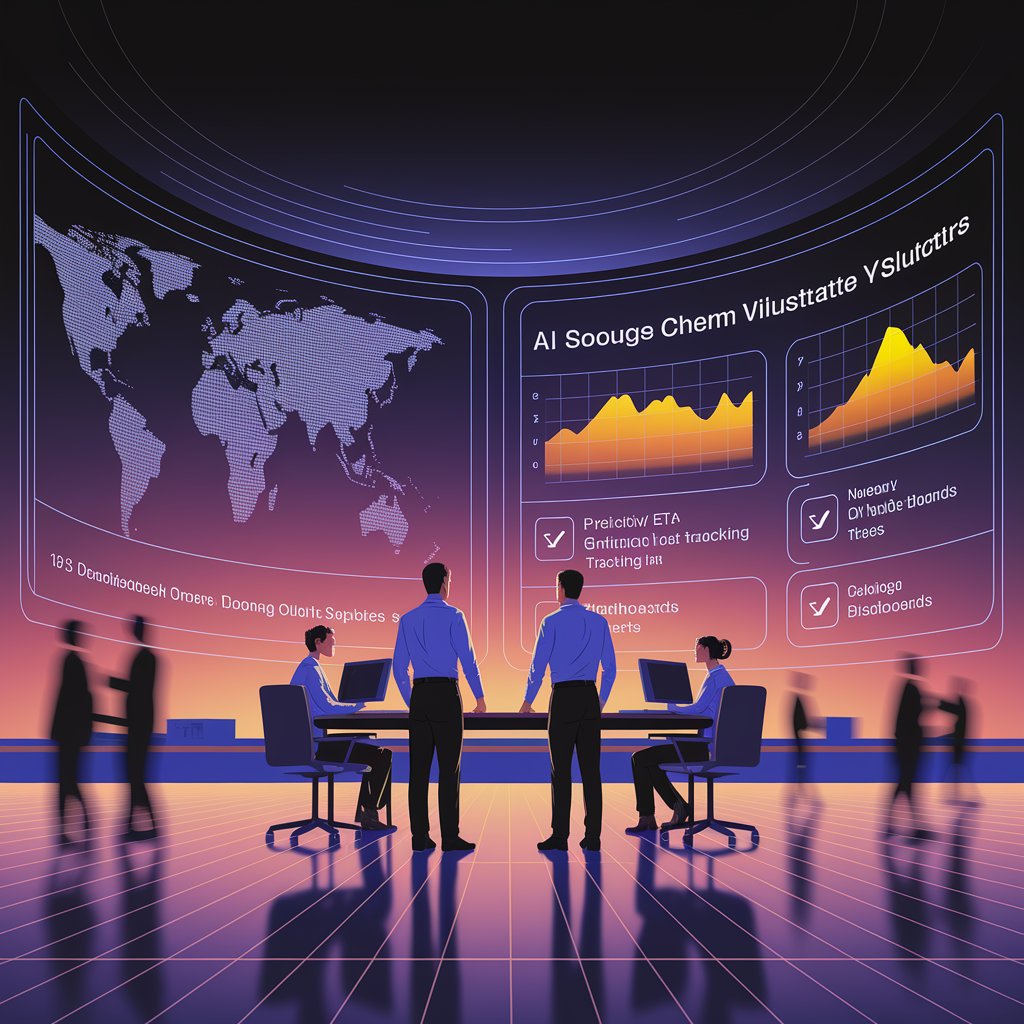
AI supply chain visibility software is a centralized digital platform providing real-time tracking and predictive insights across transportation, warehousing, and distribution networks. Unlike traditional tracking systems that only provide location information, AI-driven visibility platforms simultaneously analyze GPS and telematics data, carrier performance history, transit time variability, weather conditions, port congestion updates, inventory movements, and historical disruption patterns. The system continuously evaluates these variables to forecast delays, optimize estimated time of arrival (ETA), and recommend corrective actions. This multi-dimensional data fusion capability allows businesses to anticipate potential risks days or even weeks in advance, rather than responding passively after problems occur.
Six Major Supply Chain Challenges in 2026 and AI Solutions
Modern supply chains face unprecedented complexity. First is increasingly frequent global disruptions—from geopolitical conflicts to extreme weather events, from port strikes to carrier bankruptcies, risk sources are becoming increasingly diversified. Second is multimodal coordination challenges—when shipments need to travel through ocean, rail, and road transport to reach destinations, delays in any single link can trigger chain reactions. Third is rising customer transparency demands—both B2B customers and end consumers expect real-time cargo status updates, with proactive delay notifications becoming service standards.
Additionally, there are challenges of tight delivery timelines, capacity volatility, and cost pressures. AI supply chain visibility software addresses these challenges through six core capabilities: end-to-end real-time tracking monitoring air, ocean, rail, and road freight; predictive ETA dynamically calculating arrival times; disruption risk detection identifying potential delays before service impact; automated notifications sending milestone alerts to teams and customers; performance analytics tracking KPIs such as on-time delivery and carrier reliability; and exception management rapidly responding to unexpected events. Together, these capabilities build a “digital immune system” for supply chains, enabling businesses to maintain operational resilience amid uncertainty.
Technical Architecture of AI Visibility Platforms
Understanding AI supply chain visibility software value requires deep insight into its technical architecture. The foundation is the data integration layer, responsible for acquiring data from multiple sources—including carrier EDI/API interfaces, IoT sensors, GPS trackers, public data interfaces from ports and airports, and internal ERP/WMS systems. The key challenge at this layer is data standardization, as formats, update frequencies, and accuracy levels vary significantly across sources.
The middle layer is the AI analytics engine, the core differentiating capability of the platform. Machine learning models are trained on historical data, learning normal transportation patterns and how various disruption factors affect transit times. When real-time data flows in, models can identify anomalous deviations from normal patterns and predict their impact on ETA. The top layer is the visualization and interaction layer, transforming complex analytical results into intuitive dashboards, map views, and alert notifications. Advanced platforms also provide API interfaces, allowing enterprises to embed visibility capabilities into their customer portals or supplier collaboration platforms. This layered architecture ensures system scalability and flexibility, letting businesses choose deployment depth according to their needs.
Technical Comparison: Real-Time Tracking vs. Predictive Analytics
Essential differences exist between traditional supply chain tracking tools and AI-driven visibility platforms, manifesting across multiple dimensions. Traditional tools provide only location updates, while AI platforms deliver predictive performance insights; traditional tools use static ETAs, while AI platforms recalculate based on dynamic AI algorithms; traditional tools passively respond to customer queries, while AI platforms proactively push exception alerts; traditional tools view individual shipments in isolation, while AI platforms integrate and analyze entire network performance.
This comparison reveals an important trend: supply chain visibility is upgrading from “information provision” to “decision support”. Traditional tools answer descriptive questions (what happened), while AI platforms answer predictive questions (what will happen) and prescriptive questions (what should be done). For example, when the system detects a port closure due to strikes, traditional tools can only show “cargo detained,” while AI platforms can predict how long the detention will last, the impact on downstream deliveries, and recommend alternative routes or transportation modes. This capability leap elevates visibility value from operational efficiency to strategic decision support.
Quantified Operational Benefits of AI Visibility
Enterprises deploying AI supply chain visibility software are harvesting significant, quantifiable benefits. First is improved delivery reliability—by identifying potential delays early and taking preventive measures, businesses can significantly increase on-time delivery rates. Second is faster disruption response—when problems occur, AI systems can complete impact assessment and solution generation within minutes, whereas traditional approaches might require hours or even days of manual analysis. Third is reduced manual tracking workload—automated tracking and exception alerts free supply chain teams from repetitive query responses to focus on higher-value optimization work.
Other benefits include improved customer communication—proactive, accurate delay notifications significantly enhance customer satisfaction; enhanced operational transparency—end-to-end visibility enables management to make more informed decisions based on data; and strengthened supply chain resilience—by learning from historical disruption patterns, systems can identify vulnerable links in supply chains and suggest optimization solutions. According to industry research, enterprises deploying AI visibility achieve average supply chain-related cost reductions of 15-25% and customer satisfaction improvements exceeding 20%—numbers with decisive significance in 2026’s highly competitive market environment.
Implementation Roadmap for Building AI Visibility Capabilities
For enterprises planning to deploy AI supply chain visibility, success lies in systematic implementation approaches. Phase one is data infrastructure building—inventorying existing data sources, establishing data quality control processes, ensuring AI models receive accurate, timely inputs. This phase often requires data integration negotiations with carriers and suppliers, potentially the most time-consuming but also most fundamental step. Phase two is pilot applications—selecting a key trade lane or business unit for proof-of-concept, validating AI model accuracy and business value within limited scope.
Phase three is capability expansion—promoting successful experiences to more routes and suppliers, gradually building complete supply chain visibility networks. Phase four is deep integration—integrating visibility capabilities deeply with ERP, WMS, TMS and other core business systems, achieving automated closed loops from insight to action. For Chinese enterprises expanding overseas, special attention is needed regarding the digital maturity variations among overseas carriers and ports. In some regions, hybrid approaches may be necessary—using API direct connections in digitally mature regions, while relying on manual data entry or IoT device supplementation in less digitally mature areas. Regardless of the path chosen, 2026’s competitive reality is: without AI-driven supply chain visibility, enterprises will navigate blindly through uncertainty, while those mastering predictive insight capabilities will find optimal routes through the storm.
Source: Linbis