The Biggest Minerals Diplomacy Push Since the Cold War
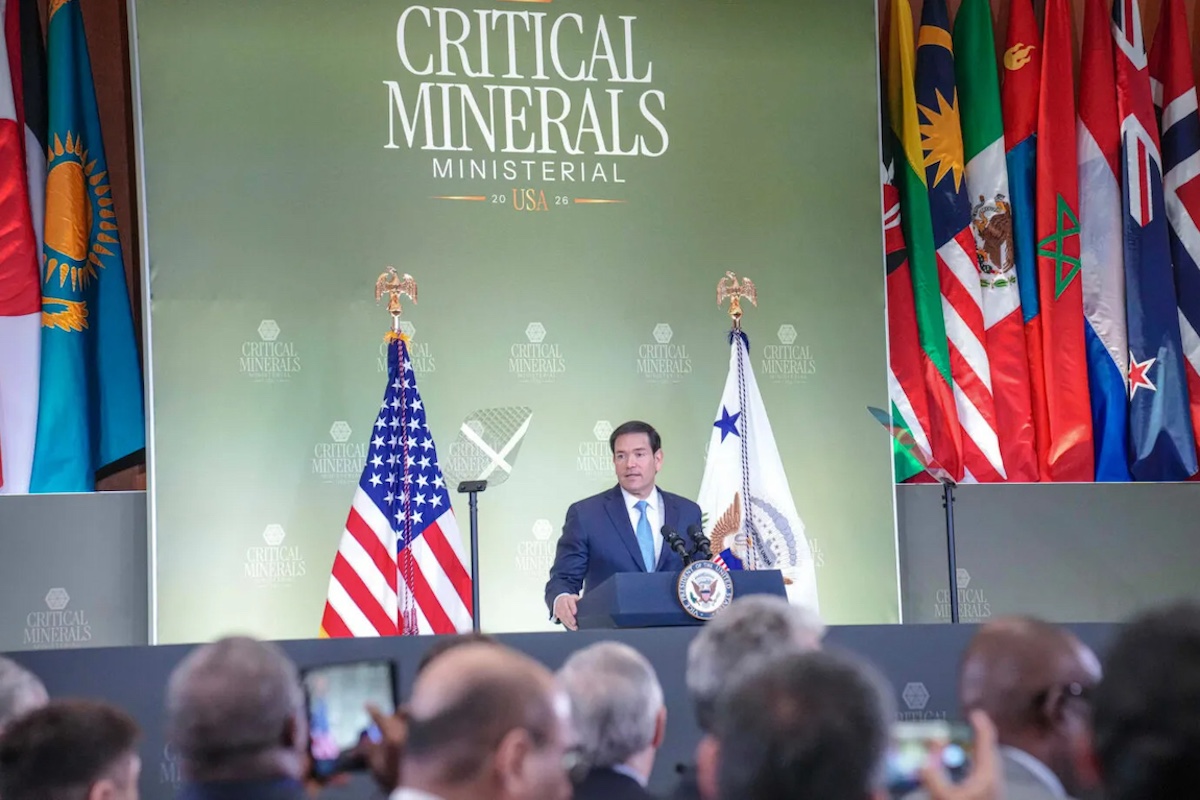
In February 2026, the United States launched what may be the most ambitious critical minerals initiative in modern history. Secretary of State Marco Rubio convened representatives from 54 countries and the European Commission — including 43 foreign ministers — at a Critical Minerals Ministerial in Washington on February 4, followed by a keynote address at the Munich Security Conference on February 14. The result was the creation of FORGE (Forum on Resource Geostrategic Engagement), a new multilateral platform designed to coordinate allied policy, investment, and supply chain development for strategic minerals vital to technology and defense sectors.
Rubio’s framing was deliberately historical, arguing that the post-Cold War era created a “dangerous delusion” that free trade alone would secure Western prosperity. “We outsourced what seemed old and unfashionable,” he told ministers on February 4. “And then one day we woke up and realized we had outsourced our economic security and our very future.” While Rubio conspicuously avoided naming China directly in either address, the strategic intent was unmistakable: to construct a Western-aligned supply chain for rare earths and other critical minerals that would not be vulnerable to coercion from any single power.
The diplomatic offensive was paired with concrete financial commitments. On February 2, President Trump announced Project Vault, led by the chairman of the US Export-Import Bank (EXIM), which approved a direct loan facility of up to $10 billion to create a domestic strategic reserve of critical minerals, shield manufacturers from supply shocks, and expand US production and processing capacity. Additional bilateral frameworks and memorandums of understanding were signed with multiple partner nations, signaling Washington’s intent to translate rhetoric into investment at scale.
America’s Mineral Vulnerability: A Supply Chain Built on Foreign Dependence
The urgency behind FORGE and Project Vault is rooted in data that reads like a national security alarm. A Commerce Department report submitted to President Trump by Secretary Howard Lutnick documented that as of 2024, the United States was 100% net-import-reliant for 12 critical minerals and at least 50% net-import-reliant for another 29. Even where domestic mining operations exist — including cobalt and nickel — the country lacks sufficient downstream processing capacity to avoid dependence on imported refined products. The report mapped critical mineral dependencies across every major industrial sector, revealing a pervasive vulnerability that extends far beyond any single commodity.
The chemical industry relies on lithium, fluorite, and bromine for synthesis and industrial processes. The communications sector depends on gallium, germanium, indium, and yttrium for fiber-optic networks and satellite systems. The energy sector requires cobalt, nickel, uranium, praseodymium, and terbium for battery storage, nuclear fuel, generators, and electric vehicle motors. From 5G infrastructure to advanced weapons platforms, from semiconductor fabrication to renewable energy deployment, critical minerals constitute the invisible foundation of modern industrial capability. A disruption in supply would cascade through multiple sectors simultaneously, creating compounding bottlenecks that could take years to resolve.
The report emphasized that the true chokepoint lies not in mining but in midstream processing — the smelting, separation, and refining stages where raw ore is transformed into usable industrial inputs. This distinction is crucial because it means that simply identifying alternative mineral deposits does not solve the fundamental problem. Without processing capacity, ore remains ore. And processing capacity is precisely where China’s dominance is most entrenched and most difficult to replicate.
China’s Calm Confidence: The 60% Market Share That Speaks Louder Than Diplomacy
Beijing’s response to the FORGE initiative has been notably measured. Chinese Foreign Ministry spokesperson Lin Jian stated on February 5 that China “opposes any country setting up exclusive blocs to disrupt the international economic and trade order,” while calling for all parties to “play a constructive role in keeping the global industrial and supply chains of critical minerals stable and secure.” The restraint in tone reflects the underlying reality of China’s position: the country controls approximately 60% of the global niche-metals market, produces roughly 92% of global rare earth output, supplies over 80% of heavy rare earths, and concentrates more than 90% of global smelting and separation capacity within its borders.
The technological dimension of China’s advantage is equally formidable. According to analysis from the China Mining Club, China’s countercurrent extraction technology enables multiple purification cycles at a fraction of overseas costs, while advanced magnet technologies and other innovations in deep processing have secured a leading global position. Of the world’s approximately 470,000 rare earth patents, China holds 222,000 — nearly half the total. Chinese commentators describe this as a technological moat built over four to five decades of continuous investment that cannot be overcome quickly through policy announcements or diplomatic conferences.
Chinese analysts have also expressed confidence that the proposed 55-country alliance will prove fragile in practice. They argue that in today’s deeply interconnected global economy, no country can develop independently of China’s manufacturing ecosystem. Resource-rich nations, particularly in Latin America, view stable cooperation with China as an economic necessity rather than a political choice. Even some European countries have signaled reluctance to commit fully to supply chains that bypass China, given the uncertainty surrounding long-term US financial commitments. This structural economic interdependence, in Beijing’s view, represents a more durable reality than any political alliance.
Alliance Fractures: Argentina’s Refusal and South Korea’s Dual-Track Approach
The cracks in the FORGE alliance emerged with remarkable speed. Argentina — a globally significant lithium producer — publicly stated that its critical minerals agreement with the United States does not exclude Chinese investment. The announcement punctured the notion of an exclusive Western bloc before the ink on the FORGE agreements had dried. As Chinese state media noted, “Washington had not expected cracks to appear so quickly after the Critical Minerals Ministerial conference on February 4.” Argentina’s position reflects clear economic logic: China is the country’s second-largest trading partner and a major investor in energy, lithium, and infrastructure projects worth billions of dollars. For a developing economy, making an exclusionary choice between Washington and Beijing carries prohibitive economic costs.
South Korea’s approach has been even more strategically revealing. Despite serving as a key US ally and co-host of alliance discussions, Seoul is pursuing what analysts describe as a sophisticated dual-track strategy: participating in the US-led alliance framework while simultaneously planning to establish a critical minerals hotline with China to ensure continued imports of key raw materials regardless of political fluctuations. This reflects a stark reality — even America’s closest allies are unwilling to concentrate all supply chain risk in a single geopolitical basket. South Korea’s semiconductor, battery, and automotive industries are heavily dependent on Chinese-processed rare earths and critical minerals, and any supply interruption could deliver catastrophic impacts to flagship companies including Samsung, SK Hynix, and Hyundai.
Industry observers note that Argentina and South Korea represent merely the visible tip of a much larger pattern. Among FORGE’s 55 member nations, the vast majority face similar dilemmas: they want access to US-led diversification funding and technology, but they are equally unwilling to sever commercial ties with the world’s largest mineral processing nation. This inherent contradiction will continue to test alliance cohesion, making it more likely to evolve into a loose coordination mechanism rather than a unified containment bloc.
The 10-20 Year Rebuilding Timeline: Why Mineral Supply Chains Cannot Be Rewired Quickly
Perhaps the most sobering assessment comes from Chinese analysts who estimate that the United States may require 10 to 20 years to build a fully independent critical minerals supply chain. This timeline is grounded in industrial reality rather than political commentary. From initial geological exploration through environmental assessment, permitting, infrastructure construction, and commercial production, a new mining project typically requires 7 to 15 years. Building the midstream smelting and refining capacity demands additional years of technology development and workforce training that cannot be compressed through political will alone.
Consider the case of Mountain Pass in California — America’s largest rare earth mine. Despite resumed mining operations, the facility’s refined output still requires shipment to China for deep processing, illustrating the persistent gap in midstream capability. Project Vault’s $10 billion loan facility, while historically significant, represents a fraction of the total investment needed to rebuild an entire industrial chain. Constructing a single lithium hydroxide processing plant comparable to Chinese industry standards requires several billion dollars and a 3-5 year construction timeline. Multiplied across dozens of critical minerals — rare earths, cobalt, nickel, germanium, gallium, and others — the total investment requirement could reach hundreds of billions of dollars.
The financial viability challenge compounds the problem further. As the Foundation for Defense of Democracies (FDD) has noted, China currently supplies more than 50% of US demand for 21 critical mineral commodities. This market dominance gives Beijing effective pricing power and the theoretical ability to render competing projects uneconomical overnight by adjusting export policies. No financial institution will commit long-term capital to a mining project when the dominant market player can make its output worthless at will. Building alternative supply chains is therefore not merely a technical and capital problem — it is fundamentally a confidence problem that requires credible, sustained government commitment over decades, not electoral cycles.
The New Risk Landscape: How Mineral Geopolitics Is Reshaping Supply Chain Management
The escalation of critical minerals competition is fundamentally altering the risk calculus for global supply chains. For electric vehicle manufacturers dependent on rare earth permanent magnets, semiconductor companies requiring gallium and germanium, and battery producers using cobalt and lithium, mineral supply has escalated from a routine procurement function to a C-suite strategic priority. Multinational corporations are accelerating diversification strategies, distributing mineral suppliers across multiple countries and regions to reduce single-source dependency. Some leading companies have begun investing in urban mining — recovering rare metals from electronic waste — as a long-term hedge against geopolitical supply risks.
Three structural shifts are emerging from the geopoliticization of critical minerals. First, strategic inventory management is expanding from a government function to a corporate imperative, with an increasing number of manufacturers establishing their own safety stocks of critical raw materials. Second, substitute materials R&D investment has surged, with motor designs that reduce rare earth content and cobalt-free battery chemistries receiving unprecedented research funding. Third, supply chain transparency requirements are intensifying, with full mine-to-product traceability becoming both a regulatory compliance obligation and a competitive barrier to market entry.
For supply chain professionals worldwide, the critical minerals contest offers a defining lesson: the decentralization of mineral supply chains is an irreversible long-term trend, but its pace will be far slower and more tortuous than politicians claim. During the 10-20 year transition period, companies with processing technology advantages and production capacity will command enormous strategic leverage, while downstream manufacturers dependent on single sources will face escalating supply chain fragility. In this era of heightened uncertainty, supply chain resilience building has shifted from an optional investment to an existential imperative. The question is no longer whether to diversify critical mineral sourcing, but how fast organizations can move before the next supply shock arrives.
Source: asiatimes.com