Palletrone Flying Trolley Elevates Cargo for Seamless Operation
Author: Paul Ridden
September 24, 2024
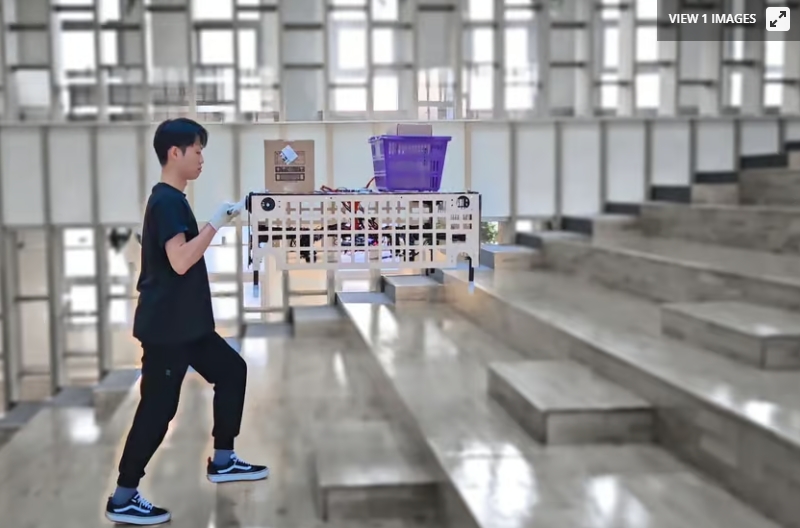
The Palletrone flies at chest height and maintains a stable upper cargo platform while being pushed by a human operator.
No matter if you’re moving items in a shopping mall or an office, you’ve likely encountered uneven-wheeled trolleys. Now, the flying Palletrone trolley could be the solution.
The concept essentially places a multi-rotor drone inside a cage to form a top-mounted platform that allows users to push cargo at chest height rather than using wheeled carts on the ground.
“The platform is designed with a spacious upper surface for easy loading of goods and comes equipped with a shopping cart-like rear handle,” noted the research team from SeoulTech in their project introduction paper. “Flight trajectory control is achieved by the human operator gripping the handle and applying three-dimensional forces and torques, while maintaining stable cargo transportation without rolling or pitching throughout the flight.”
The operator “controls the aircraft’s movement by applying force and torque to influence its flight path,” which means users steer forward momentum and direction via a handlebar, with hardware and software enabling the platform to hover above ground.
Users are encased in a porous enclosure that protects them from the high-speed rotating blades of the X-frame drone while allowing sufficient airflow for sustained flight with minimal performance loss.
Of course, one drawback is the noise generated by the drones. Another issue is the relatively low payload capacity of the current setup at 2.93 kg (6.5 lbs) — not enough to transport a week’s worth of groceries in the air or assist warehouse workers efficiently move items. Additionally, there are concerns about the limited flight time provided by onboard batteries.
However, these issues can be addressed through further adjustments, and one significant advantage is that Palletrone can easily navigate stairs. In its current version, researchers have utilized a basic flight control algorithm from previous studies of team members. The system also employs actuators to continuously adjust for roll and pitch, maintaining the platform’s level position during operation while accounting for forces applied by users.
The design assumes that all “disturbances applied to the system” come from the operator, so any obstacles encountered along the way could cause issues — the paper calls for further research in this area.
Regarding potential future applications beyond logistics or supermarket environments, team member Seung Jae Lee told IEEE Spectrum: “By mounting a camera on the platform, it can serve as a flying tripod and even as a shooting cart, allowing flexible camera movement and angles. This is particularly useful in environments where professional filming equipment is hard to come by.”
He also suggested that next steps might include developing a docking system for charging during flight to extend operational time.
Detailed information about the project can be found in the paper published on IEEE Robotics and Automation Letters.
Source: SeoulTech via IEEE Spectrum
Source Website: New Atlas