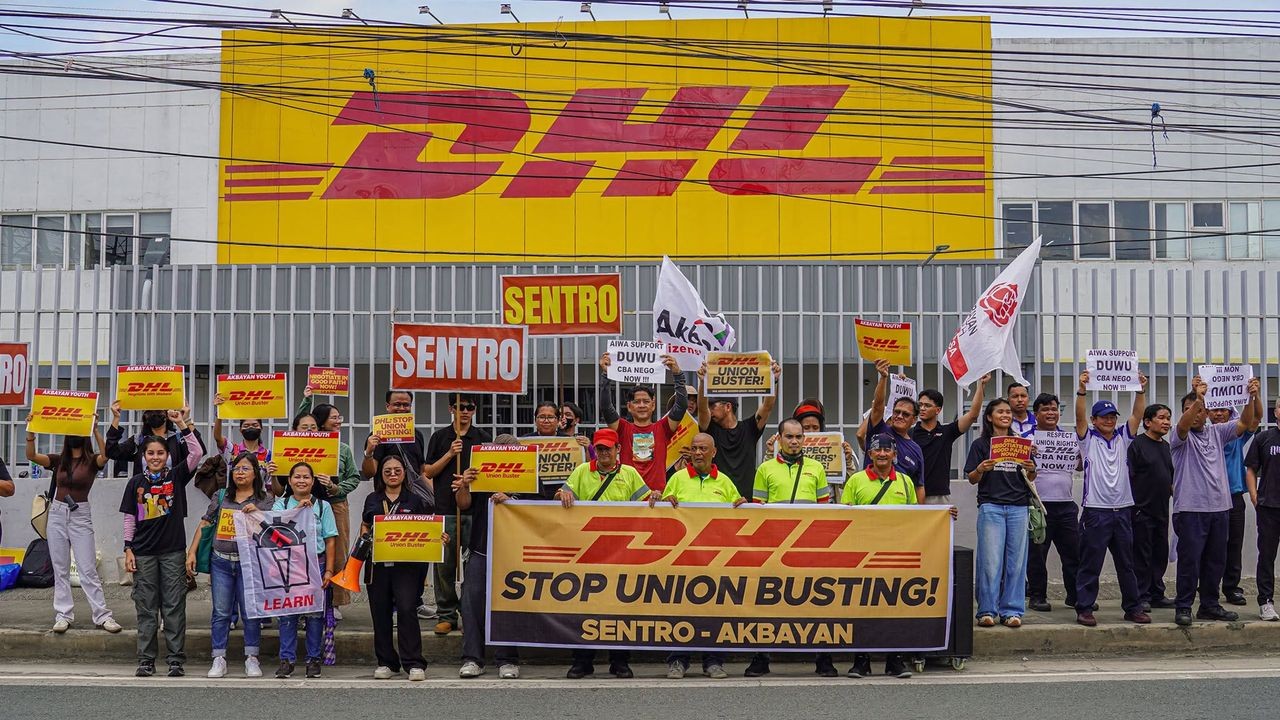
According to wsws.org, more than 430 logistics workers at the DHL Supply Chain warehouse in Muntinlupa City, Metro Manila, are on their tenth day of an indefinite strike against the facility’s scheduled closure on August 30–31.
Legal Constraints and Escalating Action
The walkout began on August 17, following DHL’s early-August announcement of the shutdown. Strikers are operating under Article 263(g) of the Philippine Labor Code — a provision inherited from the Marcos dictatorship that allows the government to assume jurisdiction over labor disputes, criminalize strikes, and enforce mandatory return-to-work orders via state police.
Workers maintain a continuous picket line at the warehouse gates. On August 21, they staged brief protests at DHL retail outlets along Timog Avenue in Quezon City and outside the Department of Labor and Employment (DOLE) central offices. Solidarity actions have also occurred at regional logistics hubs in Bulacan, Iloilo, General Santos City, Surigao, and Cebu.
The DHL United Workers Union (DUWU), certified only in May, represents workers exclusively at the Muntinlupa City site. DHL management moved immediately to undermine the union by planning the warehouse’s closure — claiming it resulted from losing its primary contract with Robinsons Supermarket. Yet the union exposed this as a pretext, noting management had publicly celebrated a three-year renewal of that same contract.
Negotiations, Delays, and Strategic Relocation
Negotiations between May and August were not conducted in good faith, according to the source. Instead, they served as a stalling tactic while corporate leadership prepared the facility for liquidation. DUWU, working with the SENTRO labor federation and the leftist Akbayan party, pursued proceedings before the National Conciliation and Mediation Board (NCMB), foregoing immediate industrial action despite restrictive labor laws.
Union leaders attended seven meetings with DHL management, which refused to table any counteroffer. The union demanded higher wages and an end to multi-layered subcontracting and casual labor schemes used to depress pay and divide the workforce. After these fruitless talks, a mandatory 30-day “cooling-off” period and a subsequent seven-day strike ban followed — delays that allowed DHL to quietly reorganize regional operations and shift logistics transactions to non-unionized provincial mega hubs.
By the time the legal requirements were met to launch the strike on August 17, workers faced only a two-week window before the closure deadline. DHL’s Philippine operations are integrated with DHL Summit Solutions, Inc. (DSSI), a joint venture with the Gokongwei Group — one of the country’s most powerful conglomerates. DHL Supply Chain holds an exclusive nationwide distribution contract for Universal Robina Corporation (URC), the Gokongwei Group’s food giant.
Transnational Context and Systemic Failure
The source links the Muntinlupa struggle to global restructuring across DHL’s operations. The DHL Group announced 8,000 layoffs in Germany last year and aggressive cost-cutting worldwide, even as it posted over €6.1 billion ($US7.1 billion) in operating profits in 2025. In the United States, 6,000 DHL workers voted by 96 percent to authorize strike action in March 2026, only for the Teamsters bureaucracy to impose a sellout contract one day before the deadline.
In 2023, 1,100 DHL workers struck for 11 days at the Global Superhub at Cincinnati Airport. The Verdi union in Germany accepted real wage cuts while Deutsche Post DHL proceeded with mass job destruction. Globally, DHL operates in over 220 countries. By treating the Muntinlupa closure as a localized labor-code violation, SENTRO and Akbayan have isolated Filipino workers from their international counterparts — leaving them vulnerable to a transnational monopoly.
Source: wsws.org
Compiled from international media by the SCI.AI editorial team.