According to www.logupdateafrica.com, sustainability across the GCC-Africa trade corridor is shifting from corporate reporting to operational precision — with regional logistics operators targeting a 40% empty-truck rate as a primary decarbonisation lever.
The Invisible Tax of Inefficiency
In traditional freight networks, underutilisation—not vehicle age—is the dominant emissions source. Every failed first delivery, every deadhead mile, and every mispositioned inventory unit imposes dual costs: financial loss and avoidable carbon output. Regional corridor authorities report that 30% to 40% of commercial trucks on the African continent run completely empty on return legs — a structural inefficiency now quantified as a core sustainability metric.
This problem is especially acute on key corridors: along the East African Northern Corridor linking the Port of Mombasa to landlocked countries like Uganda and Rwanda, empty return trips constitute a significant share of total greenhouse gas emissions on the return journey. Similarly, the Addis Ababa to Djibouti corridor suffers from chronic trade imbalances, resulting in high empty-running rates that cost the regional economy millions of dollars annually in wasted fuel and accelerated vehicle wear.
Last-Mile Friction in Megacities
Urban congestion compounds waste in Africa’s expanding megacities. In Lagos, Nairobi, and Cairo, unmapped addresses and traffic bottlenecks force delivery vehicles to idle for hours or make multiple attempts per recipient. According to data from UNCTAD (United Nations Conference on Trade and Development) and the World Bank, logistics absorbs up to 35% of the total cost of imported goods in Africa — compared to just 6% in highly developed markets — making operational waste a critical developmental bottleneck.
This disparity underscores why decarbonisation in emerging markets hinges less on fleet electrification timelines and more on mathematical and algorithmic optimisation of existing assets. As the article notes, “the greenest mile is the one you never have to drive” — a principle now guiding routing software, load-pooling platforms, and hub placement decisions.
Heavy-Lift Engineering for Clean Energy
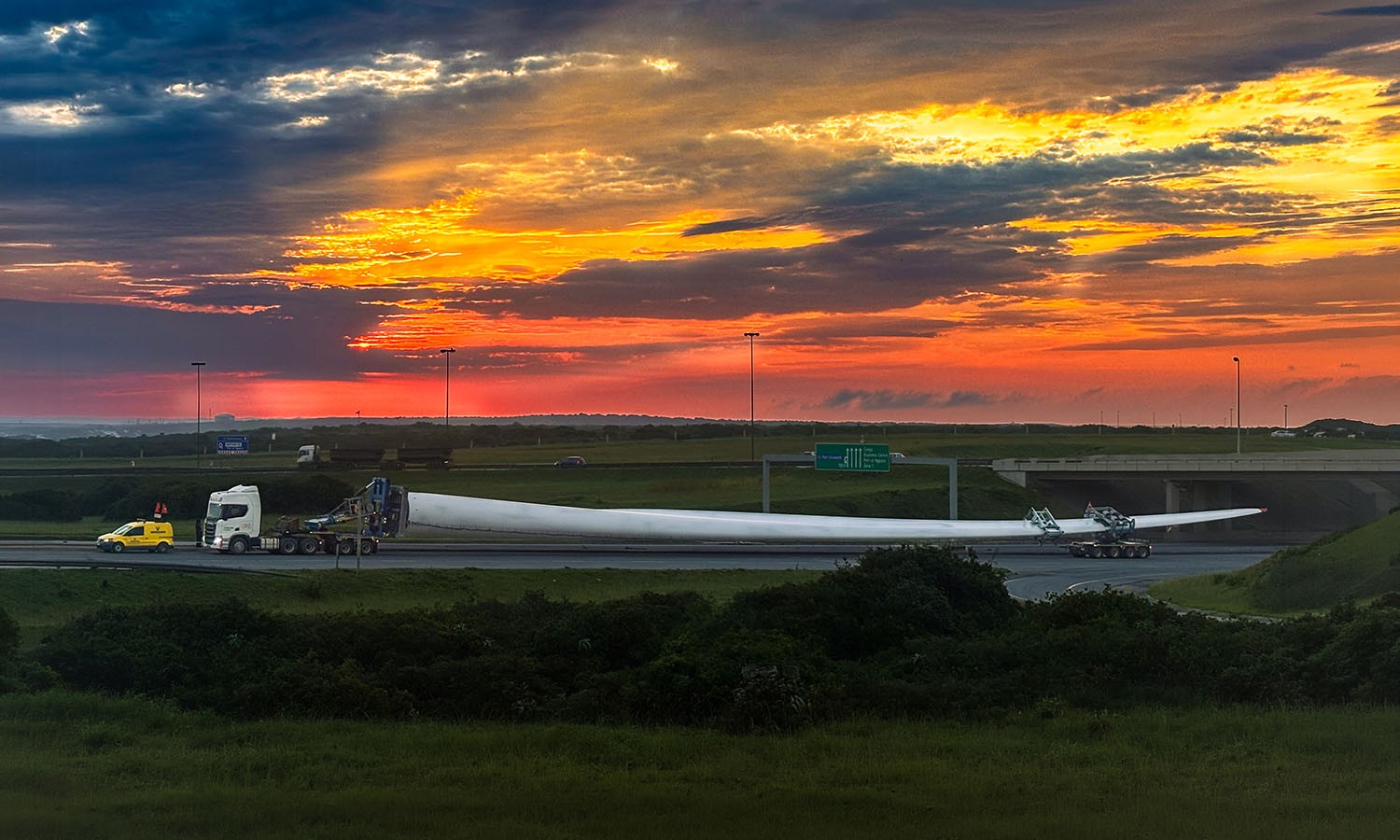
While software optimises parcel freight, industrial-scale sustainability demands physical execution. Africa’s clean energy transition relies on massive renewable infrastructure — particularly onshore wind farms — whose construction presents extreme heavy-lift logistical challenges. For specialised operator Vanguard, carbon reduction means flawlessly transporting components like 91m blades and 102m combinations over hundreds of kilometres of unpredictable terrain.
“The green transition across Africa cannot happen on paper; it has to happen on the asphalt. When you are navigating 91m blades on 102m combinations through tight rural roads and historical mountain passes, every single centimetre becomes a high-stakes calculation. The true enablers of Africa’s clean energy future aren’t just the developers building the farms; it’s the engineers and heavy-haul drivers physically charting the path to the grid.” — Ryan Hosking, Director at Vanguard
By deploying bespoke solutions — including shunt trailers that eliminate double handling at ports and advanced rotor blade transport systems — heavy-haul operators ensure renewable projects stay on schedule, avoiding carbon-intensive delays caused by transit bottlenecks.
Corridor Coordination Over Infrastructure Wait
The booming GCC-Africa trade axis faces friction at handover points: physical bottlenecks at border crossings, legacy customs procedures, and fragmented fleet ownership routinely extend transit times. When freight trucks idle at border posts for days, both environmental and financial costs escalate. Rather than waiting decades for road upgrades, operators are adopting smart corridor coordination, electronic single-window customs clearances, and localised warehousing — positioning inventory closer to end consumers in regional fulfilment hubs to bypass congestion entirely.
This approach reflects a broader strategic shift: sustainability in emerging markets is not an expensive luxury but simply good business. By treating every mile, every litre of fuel, and every cubic metre of cargo space as a premium, finite resource, operators can leapfrog legacy inefficiencies that Western supply chains spent decades untangling — using dynamic routing built for real-time demand and collaborative load-pooling platforms to solve the empty backhaul crisis.
Source: logupdateafrica.com
Compiled from international media by the SCI.AI editorial team.