Explore

  • Trending
  • Latest
  • Tools
  • Browse
  • AI Assistant
  • Subscription Feed

Logistics

  • Ocean
  • Air Cargo
  • Road & Rail
  • Warehousing
  • Last Mile

Regions

  • Southeast Asia
  • South Asia
  • Central Asia
  • Japan & Korea
  • Middle East
  • Europe
  • Russia
  • Africa
  • North America
  • Latin America
  • Australia
SCI.AI
  • Supply Chain
    • Strategy & Planning
    • Logistics & Transport
    • Manufacturing
    • Inventory & Fulfillment
  • Procurement
    • Strategic Sourcing
    • Supplier Management
    • Supply Chain Finance
  • Technology
    • AI & Automation
    • Robotics
    • Digital Platforms
  • Risk & Resilience
  • Sustainability
  • Research
  • Expert Columns
  • English
    • Chinese
    • English
No Result
View All Result
  • Login
  • Register
SCI.AI
No Result
View All Result
Home Supply Chain Manufacturing

India scales solar manufacturing to 200 GW amid China-alternative push

2026/07/25
in Manufacturing, Supply Chain
0 0
India scales solar manufacturing to 200 GW amid China-alternative push

According to www.pv-magazine.com, India’s annual solar module manufacturing capacity has surpassed 200 GW as of June 2026 — a milestone driven by policy interventions and rapid industrial scaling aimed at building a vertically integrated, China-alternative photovoltaic supply chain.

Solar manufacturing as strategic infrastructure

Solar manufacturing has evolved from an industrial sector into a core component of national security and economic sovereignty. As noted by Tanmoy Duari, CEO of AXITEC Energy India, “Success will require sustained policy support, patient capital, technology partnerships, infrastructure development, and a long-term industrial vision.” The global clean energy transition is no longer measured solely in gigawatts installed but in the geopolitical control over critical manufacturing nodes — from polysilicon refining to finished modules.

Over the past five years, disruptions including the COVID-19 pandemic, US-China strategic rivalry, maritime logistics bottlenecks, and export controls have underscored the risks of overconcentration. Today, energy security encompasses not just fuel access but assured supply of clean energy technologies. Governments across the US, Europe, Japan, and India now treat domestic solar manufacturing as a strategic capability — deploying industrial incentives, local-content mandates, and targeted procurement frameworks.

China’s entrenched dominance

China’s leadership in solar manufacturing was built systematically over two decades. By June 2026, it accounted for more than 80% of global solar manufacturing capacity and controlled over 95% of worldwide wafer production. Its vertical integration spans polysilicon refining, ingot casting, wafer slicing, cell fabrication, module assembly, and ancillary materials including glass, backsheets, and EVA films.

This ecosystem delivers unparalleled economies of scale and rapid response to technological shifts such as TOPCon and Heterojunction (HJT) cells. Chinese producers also dominate polysilicon — the foundational raw material — dictating global pricing and supply rhythms. Replicating this depth is far more complex than establishing standalone module lines, requiring coordinated investment across upstream, midstream, and downstream segments.

India’s accelerated manufacturing expansion

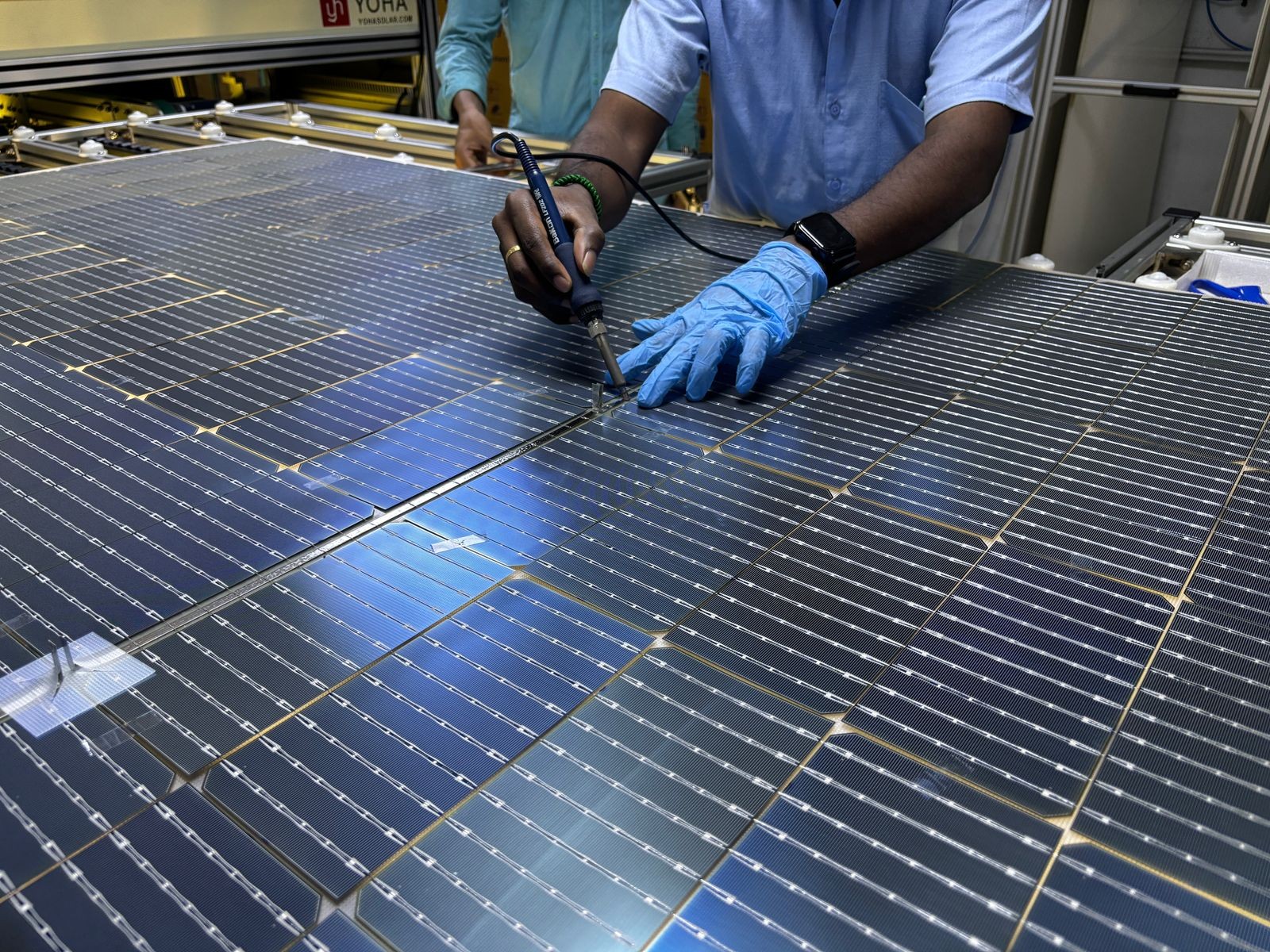
India’s solar manufacturing landscape has transformed since 2020. Five years ago, domestic capacity was limited almost entirely to module assembly, with near-total reliance on imported cells and wafers. Now, under the Production Linked Incentive (PLI) Scheme, Basic Customs Duty (BCD), and the Approved List of Models and Manufacturers (ALMM), the country has scaled rapidly. As of June 2026, ALMM-approved manufacturing capacity exceeds 190 GW, while domestic solar cell manufacturing capacity has crossed 30 GW.

Several fully integrated facilities — spanning polysilicon-to-module production — are under construction. This expansion aligns with India’s status as one of the world’s fastest-growing renewable energy markets, where utility-scale auctions and state-level procurement programs generate consistent demand. However, the next phase demands mastery of upstream segments — particularly polysilicon, ingots, and wafers — currently the most formidable barrier to true supply chain autonomy.

Pathways to full integration

Achieving end-to-end solar manufacturing requires four interlocking enablers: sustained policy continuity beyond electoral cycles; patient capital with 10–15-year horizons to absorb early-stage risk; technology transfer partnerships with established non-Chinese suppliers; and parallel upgrades to power, water, and transport infrastructure in designated industrial zones.

Unlike semiconductor manufacturing — which benefits from concentrated R&D ecosystems and mature IP frameworks — solar manufacturing relies heavily on process engineering, equipment standardization, and workforce upskilling. India’s advantage lies in its growing pool of chemical engineers, metallurgists, and automation technicians, alongside expanding vocational training programs focused on PV manufacturing. Still, gaps remain in high-purity polysilicon purification and large-diameter wafer slicing — capabilities where only a handful of non-Chinese firms operate at commercial scale.

The challenge is not merely technical but systemic: building supplier networks for specialty gases, quartz crucibles, and precision metrology tools — all currently dominated by Chinese or East Asian vendors. Success hinges on coordinated action across ministries, state governments, and private investors — not isolated factory launches.

Source: pv-magazine.com

Compiled from international media by the SCI.AI editorial team.

More on This Topic

  • Amazon, Temco cut 1,222 jobs as freight distress spreads (Jul 25, 2026)
  • Cencora invests $1B to scale cold chain, specialty drug distribution (Jul 25, 2026)
  • Container spot rates fall gently: Shanghai-Rotterdam at $4,824 (Jul 25, 2026)
  • U.S. Manufacturers Redesign Warehouses Amid 75% Organic Growth (Jul 25, 2026)
  • Amazon’s Michael Shorrosh to detail $2.6B automation scaling at IntraLogisteX Dallas (Jul 25, 2026)
ShareTweet

Related Posts

Amazon, Temco cut 1,222 jobs as freight distress spreads
AI & Automation

Amazon, Temco cut 1,222 jobs as freight distress spreads

July 25, 2026
0
Cencora invests $1B to scale cold chain, specialty drug distribution
Strategy & Planning

Cencora invests $1B to scale cold chain, specialty drug distribution

July 25, 2026
0
Container spot rates fall gently: Shanghai-Rotterdam at $4,824
Manufacturing

Container spot rates fall gently: Shanghai-Rotterdam at $4,824

July 25, 2026
0
U.S. Manufacturers Redesign Warehouses Amid 75% Organic Growth
Inventory & Fulfillment

U.S. Manufacturers Redesign Warehouses Amid 75% Organic Growth

July 25, 2026
0
Amazon’s Michael Shorrosh to detail $2.6B automation scaling at IntraLogisteX Dallas
Last Mile

Amazon’s Michael Shorrosh to detail $2.6B automation scaling at IntraLogisteX Dallas

July 25, 2026
0
Air Cargo Rates Ease Amid 17.6% Jet Fuel Surge
Logistics & Transport

Air Cargo Rates Ease Amid 17.6% Jet Fuel Surge

July 25, 2026
0

Leave a Reply Cancel reply

Your email address will not be published. Required fields are marked *

Recommended

SAP Unveils New AI-Driven Logistics Management SaaS Platform for Global Supply Chain Connectivity

SAP Unveils New AI-Driven Logistics Management SaaS Platform for Global Supply Chain Connectivity

11 Views
March 26, 2026
Trump Sets July 4 Deadline for EU Trade Deal Approval — www.ttnews.com

Trump Sets July 4 Deadline for EU Trade Deal Approval — www.ttnews.com

43 Views
May 10, 2026
**A Framework for Multi-Stage Bonus Allocation in Meal Delivery Platforms: Operationalizing Real-Time Incentive Optimization at Scale**

**A Framework for Multi-Stage Bonus Allocation in Meal Delivery Platforms: Operationalizing Real-Time Incentive Optimization at Scale**

17 Views
March 26, 2026

2026 Latin America Logistics Routes: Panama Canal, Pacific Gateways, Nearshoring Corridors

49 Views
April 12, 2026
Show More

SCI.AI

Global Supply Chain Intelligence. Delivering real-time news, analysis, and insights for supply chain professionals worldwide.

Categories

  • Supply Chain Management
  • Procurement
  • Technology


  • Risk & Resilience
  • Sustainability
  • Research

© 2026 SCI.AI. All rights reserved.

Powered by SCI.AI Intelligence Platform

Welcome Back!

Sign In with Facebook
Sign In with Google
Sign In with Linked In
OR

Login to your account below

Forgotten Password? Sign Up

Create New Account!

Sign Up with Facebook
Sign Up with Google
Sign Up with Linked In
OR

Fill the forms below to register

All fields are required. Log In

Retrieve your password

Please enter your username or email address to reset your password.

Log In

Scan to share via WeChat

Open WeChat and scan the QR code to share

QR Code

Add New Playlist

No Result
View All Result
  • Supply Chain
    • Strategy & Planning
    • Logistics & Transport
    • Manufacturing
    • Inventory & Fulfillment
  • Procurement
    • Strategic Sourcing
    • Supplier Management
    • Supply Chain Finance
  • Technology
    • AI & Automation
    • Robotics
    • Digital Platforms
  • Risk & Resilience
  • Sustainability
  • Research
  • Expert Columns
  • English
    • Chinese
    • English
  • Login
  • Sign Up

© 2026 SCI.AI