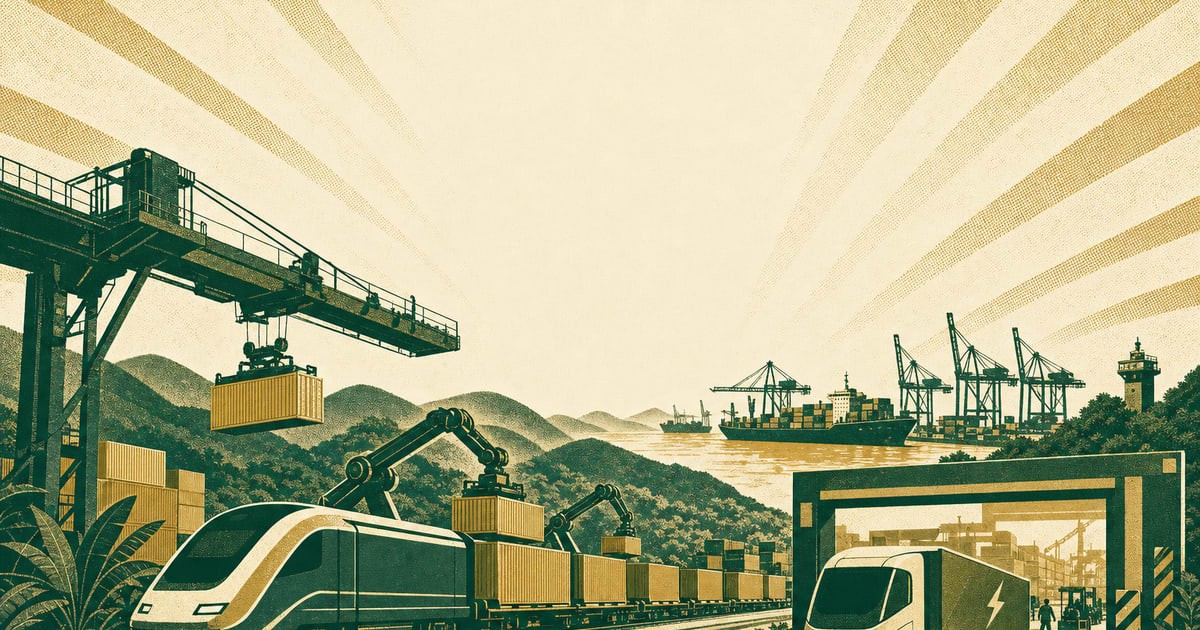
According to www.marketscale.com, Vietnam is constructing a tiered network of smart, green logistics hubs anchored to deep-water ports and border crossings — with a target of 12 major hubs operational by 2035 to position the country as ASEAN’s leading supply chain node.
A tiered national infrastructure framework
The Ministry of Industry and Trade (MoIT) has released its Logistics Services Development Strategy running to 2035, with a long-range vision extending to 2050. The strategy repositions logistics from a supporting function to a core driver of national competitiveness. Its operational centerpiece is a structured hierarchy of national, regional, and local logistics centers — not a blanket build-everywhere approach. As Bui Nguyen Anh Tuan, Deputy Director of the MoIT’s Agency for Domestic Market Surveillance and Development, explained to Vietnam News Agency (VNA), the goal is to replace fragmented logistics activity with an integrated, professional, and cost-efficient system.
Under this model, northern hubs are planned for Hai Phong and Quang Ninh, leveraging deep-water port capacity and major international border crossings with China. Southern infrastructure will concentrate around Ho Chi Minh City, the Cai Mep-Thi Vai port complex, and the Long Thanh International Airport project — integrating the southeast industrial region into a single multimodal corridor. Tuan emphasized that these hubs are no longer viewed merely as warehouses or transshipment facilities but as strategic infrastructure for manufacturing and international trade.
From transit point to supply chain orchestrator
Dr. Bui Ba Nghiem, senior specialist at the MoIT’s Agency of Foreign Trade, told VNA that Vietnam’s logistics strategy marks a new development phase in which the country could become an important logistics link within ASEAN and integrate more deeply into global logistics networks. He stressed that achieving this outcome depends on comprehensive implementation — covering institutional reforms, infrastructure investment, and the concurrent development of free trade zones alongside logistics hubs.
Vietnam recorded more than $930 billion in total import-export turnover in 2025, underscoring the scale of trade volume the new infrastructure must support. With an extensive FTA network already in place — granting preferential access to major trading blocs — the logistics strategy serves as the physical and digital infrastructure layer enabling Vietnam to fully leverage those agreements. That means faster, cheaper, and more traceable movement of goods across borders.
Green and digital standards as compliance gateways
The strategy explicitly ties hub development to green and smart logistics standards. Nguyen Le Hang, external affairs director at SLP Vietnam, told VNA that modern, environmentally friendly logistics infrastructure combined with digital technologies allows companies to compete on service quality, delivery speed, and compliance with international standards — rather than price alone.
She highlighted access to financing as a direct practical consequence: firms aligning with green investment strategies become more attractive to investors and financial institutions. Sectors identified with the most immediate growth potential under the new framework include e-commerce fulfillment, cold storage, and express delivery. This creates an emerging two-tier market: hubs and tenants meeting green and digital standards gain preferred access to financing and high-value cargo, while non-compliant operators face higher capital costs and narrower customer bases.
Operational implications for supply chain professionals
For procurement and supply chain leaders, the strategy carries concrete, actionable implications. First, audit current Vietnam-based logistics partners against the MoIT’s emerging green and digital hub standards — firms already investing in environmental infrastructure and traceability systems will be better positioned as hub-tier access criteria tighten. Second, evaluate routing strategies through northern and southern hub corridors separately: Hai Phong and Quang Ninh serve distinct rail and border-gate connections compared to the Cai Mep-Thi Vai and Long Thanh cluster in the south. Third, factor the Long Thanh International Airport’s timeline into air-freight and cold-chain planning — its integration into the southern hub network represents a structural capacity addition affecting lead times for time-sensitive or high-value cargo. Finally, when negotiating new warehousing or 3PL contracts in Vietnam, include clauses tied to digital track-and-trace and environmental compliance, as these are becoming baseline requirements for export market access and green financing eligibility.
Source: marketscale.com
Compiled from international media by the SCI.AI editorial team.