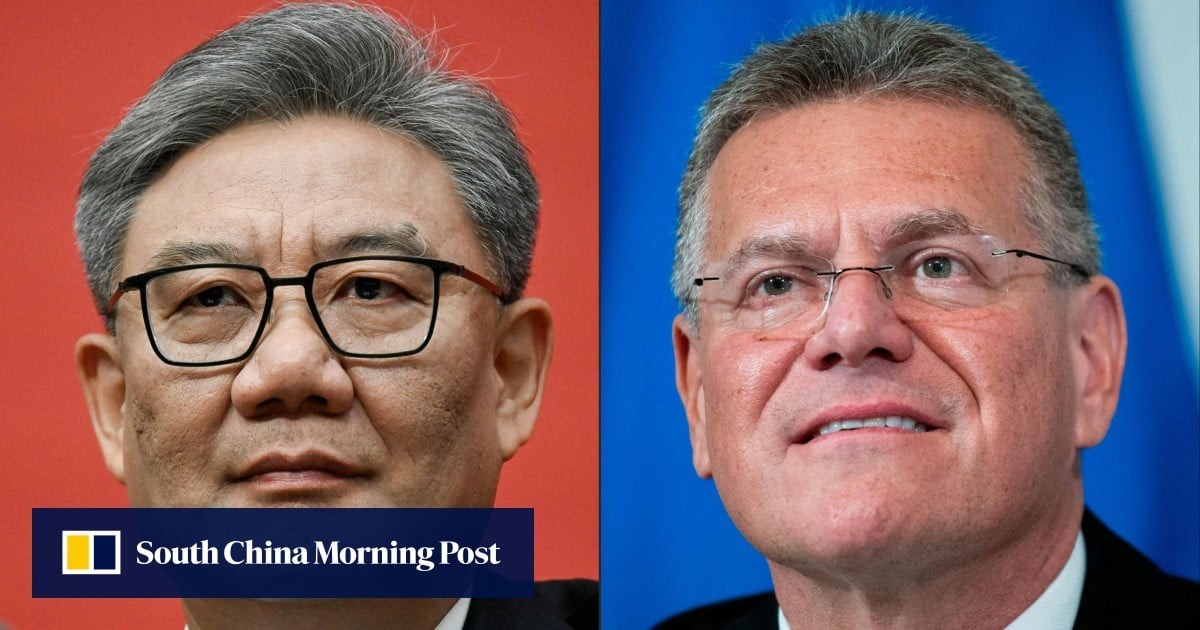
According to www.scmp.com, Chinese Commerce Minister Wang Wentao signaled during talks in Brussels this week that Beijing is open to reducing its massive trade surplus with the European Union — currently standing at more than €1 billion per day.
Direct Engagement Amid Escalating Tensions
The discussions took place as the EU intensifies pressure on China over trade imbalances and prepares to weigh new trade tools ahead of a key deadline: October 4, 2026. According to multiple people briefed on the talks, Wang conveyed willingness to explore concrete measures, including bilateral purchase agreements for European goods. This marks a notable shift — one source described it as a
“rare sign that China recognises that its billion-euro a day trade surplus has become a political problem.”
The meeting involved Maros Sefcovic, the EU’s Executive Vice-President for Trade and Interinstitutional Relations.
Import Expansion Over Export Restraint
While Beijing acknowledged concerns about its export surge into the 27-member union, officials expressed stronger enthusiasm for boosting imports from Europe. Wang emphasized expanding purchases of EU-made goods — a stance consistent with China’s long-standing policy of market-driven rebalancing. However, the delegation also floated the possibility of slowing the pace of exports, which have raised alarms among European manufacturers fearing displacement by increasingly high-quality, low-cost Chinese products. That concern has intensified since 2024, when EU industrial output growth slowed to 0.7% year-on-year amid rising import penetration from China.
Structural Constraints and Public Messaging
Publicly, Chinese authorities continue to downplay the imbalance. Officials maintain that the surplus reflects genuine market demand in Europe for Chinese manufactured goods — not policy distortion. In previous meetings, they have cited external constraints, notably Dutch export controls on advanced semiconductor manufacturing equipment, as impediments to deeper trade adjustment. Those controls, first tightened in 2023, remain in force and affect China’s ability to upgrade domestic production capacity in high-value sectors — limiting its flexibility in sourcing alternatives to EU imports.
Contextual Industry Dynamics
The EU’s trade deficit with China reached €380 billion in 2025, up from €342 billion in 2024, according to Eurostat data. That gap has driven regulatory action: the EU launched anti-subsidy investigations into Chinese electric vehicles in Q3 2024 and extended them to wind turbines and solar panels in early 2026. Meanwhile, EU policymakers are advancing the Carbon Border Adjustment Mechanism (CBAM), scheduled for full implementation in 2027, which will impose levies on carbon-intensive imports — including steel and aluminum from China. These moves underscore how trade dynamics now intersect directly with industrial policy, climate regulation, and supply chain resilience planning across the bloc.
Source: South China Morning Post
Compiled from international media by the SCI.AI editorial team.