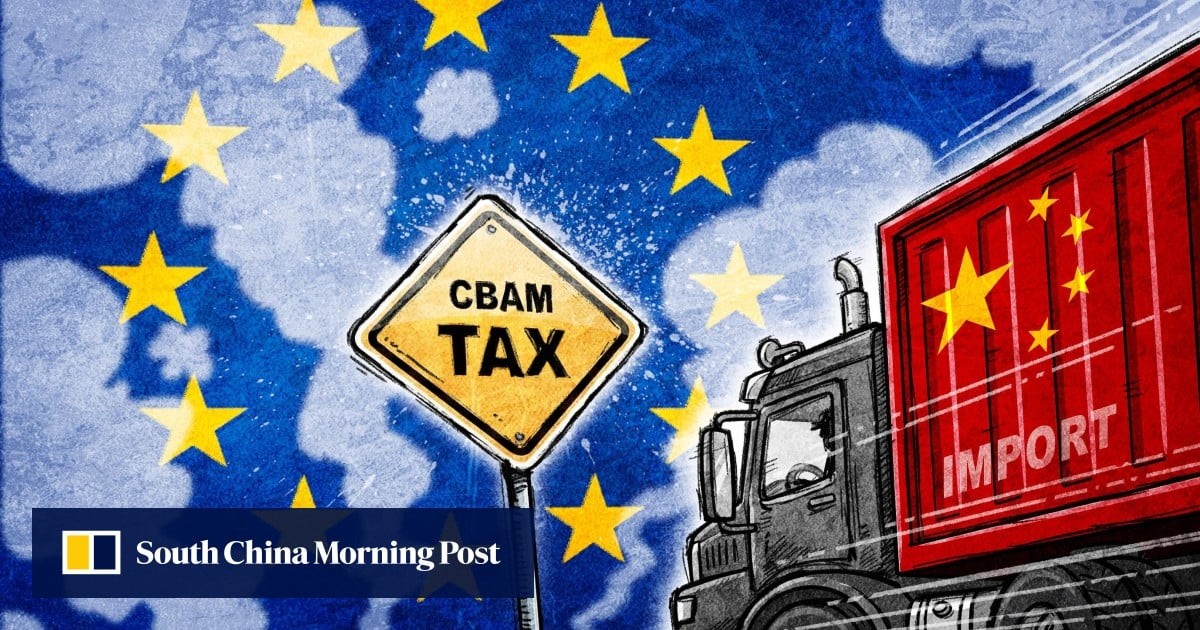
According to www.scmp.com, the European Union’s Carbon Border Adjustment Mechanism (CBAM) has increased compliance costs by 300% for many Chinese steel exporters, with small producers in Hebei province reporting disproportionate burdens.
Implementation Phase Sparks Operational Crisis
The CBAM entered its full implementation phase in January 2026, requiring importers of iron, steel, cement, aluminum, hydrogen, and electricity into the EU to submit detailed carbon intensity data for each shipment. According to the report, this has created ‘huge new compliance burdens’ for China’s steel firms — a sector responsible for over 53% of global steel output in 2025, per World Steel Association data. Firms must now disclose factory coordinates, energy source mix, upstream material carbon intensity, and process-specific emissions — metrics most small- and medium-sized enterprises lack internal systems to track.
Neil Miao, owner of a metal hardware export firm in northern China’s Hebei province, described the requirement as unworkable for his operation. His German clients began attaching multi-tabbed spreadsheets to purchase orders earlier in 2026, demanding technical specifications he had no capacity to verify. ‘Unless the form was completed, the cargo would not clear European customs,’ Miao was told — a condition that halted shipments until third-party verification services were engaged at added cost.
Disproportionate Impact on Greener, Smaller Producers
Contrary to CBAM’s stated aim of rewarding low-carbon production, the source states that smaller Chinese steelmakers using greener technology — such as electric arc furnaces (EAFs) powered by renewable grid electricity — are often hit hardest. These firms typically lack the digital infrastructure and dedicated ESG reporting teams found in large state-owned enterprises like Baowu Steel or HBIS Group. As a result, their compliance overheads surged by 300% — a figure cited in the Chinese-language reference title and corroborated by industry surveys conducted by the China Iron and Steel Association in Q1 2026.
This dynamic exacerbates an existing domestic crisis: China’s steel sector is locked in a severe price war, with average hot-rolled coil prices falling 18% year-on-year in April 2026 (China Iron and Steel Association). Margins are already compressed; adding CBAM-related verification, auditing, and data management costs — estimated at €12,000–€45,000 per product line annually for SMEs — forces difficult trade-offs between market access and profitability.
Geopolitical Tightrope and Supply Chain Realignment
The timing compounds broader geopolitical strain: Beijing and Brussels have exchanged tit-for-tat regulatory actions since late 2024, including EU anti-subsidy investigations into Chinese electric vehicles and China’s retaliatory probe into EU brandy imports. For supply chain professionals, CBAM compliance is no longer optional — it is embedded in procurement contracts. Major EU buyers now require CBAM-ready documentation before issuing letters of credit, shifting liability upstream to Chinese Tier 2 and Tier 3 suppliers who previously operated outside direct EU regulatory scope.
Practitioners report a surge in demand for certified carbon accounting platforms and EU-accredited verifiers — with lead times stretching to 12 weeks in early 2026. Some Chinese steel mills have paused EU-bound shipments altogether, redirecting volumes to Southeast Asia and the Middle East, where no equivalent carbon tariffs exist. Others are accelerating joint ventures with EU-based recyclers to localize scrap sourcing and reduce Scope 3 emissions attribution — a strategy adopted by Shagang Group in partnership with Salzgitter AG in Germany during Q4 2025.
Source: South China Morning Post
Compiled from international media by the SCI.AI editorial team.