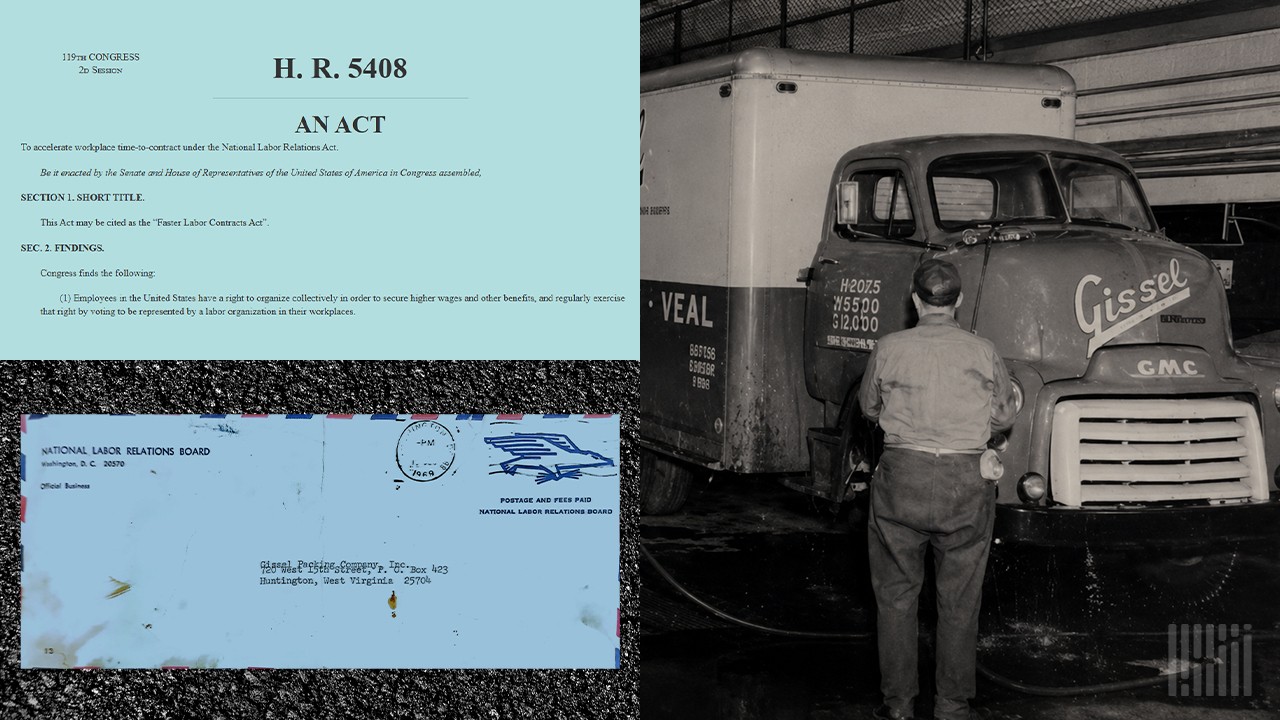
According to www.freightwaves.com, the U.S. House of Representatives passed the Faster Labor Contracts Act (H.R. 5408) on June 9, 2026, by a vote of 230 to 193.
Legislative Mechanics and Timeline
The bill amends the National Labor Relations Act to impose a rigid, federally enforced schedule for first-contract negotiations between employers and newly certified unions. Under its provisions, bargaining must begin no later than day 10 after union certification. If no agreement is reached by day 100, federal mediation through the Federal Mediation and Conciliation Service is automatically triggered. Should mediation fail by day 130, binding interest arbitration commences. By day 144, an arbitration panel must be seated and empowered to issue a complete first collective bargaining agreement — covering wages, benefits, work rules, and all related terms.
The timeline allows a maximum of 120 days of actual bargaining, including 90 days of direct negotiation and 30 days of mediation before government-imposed terms take effect. This replaces the current system, where first-contract negotiations often extend beyond one year, allowing parties time to assess operational realities unique to each sector — such as a 50-driver LTL terminal in Ohio versus a multi-state pipeline construction crew.
Procedural Path and Political Calculus
Introduced by Representative Donald Norcross of New Jersey, the bill reached 218 signatures on a discharge petition on May 20, 2026, forcing it onto the House floor without committee review, Congressional Budget Office scoring, or formal stakeholder input. The discharge petition — one of the most aggressive procedural tools in the House — succeeded despite historically low success rates.
The final vote included 20 Republican lawmakers crossing party lines alongside all 210 Democrats. Five came from Ohio: Mike Carey, David Joyce, Max Miller, Michael Rulli, and Michael Turner. Five were from New York: Andrew Garbarino, Nick LaLota, Nicholas Langworthy, Michael Lawler, and Nicole Malliotakis. Two each from Pennsylvania (Robert Bresnahan, Brian Fitzpatrick) and New Jersey (Christopher Smith, Jefferson Van Drew), plus two from Florida (Carlos Gimenez, Maria Elvira Salazar). Single votes came from Nebraska (Don Bacon), West Virginia (Riley Moore), Minnesota (Pete Stauber), and Wisconsin (Derrick Van Orden). Stauber, a former police officer who organized his own union, explicitly cited that experience in his public support.
Senate Prospects and Industry Implications
The bill now advances to the Senate, where it requires 60 votes to overcome a filibuster. With all 50 Democrats expected to support it, only eight Republican senators would need to join — a threshold made more plausible by shifting political dynamics. Fisher Phillips, one of the largest management-side labor law firms in the U.S., noted pre-vote that a White House Statement of Administration Policy in support was a “meaningful possibility,” given administration efforts to appeal to working-class voters.
This legislative shift carries direct implications for supply chain professionals overseeing unionized operations. Freight carriers, warehousing firms, and logistics service providers — especially those with recent or pending union certifications — face compressed decision windows for staffing models, lane pricing strategies, and terminal labor planning. For example, a parcel sorting facility negotiating its first contract under H.R. 5408 would have just over four months to align wage structures, scheduling protocols, and safety standards with binding arbitration outcomes — not internal budget cycles or seasonal demand forecasts. The Gissel Packing Co. precedent (NLRB v. Gissel Packing Co., 1969), still taught in every U.S. labor law course, underscores how foundational first-contract processes are to employer autonomy — a principle the bill directly restructures.
Source: FreightWaves
Compiled from international media by the SCI.AI editorial team.