According to roboticsandautomationnews.com, Swedish multinational Thule has selected Poland as the site for a new automated warehouse to centralise its European distribution. The facility — located in Krzyż Wielkopolski — will serve as a strategic logistics hub for Thule’s product range across Europe and other international markets.
Automated Infrastructure and Scale
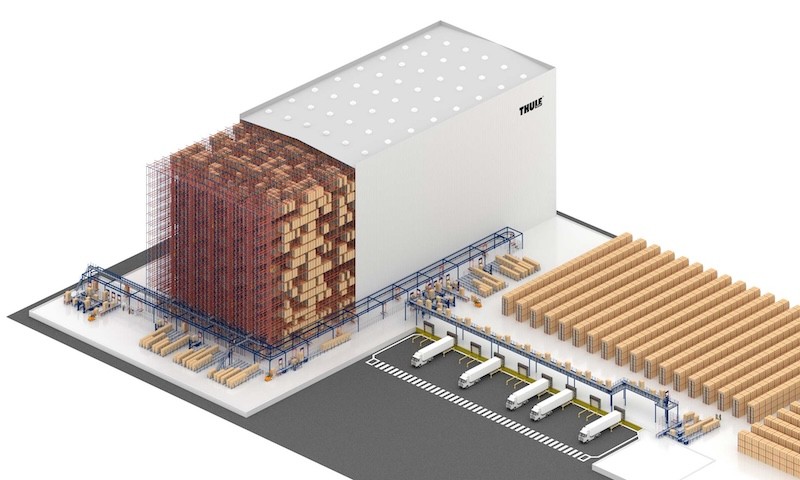
The new clad-rack warehouse will measure 51 m wide, 135 m long, and 42 m high, making it one of the tallest automated facilities in Thule’s network. It will house nearly 40,000 pallets, managed by six double-deep automated stacker cranes. A temperature and humidity control system will ensure environmental integrity for sensitive products. To integrate with existing infrastructure, the automated warehouse will connect directly to the manual warehouse and production hall via a conveyor and pallet lift. A floor-mounted electric monorail system will transport pallets from receiving to storage and from storage to 16 flow channels in the dock area.
Digital Orchestration with Easy WMS
Mecalux’s Easy WMS warehouse management system will govern all operations. According to the report, the software will assign storage locations based on product category and turnover, organise order picking, and provide full product traceability. Digitalisation combined with automation is expected to reduce manual handling, improve staff safety and ergonomics, and increase operational efficiency to meet anticipated demand growth.
Strategic Rationale and Leadership Perspective
Thule’s move reflects a broader industry trend toward consolidating regional logistics networks amid rising cost pressures and service expectations. With a presence in 138 markets, the company aims to strengthen competitiveness through logistics automation. Paweł Pêpiak, director of the distribution centre for Europe and ROW, stated:
“Our goals are to increase throughput, leverage our storage space and ensure product traceability.” — Paweł Pêpiak, director of the distribution centre for Europe and ROW
He added that automation will enhance cost efficiency and streamline processes “to deliver superior service and improve customer satisfaction.”
This investment aligns with wider European supply chain developments: major outdoor and consumer goods firms — including Decathlon and Columbia Sportswear — have recently pursued similar consolidation and automation initiatives in Central Europe to balance proximity to key markets, labour availability, and infrastructure connectivity. For supply chain professionals, the project underscores the growing operational value of integrating high-bay automation with real-time WMS-driven decision logic — especially when scaling across fragmented regional demand patterns.
Source: Robotics & Automation News
Compiled from international media by the SCI.AI editorial team.