According to markets.financialcontent.com, Amazon and Walmart have escalated their rivalry into a high-stakes AI-driven logistics race centered on one-hour delivery — fundamentally restructuring North American supply chains through hyper-regionalization, agentic AI, and automated fulfillment.
The Regionalization 2.0 Shift
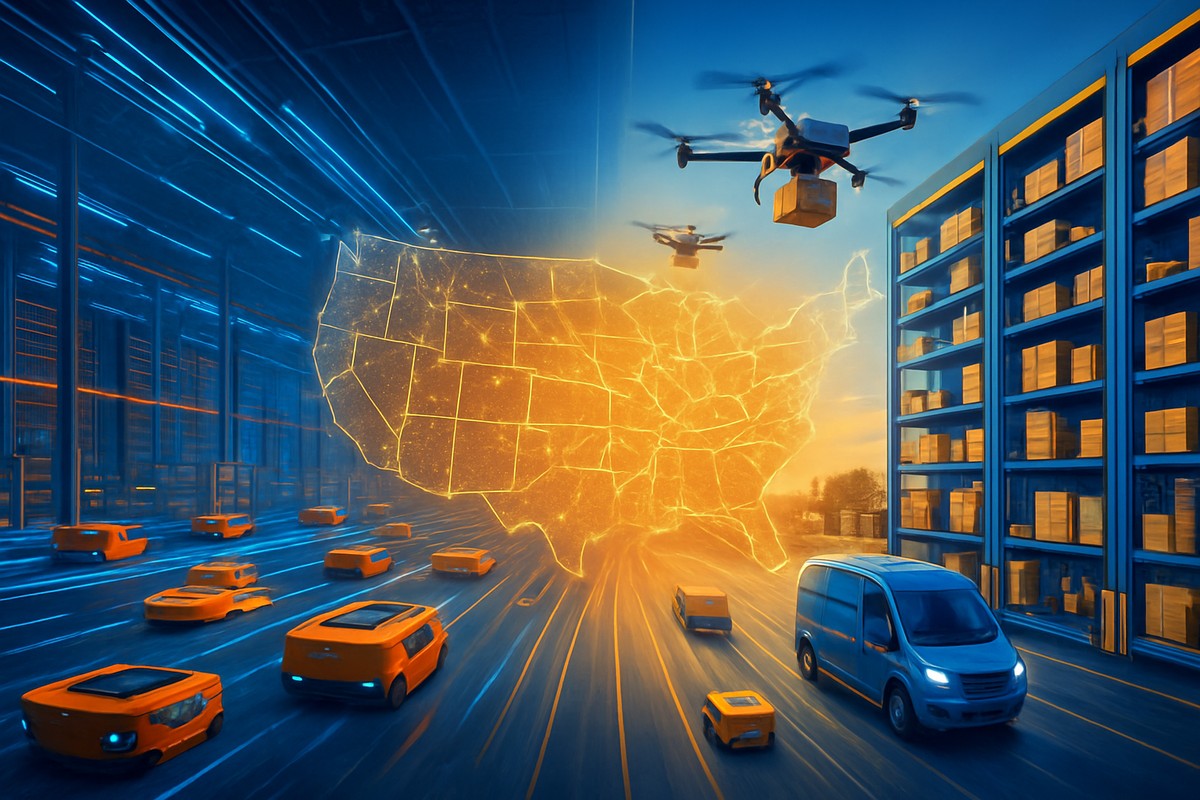
The source states that Amazon has abandoned its legacy national ‘hub-and-spoke’ model in favor of eight interconnected regional clusters, ensuring 80% of orders are fulfilled within the same region they are placed. This restructuring enabled Amazon to deliver over 13 billion items on a same-day or next-day basis throughout 2025. The centerpiece of its March 2026 announcement is the ‘One-Day Center’ (1DC) layer — a specialized tier of micro-fulfillment sites using agentic AI to ‘pull’ high-velocity inventory into residential zones, enabling one-hour delivery for over 90,000 essential products.
Walmart’s Physical-AI Integration
Walmart has taken a distinct path by leveraging its 4,700 U.S. stores. By March 2026, it retrofitted 23 of its 42 regional distribution centers with AI-powered robotics from Symbotic Inc. (NASDAQ: SYM). It also deployed 400 ‘Accelerated Pickup and Delivery’ (APD) centers — automated mini-warehouses embedded in store backrooms — capable of picking and packing complex grocery orders in under ten minutes. Walmart aims for 65% of its stores to be served by automated fulfillment by end-2026, targeting a 20% reduction in unit-level fulfillment costs.
Strategic Implications for Supply Chain Professionals
This acceleration creates what the report terms a ‘Readiness Gap’, threatening mid-tier retailers lacking capital for comparable AI infrastructure. Amazon’s shift to ‘Logistics-as-a-Service’ (MCF) now enables it to fulfill orders for independent brands and Shopify-based businesses — positioning it as underlying infrastructure rather than just a retailer. Walmart’s advantage lies in physical proximity: 90% of the U.S. population lives within 10 miles of a store, reinforcing Walmart+ as a Prime competitor. Its ‘Self-Healing Inventory’ AI autonomously reroutes overstocked items to stores with higher real-time demand — saving an estimated $55 million in pilot programs.
Market-Wide Pressures and Industry Context
The source notes mounting pressure on third-party platforms: DoorDash (NASDAQ: DASH) and Instacart (NASDAQ: CART) face erosion of their ‘convenience moat’ as Amazon expands Fresh delivery to over 2,300 cities and Walmart perfects in-store automation. Traditional department stores and smaller grocers risk relegation to ‘slow-lane retail’ without capacity to invest in AI-driven robotics. Meanwhile, Target Corp. (NYSE: TGT) is committing upwards of $2 billion in incremental tech spending just to remain competitive — underscoring how rapidly the baseline expectation has shifted to sub-two-hour delivery windows.
Workforce and Regulatory Dimensions
The report highlights that U.S. Department of Labor and state agencies are scrutinizing AI-driven logistics’ impact on employment. Though both companies describe their systems as ‘people-led’, the rise of automated fulfillment centers (AFCs) raises questions about long-term viability of traditional warehouse roles. Antitrust discussions are also resurfacing around ‘Logistics-as-a-Service’, with parallels drawn to 19th-century railroad consolidation — except this duopoly reshaped the retail landscape in less than five years.
Next Frontiers: Drones and Multi-Modal Fulfillment
- Amazon is expected to scale its ‘Prime Air’ drone fleet from experimental pockets into mainstream suburban markets to support one-hour delivery.
- Walmart — already established in drone delivery via partnerships with Zipline and Wing — is likely to prioritize ‘Multi-Modal’ fulfillment, blending autonomous vehicles, micro-hubs, and in-store automation.
- Symbotic’s Gen-2 robotics platform has become a global benchmark, with other retailers scrambling to license it after its Walmart proof-of-concept.
Source: markets.financialcontent.com
Compiled from international media by the SCI.AI editorial team.