According to www.openpr.com, Autonomous Delivery Pods (ADPs) — self-driving, battery-powered ground vehicles designed for goods, parcel, and food delivery without human intervention — are reshaping last-mile logistics through AI-driven cost efficiency and regulatory-compliant automation.
Technical Specifications & Market Scale
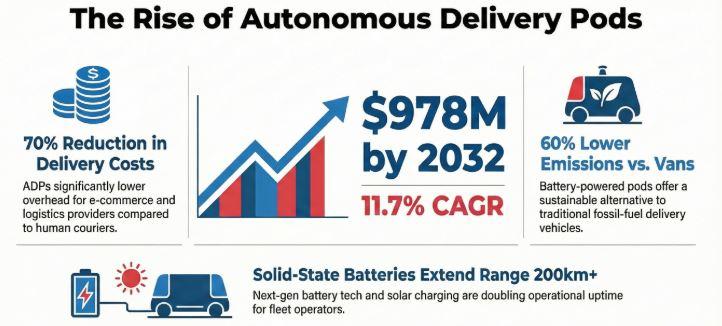
ADPs integrate LiDAR, cameras, millimeter-wave radar, GPS, and AI algorithms, with modular cargo compartments and IP67 weather resistance. They operate safely on sidewalks, bike lanes, or roads at speeds up to 25 km/h. Payload capacity ranges from 50–500 kg, supporting applications from campus meal delivery to industrial B2B transfers. The global ADP market was valued at US$457 million in 2025 and is projected to reach US$978 million by 2032, growing at a CAGR of 11.7% from 2026–2032. In 2024, production totaled 9,800 units, with sales volume between US$410–420 million at an average unit price of US$42,000. Output remains constrained in 2025 due to chip shortages and evolving regulatory approvals.
Manufacturers & Market Structure
Leading global ADP producers include:
- Nuro, Inc. (USA, Private)
- Starship Technologies (Estonia/USA, Private)
- Neolix Technologies Co., Ltd. (China, Private)
- JD Logistics (China, NASDAQ: JD)
- Amazon Robotics / Zoox (USA, NASDAQ: AMZN)
- Kiwibot (USA, Private)
- Yandex Self-Driving Group (Russia, Private)
- Udelv Inc. (USA, Private)
- Meituan (China, HKEX: 3690)
- Ottonomy.IO (USA, Private)
- Refraction AI (USA, Private)
- BoxBot Inc. (USA, Private)
In 2025, the top three vendors captured 40–50% of revenue via integrated hardware-software fleet solutions. Average gross margins for major manufacturers stand at 28–35%, supported by proprietary software IP and recurring fleet services — a critical buffer amid U.S. tariff uncertainties affecting component sourcing and supply chain configuration.
Deployment Environments & Performance Gains
ADPs serve distinct end-use segments with measurable operational advantages:
- Campus & Smart Communities: Geofenced deployments at institutions like MIT and Stanford demonstrated up to 40% faster delivery times versus human couriers, enabling 24/7 operations with reduced labor dependency.
- Supermarkets & Restaurants: Focused on meal and grocery delivery in controlled zones; leverages predictable routing and low-speed navigation for safety and repeatability.
- E-Commerce & Logistics: Integrated into platforms including JD.com and Meituan, ADPs handle high-volume parcel flows while cutting last-mile costs and lowering emissions by 60% versus traditional vans.
- Healthcare & Industrial: Supports chain-of-custody tracking for medications and lab samples; delivers tools and parts across rugged terrains in construction and factory settings; enables B2B inventory shuttles for just-in-time manufacturing.
Technology Trends & Supply Chain Implications
Innovation centers on multimodal sensor fusion, edge AI, and sustainability-aligned hardware. V2X/5G swarm coordination enables 90% safer urban navigation. Solid-state batteries extend range to 200+ km and support wireless charging; digital twins reduce regulatory certification timelines by 50%. Battery swaps and solar-assisted charging improve uptime in off-grid locations. Biodegradable plastics and recyclable composites address investor-mandated ESG compliance, while Level 5 autonomy — still emerging — promises expansion into rural and highway environments, potentially tripling the addressable market volume by 2030.
Source: www.openpr.com
Compiled from international media by the SCI.AI editorial team.