Explore

  • Trending
  • Latest
  • Tools
  • Browse
  • Subscription Feed

Logistics

  • Ocean
  • Air Cargo
  • Road & Rail
  • Warehousing
  • Last Mile

Regions

  • Southeast Asia
  • South Asia
  • Central Asia
  • Japan & Korea
  • Middle East
  • Europe
  • Russia
  • Africa
  • North America
  • Latin America
  • Australia
SCI.AI
  • Supply Chain
    • Strategy & Planning
    • Logistics & Transport
    • Manufacturing
    • Inventory & Fulfillment
  • Procurement
    • Strategic Sourcing
    • Supplier Management
    • Supply Chain Finance
  • Technology
    • AI & Automation
    • Robotics
    • Digital Platforms
  • Risk & Resilience
  • Sustainability
  • Research
  • Expert Columns
  • English
    • Chinese
    • English
No Result
View All Result
  • Login
  • Register
SCI.AI
No Result
View All Result
Home Supply Chain

Africa’s Port Resilience: 2026 Hormuz Crisis Tests Supply Chain Strategy

2026/04/01
in Supply Chain
0 0
Africa’s Port Resilience: 2026 Hormuz Crisis Tests Supply Chain Strategy

According to www.inonafrica.com, the closure of the Strait of Hormuz on 2 March 2026 catalysed a strategic pivot in African port infrastructure investment—from capacity expansion to supply chain resilience.

Africa’s Infrastructure Shift Amid Global Disruption

The Hormuz shutdown triggered immediate rerouting by global carriers including Maersk, CMA CGM, and Hapag-Lloyd, diverting vessels around the Cape of Good Hope. This surge in maritime traffic placed unprecedented demand on African seaports—testing their ability to absorb volume spikes without congestion or delay. The crisis followed earlier stress tests: since October 2023, repeated disruptions to the Suez Canal by Yemen-based militants had already forced reroutes through African waters, affecting shipments bound for African markets—including consumer goods and industrial products.

From Raw-Export to Value-Added Logistics

African infrastructure upgrades are no longer solely about moving raw materials to export terminals. Investment is now focused on enabling local transformation—e.g., processing rare earth elements into electric vehicle batteries or refining crude oil domestically. This shift supports industrialisation goals under the African Union’s Agenda 2063 and aims to capture higher value from Africa’s natural resources.

Investment Scale and Priorities

  • Roads account for 32% of total transportation infrastructure investment; railways for 24%
  • 42% of spending goes toward maintenance of existing infrastructure
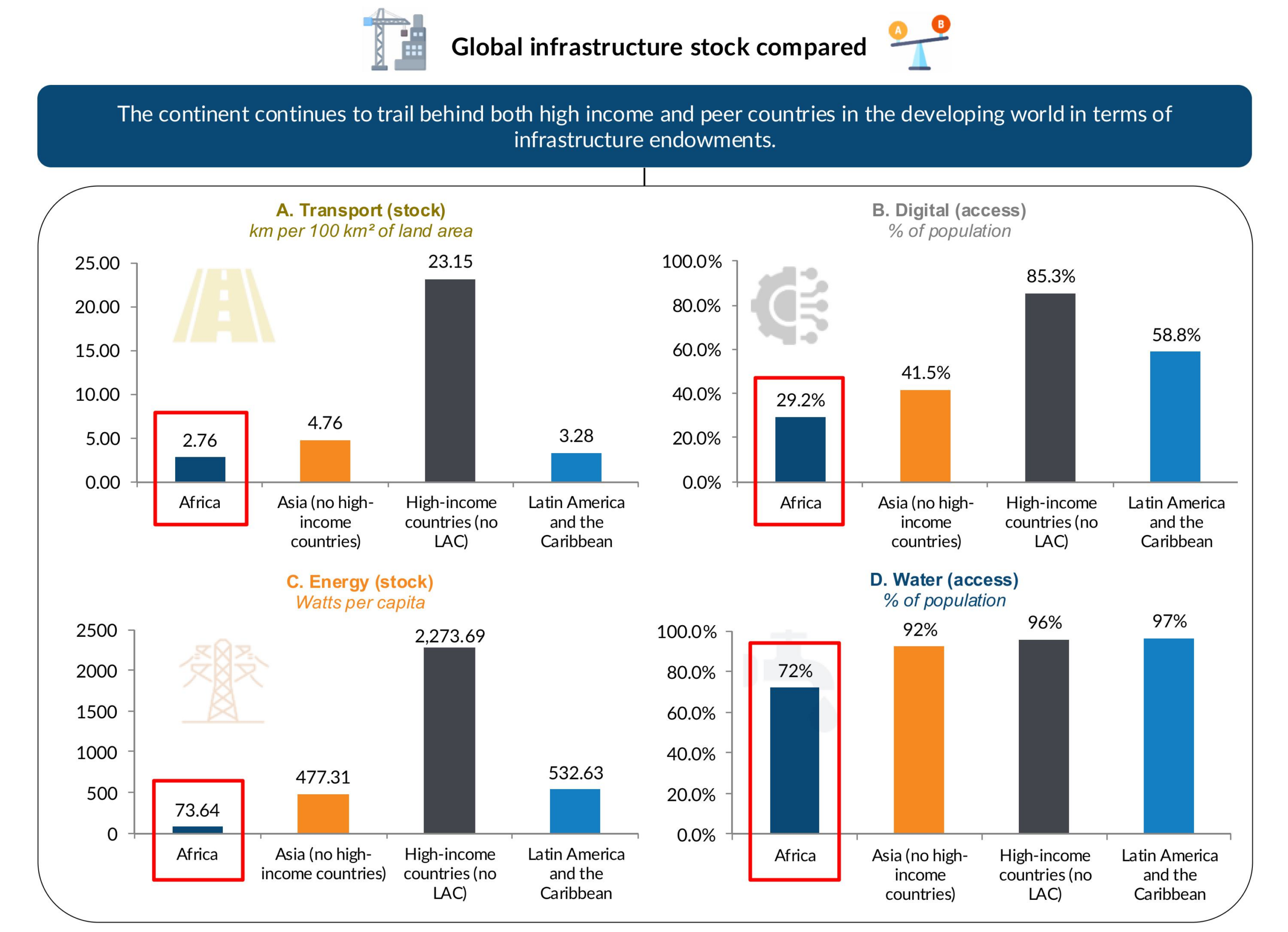
  • The OECD estimates US$155 billion in average annual investment through 2040 is needed to bring African transport systems to parity with Asia, Europe, and North America
  • Such investment could lift average annual GDP growth to 4.5% by 2040—doubling current growth and advancing Agenda 2063’s 7% target

Resilience Through Diversification and Integration

African governments are reducing overreliance on single foreign partners—for instance, moving beyond China-led construction or Germany-supplied rail hardware—by expanding public-private partnerships (PPPs). Regional integration is accelerating: national road and rail networks now interconnect as part of the continental African highway system. This enables redundancy—if one corridor is disrupted by storms or conflict, shippers access alternative routes. The AfCFTA further amplifies this benefit by boosting intra-African trade and reinforcing multimodal connectivity across ports, airports, and river shipping systems.

Practitioner Implications for Global Supply Chains

For supply chain professionals, Africa’s infrastructure evolution signals more than regional development—it presents tangible options for supply chain diversification and geopolitical risk mitigation. Ports like Maputo (Mozambique) have prioritised operational efficiency and responsiveness, while others—such as Mombasa (Kenya)—still face bottlenecks that undermine resilience. As rerouting becomes recurrent—not exceptional—shippers must assess not just port depth or container throughput, but also hinterland connectivity, customs digitisation, warehousing readiness, and real-time visibility across integrated rail, road, and air cargo nodes. Maintenance discipline and PPP governance quality now carry equal weight with headline infrastructure metrics in supplier risk scoring.

Source: www.inonafrica.com

Compiled from international media by the SCI.AI editorial team.

More on This Topic

  • STG Logistics Reorganization Approved — 90% Debt Cut (May 20, 2026)
  • Mecalux Unveils AI Agents — Logistics Business (May 20, 2026)
  • Locus Robotics收购Nexera Robotics — Logistics Business (May 20, 2026)
  • Savannah Port Volumes Down 14% — gCaptain (May 20, 2026)
  • AI Boom vs Helium Crisis: 5% of Air Cargo at Risk — The Loadstar (May 20, 2026)
ShareTweet

Related Posts

STG Logistics Reorganization Approved — 90% Debt Cut
AI & Automation

STG Logistics Reorganization Approved — 90% Debt Cut

May 20, 2026
2
Mecalux Unveils AI Agents — Logistics Business
AI & Automation

Mecalux Unveils AI Agents — Logistics Business

May 20, 2026
4
Locus Robotics收购Nexera Robotics — Logistics Business
AI & Automation

Locus Robotics收购Nexera Robotics — Logistics Business

May 20, 2026
1
Savannah Port Volumes Down 14% — gCaptain
AI & Automation

Savannah Port Volumes Down 14% — gCaptain

May 20, 2026
2
AI Boom vs Helium Crisis: 5% of Air Cargo at Risk — The Loadstar
AI & Automation

AI Boom vs Helium Crisis: 5% of Air Cargo at Risk — The Loadstar

May 20, 2026
2
US Releases 2026 Freight Plan to Modernize $68B Daily Network
Strategy & Planning

US Releases 2026 Freight Plan to Modernize $68B Daily Network

May 20, 2026
4

Leave a Reply Cancel reply

Your email address will not be published. Required fields are marked *

Recommended

AI Industrial Robotics: $500M Mind Robotics Funding Reshapes Supply Chain Automation

AI Industrial Robotics: $500M Mind Robotics Funding Reshapes Supply Chain Automation

6 Views
March 24, 2026
Latin America Logistics Dual-Track Strategy: 2 Models, 138M Aging by 2035

Latin America Logistics Dual-Track Strategy: 2 Models, 138M Aging by 2035

21 Views
April 9, 2026
Logistics Tech Boom in SEA: $223.6B to $360B by 2034

Logistics Tech Boom in SEA: $223.6B to $360B by 2034

7 Views
March 30, 2026
GCC Logistics SaaS Surge: 98% AI Adoption as $86B Market Undergoes Digital Overhaul in 2026

GCC Logistics SaaS Surge: 98% AI Adoption as $86B Market Undergoes Digital Overhaul in 2026

24 Views
March 9, 2026
Show More

SCI.AI

Global Supply Chain Intelligence. Delivering real-time news, analysis, and insights for supply chain professionals worldwide.

Categories

  • Supply Chain Management
  • Procurement
  • Technology


  • Risk & Resilience
  • Sustainability
  • Research

© 2026 SCI.AI. All rights reserved.

Powered by SCI.AI Intelligence Platform

Welcome Back!

Sign In with Facebook
Sign In with Google
Sign In with Linked In
OR

Login to your account below

Forgotten Password? Sign Up

Create New Account!

Sign Up with Facebook
Sign Up with Google
Sign Up with Linked In
OR

Fill the forms below to register

All fields are required. Log In

Retrieve your password

Please enter your username or email address to reset your password.

Log In

Scan to share via WeChat

Open WeChat and scan the QR code to share

QR Code

Add New Playlist

No Result
View All Result
  • Supply Chain
    • Strategy & Planning
    • Logistics & Transport
    • Manufacturing
    • Inventory & Fulfillment
  • Procurement
    • Strategic Sourcing
    • Supplier Management
    • Supply Chain Finance
  • Technology
    • AI & Automation
    • Robotics
    • Digital Platforms
  • Risk & Resilience
  • Sustainability
  • Research
  • Expert Columns
  • English
    • Chinese
    • English
  • Login
  • Sign Up

© 2026 SCI.AI