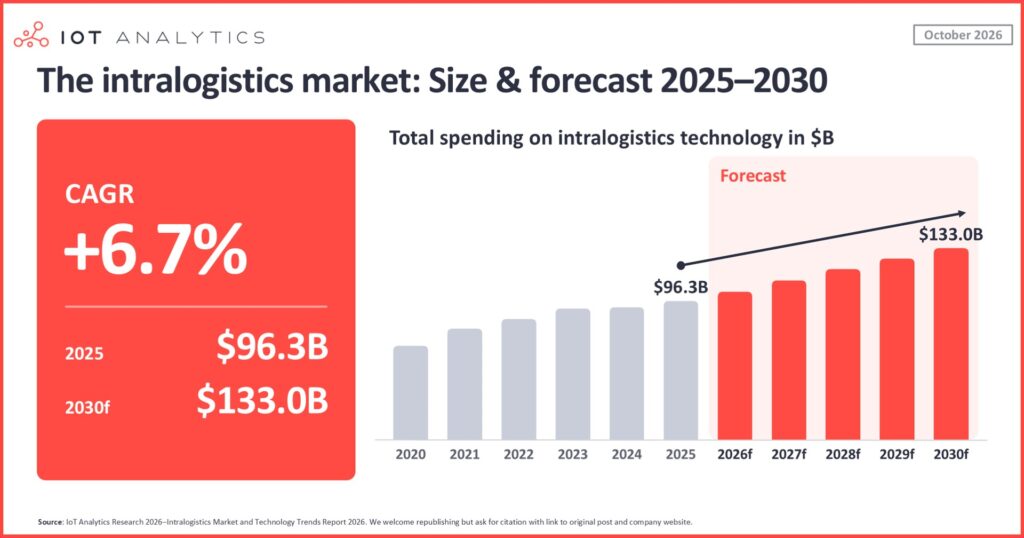
Warehouse robot adoption is accelerating beyond the enterprise tier. A 2025 MHI study (216 respondents, majority SMEs) found robot penetration rose from 23% to 48% in three years, with RaaS subscription models as the key driver. Superior Communications deployed 37 Brightpick robots via RaaS; UniUni automated sorting across 100+ North American warehouses through a GRS partnership. Yet ROI uncertainty remains the #1 barrier, and industry experts warn against a 'keeping up with the Joneses' mentality.
The RaaS Revolution: Dismantling the Capital Barrier to Warehouse Automation
For most of the past decade, advanced warehouse robotics — autonomous mobile robots, AI-powered sorters, goods-to-person fulfillment systems — were the exclusive domain of trillion-dollar retailers like Amazon and Walmart. The price of entry was prohibitive: multi-million-dollar capital expenditures, months-long system integration projects, and IT overhauls that only the largest operators could absorb. That reality is changing rapidly, driven by the rise of Robotics-as-a-Service (RaaS) subscription models that convert heavy capital costs into predictable operational expenses.
The RaaS model mirrors what cloud computing did to enterprise IT infrastructure: it eliminates the need for upfront equipment ownership and shifts maintenance, upgrades, and support responsibilities to the vendor. Instead of purchasing robots outright, operators pay monthly or per-transaction fees, enabling phased deployments with lower financial risk. This structural shift is unlocking a demographic that was previously locked out of automation entirely — small and mid-sized operators running warehouses with revenues under $50 million annually.
Evidence of the trend is mounting. According to a 2025 annual study conducted by MHI, Peerless Research Group and The Robotics Group — surveying 216 respondents, with over half being companies with less than $50 million in annual revenue — 64% of participating organizations reported using a RaaS or SaaS system, up from 46% two years prior. That 18-percentage-point jump in just two years signals that subscription-based automation is rapidly becoming the industry’s default deployment model, not a niche alternative.
MHI Data Confirms: Warehouse Robot Adoption More Than Doubled in Three Years
The headline statistic from the MHI study is striking: 48% of surveyed organizations were using robots in their plants and/or warehouses in 2025, up from just 23% three years earlier — a more than doubling of penetration in just three years. For an industrial technology category, this represents an unusually rapid diffusion curve, suggesting the market may be approaching an inflection point where automation becomes a competitive necessity rather than a differentiating advantage.
This data directly addresses what had long been called the “expectation-reality gap” in warehouse automation. Earlier surveys — including DHL’s Insight 2030 report presented at the 2026 Manifest conference — noted that while 73% of supply chain leaders believed robotics would be widespread within five years, actual deployment rates lagged at 44%. The 2025 MHI data suggests this gap is closing with accelerating speed, as real-world deployments begin catching up to earlier optimism.
“That’s a huge indicator there’s an appetite for this. It’s not just all the big companies.” — Sonya Snellenberger, VP of Partnerships, Conexus Indiana, commenting on record-breaking ProMat 2025 attendance
The most visible manifestation of this trend was the record-breaking attendance at MHI’s ProMat trade show in March 2025, which saw its show floor flooded with robotics solutions from vendors of every scale. Sonya Snellenberger, VP of partnerships at Conexus Indiana — a nonprofit focused on advancing Indiana’s manufacturing and logistics sectors — cited the event as a powerful demand signal: the appetite for automation is now distributed across the entire operator spectrum, not concentrated at the enterprise tier.

Superior Communications: The 37-Robot RaaS Decision That Reshaped a Tennessee DC
Mobile accessories distributor Superior Communications offers a textbook case study in how mid-market operators are approaching robotics adoption. The company is working with Brightpick — a Czech-founded robotics firm specializing in autonomous fulfillment — to deploy 37 multi-purpose autopicker robots in its Tennessee distribution center. These robots operate on a goods-to-person model, autonomously navigating the facility, retrieving items from storage, and delivering them to packing stations — eliminating the most physically demanding elements of manual pick-and-pack operations.
Superior Communications CEO Solomon Chen explicitly highlighted the RaaS purchase structure as a decisive factor in selecting Brightpick as a robotics partner. By avoiding capital ownership, the company sidesteps equipment depreciation cycles and maintenance obligations while gaining access to continuous software improvements. The deployment is expected to optimize throughput and reduce fulfillment costs — two metrics that directly determine competitiveness in the high-SKU, high-velocity world of mobile accessories distribution, where seasonal demand spikes can overwhelm manual operations.
The Superior Communications case illustrates the decision logic that is now repeating across the mid-market: rising order volumes pressure human capacity limits; labor costs and availability constrain scaling; RaaS removes the capital barrier; peer success stories provide social proof for the investment thesis. Mobile accessories — high SKU count, strong seasonality, rapid product cycles — represent exactly the kind of complex fulfillment environment where flexible, software-guided AMRs deliver maximum value over rigid, fixed-track AGV systems.
UniUni’s 100-Warehouse Journey: Systematic Automation from Sorting to Sequencing
While Superior Communications represents an operator taking its first major robotics step, parcel carrier UniUni demonstrates what mature, systematic automation deployment looks like at scale. UniUni, which operates over 100 warehouses across North America, began its robotics journey in 2023 through a partnership with UK-based Global Robotics Services (GRS), a firm specializing in RaaS deployments with flexible lease terms and low upfront cost structures.
UniUni’s approach reflects deliberate, evidence-based sequencing. CEO Peter Lu explained that the company’s first automated processes were parcel sorting and sequencing, which he described as “two of the most labor-intensive and time-sensitive stages of warehouse operations.” This selection was strategic rather than arbitrary: high-frequency, standardized, precision-dependent processes offer the clearest ROI case for robotics — measurable throughput gains, reduced error rates, and direct labor cost offsets that can be tracked from day one.
In April 2025, UniUni made its GRS partnership public, announcing the deployment of two AI-powered sorting tools integrated with its existing warehouse execution system (WES). The GRS RaaS arrangement offered three structural financial advantages: a lower initial capital commitment, a more predictable cost structure through reduced fixed infrastructure, and flexible lease terms that allow UniUni to scale robot fleets in parallel with parcel volume growth. Lu concluded: “This trend is exciting — it’s driving innovation throughout the industry, encouraging both large and small companies to rethink how technology can enhance efficiency and service quality.”
The ROI Fog: Why Return on Investment Uncertainty Remains the #1 Investment Barrier
Despite the structural improvements that RaaS brings to the financial case for warehouse automation, ROI uncertainty remains the single largest barrier to adoption, according to a white paper from Pennsylvania State University commissioned by MHI analyzing its 2024 survey data. For technology investment decisions, identifying a clear path to return on investment outranks concerns about implementation complexity, integration challenges, or workforce impact as the primary reason operators delay or decline automation investments.
The sources of ROI uncertainty are multidimensional. Hidden implementation costs are a major factor: beyond equipment fees, operators must account for WMS/WES integration engineering, algorithm licensing, operator training programs, workflow redesign, and the productivity dip during transition — costs that are notoriously difficult to quantify at the decision stage. Attribution complexity compounds the challenge: automation deployments rarely happen in isolation, and separating the efficiency contribution of robots from simultaneous process improvements, staffing changes, or technology upgrades is methodologically difficult.
Snellenberger identified a practical path through the ROI fog that vendor ROI presentations cannot match: peer benchmarking from operators with comparable business profiles. “I can hear all day from a tech integrator what they believe the ROI is,” she said. “But I want to hear from my peers.” This observation reflects a fundamental dynamic in supply chain technology adoption — real-world case studies from operators facing similar constraints, order profiles, and cost structures carry exponentially more persuasive weight than vendor-provided projections. UniUni’s public disclosure of its GRS partnership results, and Superior Communications’ willingness to discuss the RaaS decision-making process, are precisely the kind of peer evidence that accelerates industry-wide adoption.
The Anti-Herd Warning: Why Robots Are Not a Universal Solution
Amid the undeniable momentum of warehouse robotics adoption, MHI managing executive Jayesh Mehta issued a pointed caution against what he called the “keeping up with the Joneses” mentality — the impulse to invest in automation simply because competitors or peers are doing so. His warning cuts to the core of disciplined technology investment: operators must rigorously evaluate whether robotics genuinely improves operational efficiency in their specific context, or merely automates a task with minimal net impact on business outcomes.
The caution is well-founded. Robotic automation does not deliver uniform returns across all warehouse environments. Highly customized, low-frequency, or extreme-SKU-fragmentation operations often struggle to generate the throughput volumes necessary to justify automation investment. Physical infrastructure constraints — ceiling height, floor load capacity, aisle widths — can impose costly facility modifications that erode projected ROI. And poorly designed human-robot collaboration workflows can paradoxically reduce efficiency by creating handoff bottlenecks that the automation was meant to eliminate.
A rational automation decision framework requires evaluation across four dimensions:
- Volume threshold assessment: Has daily order volume reached the point where manual operations create consistent capacity constraints?
- Process standardization audit: Are the target processes sufficiently repetitive and defined to allow robotic execution without constant exception handling?
- Growth trajectory validation: Will projected volume growth generate sufficient throughput over the robot system’s lifecycle to cover total cost of ownership?
- Technology ecosystem compatibility: Does the selected platform offer proven integration with existing WMS, TMS, and ERP systems?
It is this kind of rigorous, context-specific analysis — rather than peer pressure or vendor enthusiasm — that separates operators who extract sustainable competitive advantage from automation from those who accumulate expensive equipment that underperforms expectations.
Source: supplychaindive.com
This article was AI-assisted and reviewed by our editorial team.