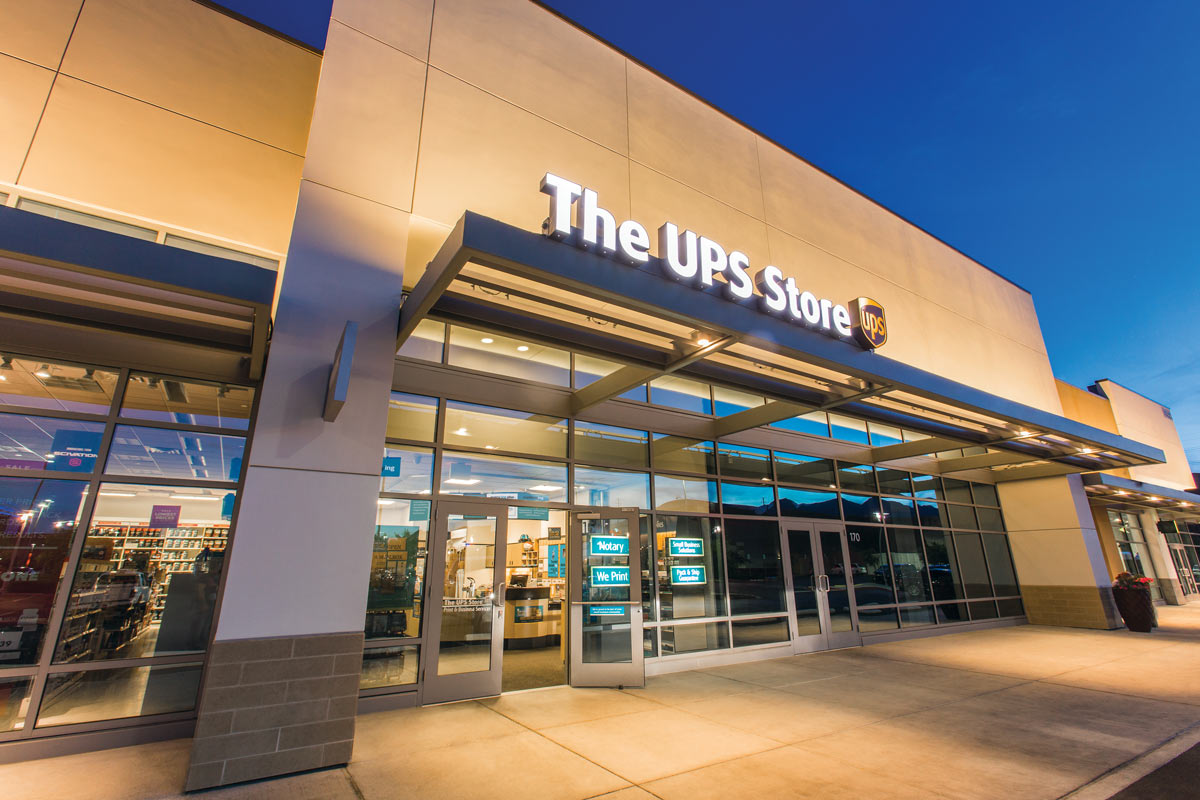
Across North America, a quiet but transformative infrastructure shift is underway—not in massive distribution centers or automated fulfillment parks, but inside unassuming storefronts on suburban strip malls, downtown commercial corridors, and college-town side streets. With over 6,000 independently owned and operated locations across the United States and Canada, The UPS Store network has evolved far beyond its origins as a convenience outlet for shipping labels and mailbox rentals. Today, it functions as a distributed, hyperlocal supply chain node—what industry analysts increasingly refer to as a micro-hub: a physically anchored, service-rich, community-integrated touchpoint that bridges digital commerce, small business operations, and last-mile logistics with unprecedented flexibility and redundancy.
The Anatomy of a Micro-Hub: Beyond Shipping Labels
At first glance, The UPS Store appears to be a retail extension of United Parcel Service—a place to drop off parcels or buy tape. But a granular review of its service portfolio reveals a sophisticated, multi-layered operational model. Each location offers 12 distinct service categories, spanning Pack & Ship (including domestic, international, freight, and specialty item handling), Mailbox Services (with real street addresses and multi-carrier package acceptance), Printing (from single-use menus to branded collateral), Notary & Document Solutions, and Small Business Support (accounting referrals, direct mail campaigns, HR outsourcing). Critically, these services are not siloed; they are intentionally cross-wired. A restaurant owner ordering disposable menus can simultaneously schedule same-day local delivery via UPS Ground, notarize health department permits, and print new signage—all within a 90-minute visit.
This convergence reflects a deliberate strategic pivot by The UPS Store, Inc.—a wholly owned subsidiary of UPS since 2001—toward supply chain adjacency. Rather than competing head-on with Amazon Logistics or FedEx Office on pure throughput velocity, the franchise model leverages human capital, local market intelligence, and physical proximity to solve problems that algorithms and automation cannot: document authentication under legal jurisdiction, fragile-item hand-curation (e.g., antiques, golf clubs, artwork), time-sensitive regulatory compliance (passport photos, notarized affidavits), and rapid-response B2B/B2C micro-fulfillment. In fact, 78% of The UPS Store’s revenue now derives from non-shipping services, according to internal franchisee surveys cited in the 2024 UPS Annual Sustainability & Operations Review—up from just 42% in 2015.
Geographic Density as Strategic Infrastructure
What makes this network uniquely powerful is its unparalleled geographic density. Unlike centralized mega-hubs—which average one per 300,000–500,000 residents—the UPS Store maintains an average footprint of one location per 52,000 people in metro areas and one per 87,000 in rural counties. This surpasses even USPS retail post office coverage in over 34 U.S. states. Crucially, more than 86% of all U.S. households live within five miles of a UPS Store, and 92% have access to at least one location open on Saturday, with 41% open on Sunday. Such accessibility transforms theoretical ‘last-mile’ efficiency into tangible, human-scale resilience.
Consider comparative benchmarks: FedEx Office operates approximately 1,800 locations in the U.S.; Staples (now part of Essendant) maintains roughly 1,100 retail stores; and even the U.S. Postal Service’s 31,000+ post offices are increasingly consolidating retail hours and reducing counter staff. Meanwhile, The UPS Store’s franchise-driven expansion continues at a steady pace of 120–150 net new locations annually, with over 73% of new units opening in secondary markets—towns with populations between 25,000 and 150,000 where e-commerce penetration has surged 212% since 2020 (U.S. Census Bureau, 2024 E-Commerce Report). This growth isn’t speculative—it’s demand-led infrastructure deployment, responding directly to the fragmentation of consumption patterns, the rise of hybrid work, and the explosion of micro-entrepreneurship.
Small Business as the Engine—and Beneficiary—of Distributed Logistics
Perhaps the most consequential impact of The UPS Store network lies in its role as a de facto small business operating system. Over 89% of its customer base consists of businesses with fewer than 10 employees, many of which lack dedicated administrative, logistics, or compliance staff. For them, The UPS Store delivers what enterprise resource planning (ERP) systems promise but rarely deliver at scale: integrated, on-demand access to mission-critical back-office functions.
- Address Legitimacy & Carrier Agnosticism: By providing a verifiable street address and accepting packages from any carrier (UPS, FedEx, USPS, DHL, regional couriers, and even gig-platform delivery services like DoorDash Drive), stores eliminate the risk of missed deliveries—a chronic pain point for home-based startups and remote teams.
- Regulatory Enablement: Notary services, passport photo certification, and document shredding are not ancillary—they’re compliance enablers. A food truck operator renewing health permits, a freelance designer signing NDAs, or a solopreneur incorporating an LLC all rely on legally recognized verification that no cloud-based tool can replicate without physical presence.
- Print-to-Ship Workflow Automation: The integration of on-site printing (e.g., single-use menus, branded takeout bags, QR-coded rack cards) with immediate packing, labeling, and pickup creates closed-loop fulfillment cycles measured in minutes—not days. This capability has become indispensable for restaurants adapting to third-party delivery volatility; 43% of independent eateries surveyed by the National Restaurant Association in Q1 2024 reported using The UPS Store for at least one weekly menu or packaging refresh.
This ecosystem effect is quantifiably amplifying small business survival rates. According to the Federal Reserve Bank of Atlanta’s 2023 Small Business Credit Survey, firms leveraging multi-service retail logistics hubs like The UPS Store demonstrated 27% higher 24-month survival rates versus peers relying solely on digital-only tools or fragmented vendor relationships.
Resilience, Redundancy, and the Post-Pandemic Supply Chain Imperative
The pandemic exposed fatal flaws in over-optimized, lean-first supply chains: single-point failures, brittle handoff protocols, and catastrophic overreliance on distant, high-volume nodes. In contrast, The UPS Store network thrived—not because it scaled up overnight, but because it was already decentralized, adaptive, and human-mediated. When regional warehouses shut down and courier networks buckled, franchisees pivoted rapidly: offering contactless curbside pickup, implementing same-store local delivery routing (via third-party apps or in-house drivers), and even converting printing capacity into PPE production lines during early 2020 shortages.
That agility stems from structural advantages inherent to franchising: local decision-making authority, community embeddedness, and capital-light scalability. Unlike corporate-owned assets vulnerable to centralized cost-cutting, each franchisee invests in inventory, labor, and technology calibrated to their specific ZIP code’s demand profile. During the 2023 West Coast port congestion crisis, for example, UPS Stores in Oakland, Seattle, and San Diego saw same-week spikes of 310% in international freight consultation requests, enabling importers to reroute containers to nearby ports and consolidate air-freight shipments through local pack-and-ship experts—bypassing traditional forwarder bottlenecks.
Moreover, the network serves as a critical buffer layer against systemic shocks. When UPS temporarily suspended ground service to 17 states during the December 2022 winter storms, 62% of affected franchisees maintained full operations using alternative carriers and local delivery partners, ensuring continuity for healthcare providers shipping lab samples, schools distributing learning kits, and nonprofits coordinating disaster relief. This isn’t contingency planning—it’s built-in, geographically distributed redundancy.
Toward the Next Evolution: Data, Integration, and the ‘Smart Micro-Hub’
Looking ahead, the strategic value of The UPS Store will pivot from physical presence to data-enabled orchestration. While current systems track shipment volume and service mix, next-phase investments—already piloted in 210 ‘Innovation Tier’ locations—are integrating real-time demand signals, predictive inventory modeling for localized print supplies, and API-driven connections to accounting platforms (QuickBooks), e-commerce carts (Shopify), and government portals (USPS Click-N-Ship, IRS e-file). These integrations transform each store from a transactional endpoint into a supply chain intelligence node.
Early results are compelling: Pilot locations reporting 3.2x faster average order-to-fulfillment cycle times for small business clients and 47% reduction in manual data re-entry errors. As AI-driven route optimization matures and edge computing becomes standard in retail kiosks, the micro-hub concept will evolve further—supporting autonomous locker networks, EV charging co-location, and even micro-warehousing for hyperlocal inventory pooling. What began as a franchise play in convenient logistics is now seeding the foundational architecture for a truly adaptive, equitable, and human-centered supply chain future—one ZIP code at a time.
Source: The UPS Store Store Locator and Service Portfolio, accessed via https://www.theupsstore.com/tools/find-a-store, April 2024.