Skip to content

Road & Rail · Supply Chain · Warehousing & Transport

Truck Transport Contract Rates Rise Ahead of Peak Season

Recent Increase in Key Metric Helps Carriers Avoid Further Downturn

Original source: Source information pending

Truck Transport Contract Rates Rise Ahead of Peak Season

Ask SCI.AI about this story

📋 本文要点

Recent Increase in Key Metric Helps Carriers Avoid Further Downturn

Truck Contract Rates Rise Ahead of Peak Season
===============================================

A key indicator has shown some growth recently as carriers aim to avoid further declines.

Published on October 11, 2024

### Key Highlights:

* According to DAT, new truck contract rates as of September 22 have risen by 1% compared to previous contracts, which could be a sign of improvement following a two-year freight downturn.
* Chad Kennedy, Product Manager at DAT Freight & Analytics, mentioned in the weekly market update that this metric, known as the new rate difference, has occasionally been positive over the past year or so.
* “It might stick around for a while and then drop off,” said Kennedy. “We’ll have to wait and see. We’re keeping an eye on it to see if contract rates continue to rise.”

### In-Depth Insights:

Analysts and executives have noted positive changes in the market over recent months, with disruptive hurricanes adding pressure to the southeastern region.

Derek Leathers, CEO of Werner Enterprises, stated at Morgan Stanley’s 12th Laguna Conference in California last month that carrier contract rates need to increase to reflect inflationary pressures and the threat of rate cuts.

“We believe rates will have to go up during the 2025 bid season,” said Leathers. “The question is how much, which will largely depend on capacity reductions and the overall economic situation.”

Meanwhile, another key indicator, the spot premium ratio, shows that spot rates continue to be below contract rates and are under downward pressure, indicating a weak market, according to Kennedy.

“We’ve been in a weak market for just over two years,” he said.

—

Source: Supply Chain Dive
Ask SCI.AI Finished reading? Continue with SCI.AI. Explore the related policy, route, company and historical context. Continue asking
Stay ahead of supply chain shifts

One email a week: the stories that matter and new risk events — in English, free.

Prefer RSS? Articles Risk events

Xeneta: Asia-US West Coast spot rates jump 343% on Iran war
Warehousing & Transport

Xeneta: Asia-US West Coast spot rates jump 343% on Iran war

Asia-U.S. West Coast container spot rates were 343% above their February 28 level in October, just 14% below the pandemic-era record, according to freight-rate intelligence provider Xeneta. The company forecasts a 5% decline in long-term contract rates for 2027, with the global container fleet expected to grow 6.8% while demand rises between 2.5% and 4%. Xeneta chief analyst Peter Sand traces the volatility to the Red Sea conflict in 2024, U.S. tariffs in 2025 and the Strait of Hormuz closure in 2026, and warns that fuel costs and route disruptions could still upend the outlook.

AI hardware demand lifts air cargo rates 30% year over year
Warehousing & Transport

AI hardware demand lifts air cargo rates 30% year over year

Air cargo rates are up 30% year over year and volumes have grown about 6%, according to FreightWaves, as surging AI equipment demand offsets slower e-commerce and automotive flows. The strength has defied forecasts of a 2025 softening after a down 2024. Meanwhile, Walmart is deploying Wing and Zipline drones across nearly 300 stores; Zipline raised $1.5 billion and Wing plans a $125 million Texas factory ahead of anticipated FAA beyond-line-of-sight rules.

Truckload rejections hold at 12.8% as peak season stalls
Risk & Resilience

Truckload rejections hold at 12.8% as peak season stalls

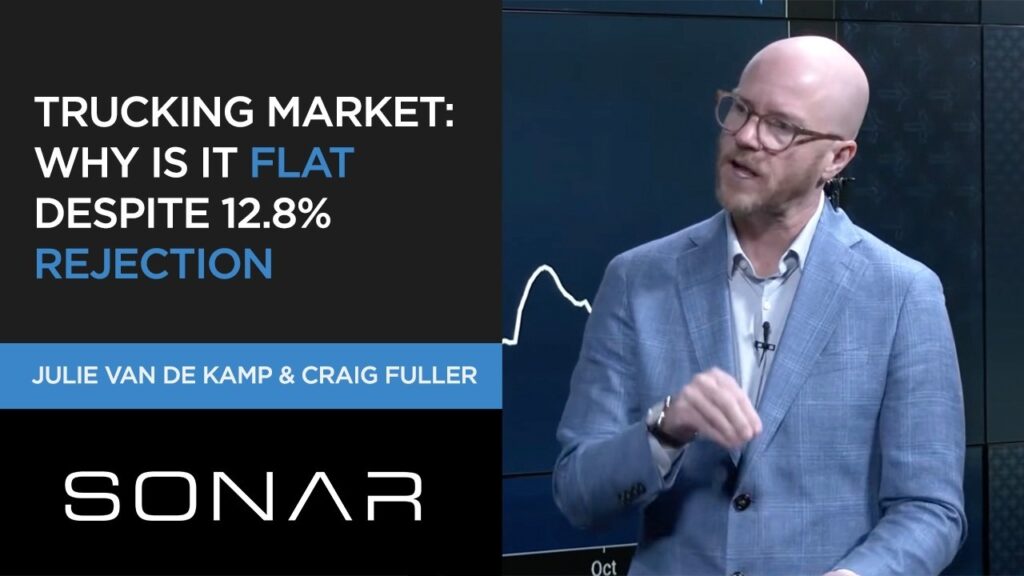
Truckload tender rejections are holding near 12.8%, roughly double the 6% recorded a year earlier, yet FreightWaves analysts Julie Van de Kamp and Craig Fuller say the market shows little of the tightening momentum normally seen ahead of peak season. The rejection index has slipped only about one percentage point in 20 days, even as November's Outbound Tender Volume Index averages 11,434, up 12% year over year and 3% from October. Refrigerated freight is the exception, with reefer rejections at 21% versus 12.6% last year, and a super El Niño could add further pressure on reefer capacity this winter.

Welcome Back!

Login to your account below

Create New Account!

Fill the forms below to register

Retrieve your password

Please enter your username or email address to reset your password.

Scan to share via WeChat

Open WeChat and scan the QR code to share

QR Code

Add New Playlist