GXO will deploy Agility Robotics' Digit humanoid robots at distribution centers in North Carolina and Tennessee, expanding a 2024 partnership that began at a Georgia site serving Spanx. Digit has moved more than 100,000 totes at the Flowery Branch facility under a Robots-as-a-Service agreement. Deployments at the Statesville and Lebanon sites are expected to begin in early 2027 with Digit 4, migrating to Digit 5 when commercially available. Agility CEO Peggy Johnson said the expansion signals that customers are deciding where to scale humanoids. Agility's RoboFab plant in Salem, Oregon, is designed for annual capacity of up to 10,000 robots. GXO has also piloted humanoids from Apptronik and Reflex.
According to DC Velocity, contract logistics provider GXO will deploy humanoid robots from Agility Robotics at distribution centers it operates in North Carolina and Tennessee, broadening a partnership that began in 2024 with a single Georgia facility serving the womens clothing brand Spanx.
Georgia pilot moves 100,000 totes
Since the Georgia test began, Agility’s Digit model has moved more than 100,000 totes at the Flowery Branch site, which GXO says demonstrates the robot’s ability to handle repetitive material-handling work reliably inside an active logistics environment.
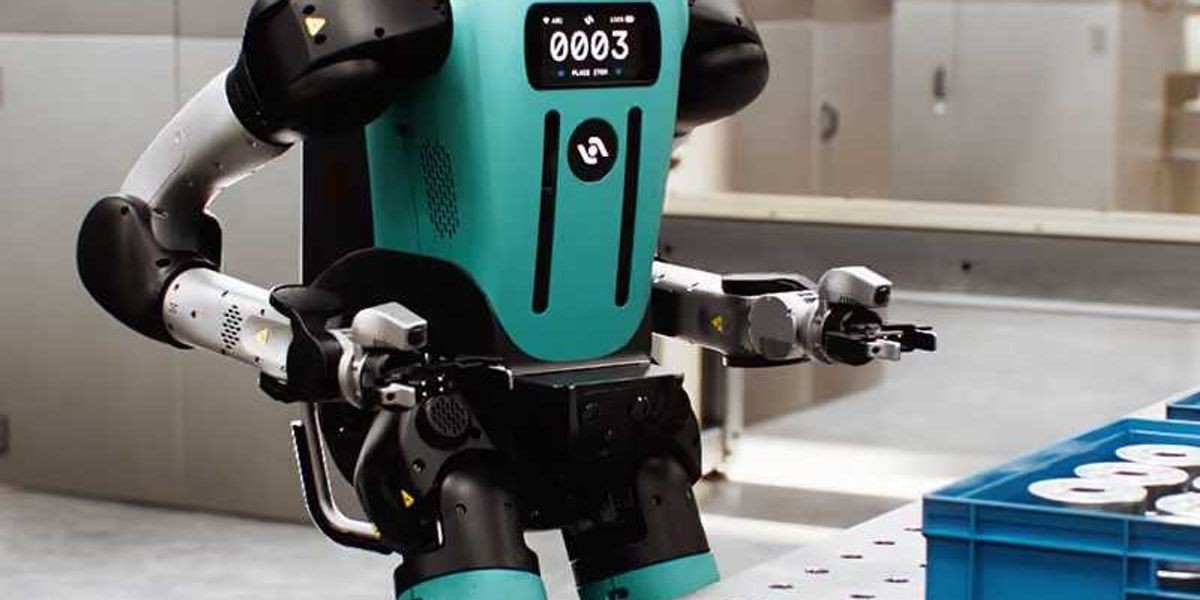
At that location the two companies have run a Robots-as-a-Service (RaaS) agreement. GXO deployed Digit units alongside Agility Arc, Agility’s cloud-based platform for managing robot fleets and integrating them into customer operations, and the robots have worked with existing automation to move totes and place them onto conveyors.
The Flowery Branch deployment gave Agility a live commercial reference in a working warehouse rather than a controlled trial, and GXO has cited the tote count as evidence that the equipment performs under production conditions.
New sites start in early 2027
Under the expanded agreement, Digit will support e-commerce fulfillment at GXO’s Statesville and Lebanon sites, taking on highly repetitive material-handling tasks. Deployments are expected to begin in early 2027 using Digit 4 and will migrate to Digit 5 once that model is commercially available.
According to the source, the Digit 5 model is designed for cooperatively safe work in close proximity to people and to address a broader range of industrial workflows, a specification that matters as GXO places the machines in facilities where human associates remain on the floor.
The two new locations extend the partnership beyond a single apparel account into e-commerce fulfillment, where order profiles and tote volumes differ from the Georgia operation.
Agility chief ties expansion to proven value
Agility CEO Peggy Johnson framed the multi-site rollout as validation of the commercial model rather than a test of feasibility, noting that GXO was the first customer to run Digit in live operations under a commercial agreement.
“GXO was the first customer to put Digit to work in live operations under a commercial agreement, and expanding to additional sites is the clearest signal that the value is real. Customers are moving beyond asking whether humanoid robots can work to deciding where they can scale them. Years of experience performing real work in GXO’s operations have shaped how we build, deploy and support Digit, and we’re focused on disciplined execution as we grow this partnership.” — Peggy Johnson, CEO of Agility Robotics
To support broader commercial adoption, Agility has invested in manufacturing and support infrastructure, including RoboFab, its 70,000-square-foot facility in Salem, Oregon, designed for annual production capacity of up to 10,000 robots.
GXO tests multiple humanoid suppliers
GXO has also trialed humanoid robots from technology providers Apptronik and Reflex in separate pilots, according to the report, indicating the logistics provider is evaluating several hardware suppliers rather than committing to a single vendor.
The Agility expansion nonetheless makes Digit the only humanoid model GXO has confirmed for deployment at named facilities in both Georgia and, from early 2027, North Carolina and Tennessee.
Source: DC Velocity
Compiled from international media by the SCI.AI editorial team.