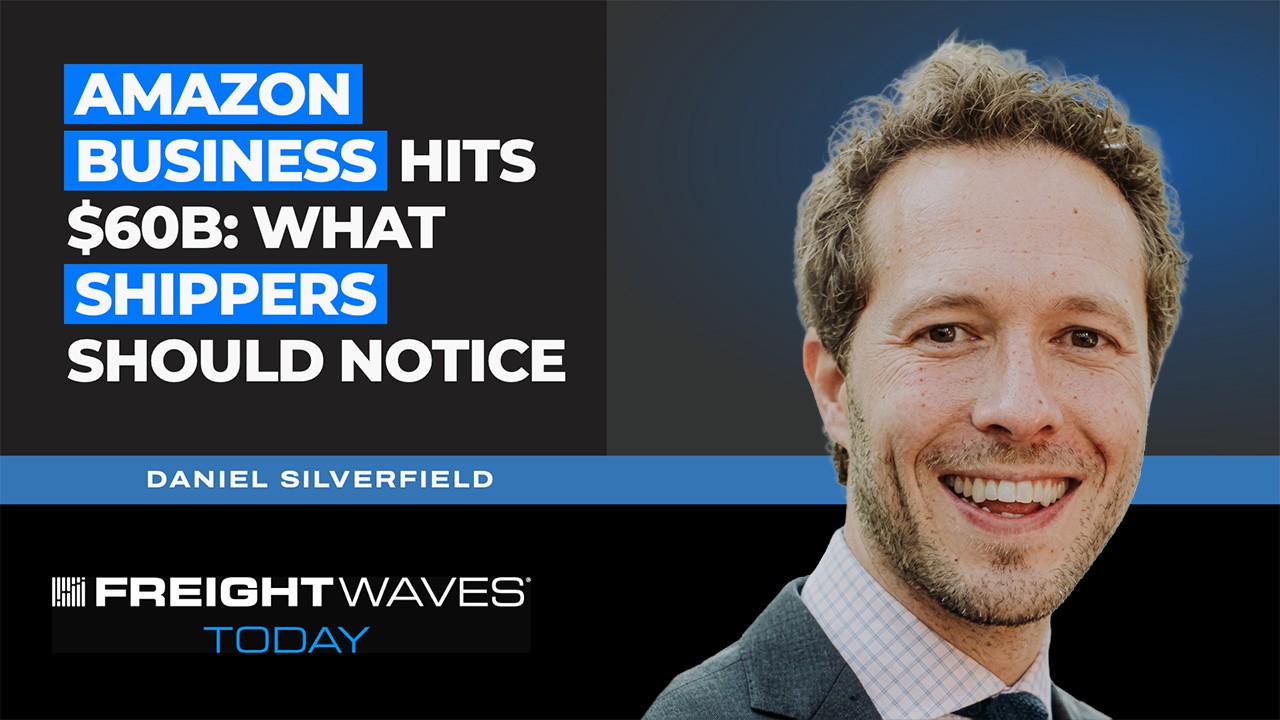
According to www.freightwaves.com, Amazon Business has reached $60 billion in annualized gross sales and now serves 11 million customers worldwide — including 1.8 million organizations added this year alone.
Scale and growth trajectory
The platform’s rapid expansion positions it at scale comparable to a Fortune 100 company if operated independently. Launched roughly a decade ago after Amazon observed widespread business purchasing behavior on its consumer site, Amazon Business now supports procurement across sectors — from office supplies to same-day groceries. Its 30% year-over-year increase in new items reflects accelerating product diversification, while its geographic footprint spans global markets with concentrated U.S. deployment.
Amazon Business launched same-day grocery delivery across 2,300 U.S. cities in the first half of 2026, responding directly to customer demand. That capability underscores how the platform is shifting beyond transactional e-commerce into time-sensitive, operationally complex B2B fulfillment — a development with direct implications for shippers, carriers, and logistics brokers.
The platform’s growth is not merely volumetric: it is reconfiguring procurement cycles, moving them from quarterly reporting cadences to an always-on, data-driven model. Each order migrating to Amazon Business represents one fewer touchpoint for traditional distributors and one more shipment routed through Amazon’s integrated logistics infrastructure.
AI-powered procurement tools
Daniel Silverfield, head of value and selection for Amazon Business, emphasized that buyers increasingly seek consolidation, visibility, and waste reduction — not just convenience. To meet those needs, the platform deploys two core AI tools: Amazon Business Assistant, a conversational agent that identifies optimal products by price and delivery speed, and Savings Insights, which analyzes cross-location purchasing data to flag redundancy — such as five sites ordering different paper towel brands weekly — and recommends centralized, bulk monthly orders instead.
Silverfield described the evolving procurement journey as “continuous, always-on, conversational-powered,” where agents may negotiate pricing or compare options autonomously — even while users sleep — then surface only the best choice.
“The big shift that we’re seeing is that people are moving to a continuous, always-on, conversational-powered procurement journey where agents may be looking for the best price while they’re asleep, maybe negotiating on their behalf while they’re asleep, and then surfacing to them the best product to buy.” — Daniel Silverfield, head of value and selection for Amazon Business
These tools also address compliance pain points: generative AI automatically surfaces unauthorized or redundant subscriptions across decentralized procurement teams — a frequent operational challenge for large organizations. Spending rules, category blocks, and buyer-level visibility controls are built directly into the platform.
Logistics infrastructure evolution
To support B2B delivery complexity, Amazon Business deployed a dedicated fleet of branded trucks last year — explicitly designed for loading dock access, pallet consolidation, scheduled arrival windows, and multi-stop deliveries to high-compliance environments like hospitals and universities. As Silverfield noted, “Delivering to a loading dock is very different than delivering to a porch.” The goal is to replace fragmented, multi-day, multi-package deliveries with single, pre-agreed shipments — reducing handling, delays, and administrative overhead.
This infrastructure investment aligns with the platform’s broader savings impact: Amazon Business saved customers $880 million on Prime free shipping and $1 billion through business-specific discounts last year. Those figures reflect both scale-driven efficiencies and targeted incentive design embedded in the procurement workflow.
Businesses can access all tools and services at amazonbusiness.com. Upcoming FreightWaves events — including the Brokerage Compliance Symposium and F3: Future of Freight Festival — will further explore these shifts in logistics and procurement strategy.
Source: FreightWaves
Compiled from international media by the SCI.AI editorial team.