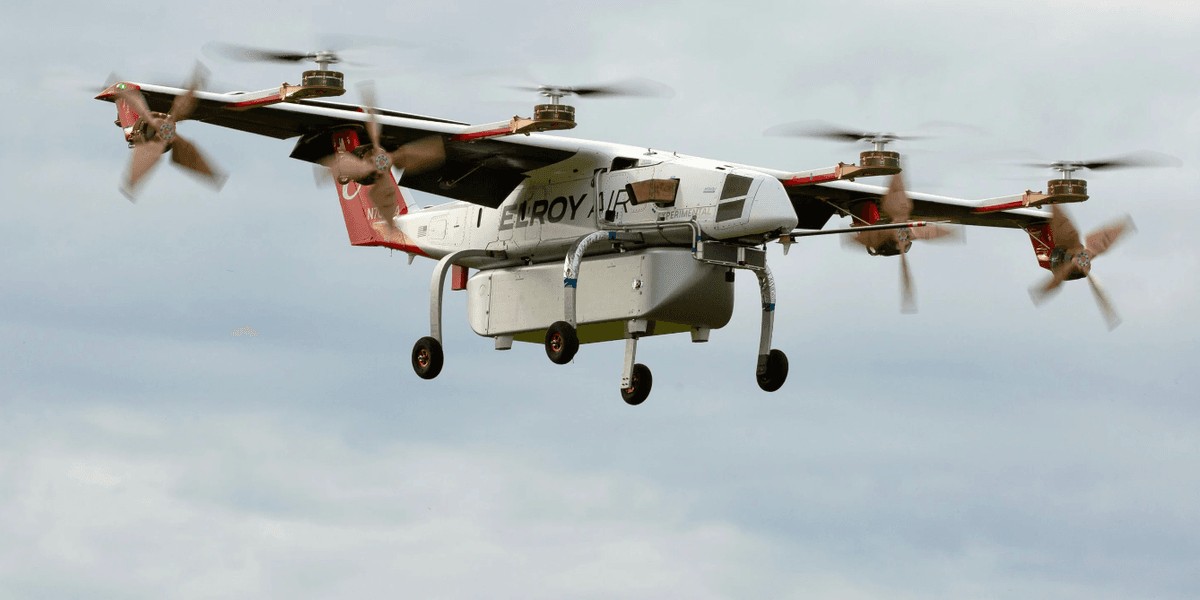
According to www.dcvelocity.com, Elroy Air’s Chaparral unmanned aerial system completed a fully autonomous multi-mode cargo delivery demonstration for the U.S. Army on July 15, 2026 — executing precision airdrops and ground delivery without personnel or infrastructure at the receiving site.
Three Unattended Delivery Modes Validated
The Byron, California-based company confirmed that its Chaparral drone now supports three distinct unattended delivery methods: precision airdrop from a hover, precision airdrop during forward flight, and ground delivery after autonomous landing. All modes were demonstrated in live exercises with zero human intervention at the drop zone. In the July 15 test, the aircraft released a 68-pound payload from a close-in hover and a 70-pound payload from 65 feet altitude while in forward flight — both triggered solely by pre-programmed software commands.
The Chaparral’s swappable cargo pod — measuring approximately six feet long and two feet wide — provides 19 cubic feet of internal volume and enables rapid mission reconfiguration without airframe modifications. This flexibility allows a single aircraft to support diverse operational requirements across defense and commercial use cases.
Hybrid-Electric Design Enables Tactical Range and Payload
Designed under contract with the U.S. Army, the Chaparral is a hybrid-electric vertical takeoff and landing (VTOL) aircraft featuring an 30-foot wingspan, eight vertical lift rotors, and four forward-flight rotors. Its architecture enables helicopter-like takeoff and landing plus fixed-wing efficiency, yielding a maximum range of 450 miles and a maximum payload capacity of 500 pounds. The drone’s powertrain integrates battery and internal combustion components to balance endurance, speed, and operational resilience in austere environments.
Elroy Air stated that production units will be manufactured by Kratos Defense & Security Solutions at its expanding facility in Sacramento, California — a strategic decision aligning with domestic defense industrial base priorities. The company plans to go public during the fourth quarter of 2026.
Military and Commercial Applications Expand
The new delivery capabilities directly address logistics challenges in contested, remote, or infrastructure-deficient settings — including maritime resupply, disaster response, distributed operations, and austere terrain. As noted by Mark Rodrigo, who leads Federal Business Development at Elroy Air and served as a U.S. Air Force intelligence officer supporting ISR operations across five continents:
“Contested logistics is one of the hardest problems the joint force faces, from maritime resupply to sustaining distributed forces far from established hubs. One Chaparral can now resupply multiple positions in a single sortie, with no pilot at risk and no personnel required at the drop point. That’s a force multiplier for units operating at the tactical edge.”
Beyond defense, Elroy Air emphasized that the technology is engineered for rapid-response commercial logistics, including time-sensitive medical deliveries, last-mile support in congested urban zones, and just-in-time replenishment for remote industrial sites. The firm highlighted that all three delivery modes will be standard on production Chaparral aircraft — not limited to prototype or experimental configurations.
Strategic Positioning Amid Growing Drone Logistics Investment
Elroy Air’s progress reflects broader momentum in military and civilian unmanned cargo systems. The U.S. Department of Defense has accelerated investment in autonomous aerial resupply since 2023, with over $1.2 billion allocated to VTOL logistics platforms across Army, Air Force, and Marine Corps programs through fiscal year 2025. Meanwhile, commercial logistics operators are evaluating similar technologies to reduce reliance on ground transport in high-risk or geographically constrained areas — particularly in the U.S. West Coast and island territories where terrain and congestion limit traditional access.
The Chaparral’s ability to operate without ground infrastructure or personnel at the destination differentiates it from conventional UAVs requiring landing zones or parachute-based airdrop systems with lower accuracy. According to Elroy Air, this capability reduces logistical footprint, enhances operational security, and shortens response timelines — factors increasingly critical in both defense planning and emergency supply chain management.
Source: DC Velocity
Compiled from international media by the SCI.AI editorial team.