According to theloadstar.com, Maersk has expanded its operated container capacity on the intra-North Europe trade lane by 28% year-on-year — from 39,800 TEU in July 2025 to 50,800 TEU as of June 2026 — lifting its market share from 13.5% to 16.2%.
Market consolidation reshapes operator rankings
The acquisition of Icelandic carrier Samskip’s UK–continental Europe container shipping services by ro-ro and multimodal operator CLdN — completed in June 2026 — triggered a sharp realignment in the intra-North Europe league table. Luxembourg-based CLdN, which relocated its shipping operations headquarters to London in May 2026, climbed four positions, from 17th to 13th largest operator, according to Alphaliner analysis.
Samskip’s own operated container capacity fell from 9,600 TEU to 5,800 TEU — a 40% reduction — causing its rank to drop from 7th to 14th, described by Alphaliner as “the steepest drop of any operator.” CLdN’s capacity surged from 2,750 TEU in July 2025 to 6,300 TEU following the deal, which the company said “aligned with CLdN’s strategy of providing complementary ro-ro services for mixed cargo and lo-lo services specifically for containers.”
Growth across the trade lane
Total deployed container capacity on the intra-North Europe route increased by 20,000 TEU over the past 12 months, representing a 6.8% year-on-year rise. As of June 2026, 243 vessels with an average capacity of 1,294 TEU were active on the route, up from 235 vessels averaging 1,253 TEU a year earlier.
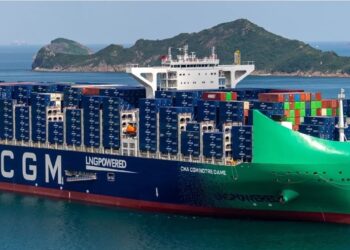
Market leader MSC saw its capacity grow by 4,000 TEU — a 6.2% increase — slightly below the market average. Its market share contracted marginally, from 21.3% to 21.2%. Third-placed DP World Shipping Services (formerly Unifeeder) lost two vessels and saw its market share decline from 12.2% to 11%. CMA CGM’s capacity dropped 14.4%, to 30,200 TEU, and its market share slipped from 12% to 9.6%, placing it fourth.
Maersk’s strategic expansion
Maersk’s outsized growth stems from its “hub and spoke” network model implemented in partnership with Hapag-Lloyd under the Gemini alliance. Its latest additions include two new Baltic feeder services connecting Germany and Poland, deploying four vessels ranging from 2,100 TEU to 4,800 TEU, adding 14,300 TEU of capacity.
One of these is the Laura Maersk, a methanol-powered eco-flagship vessel with a capacity of 2,100 TEU. The service portfolio supports more than 1,000 port calls annually, serving blue-chip consumer goods manufacturers and managing the transfer of lease agreements for over 5,000 multimodal cargo units.
CMA CGM adapts via slot charters
While CMA CGM reduced its owned feeder fleet, it offset capacity losses through slot-charter agreements. According to Xeneta’s eeSea liner database, the French carrier holds slots on eight BG Freight Line services between continental Europe and the UK/Ireland, including EUCON’s Antwerp–Belfast shuttle. On the 1,400 TEU BG Orange — operating on Peel Ports’ Butterfly 1 service (ECUK56) — CMA CGM reserves an estimated 20% of available slots.
This vessel was recently involved in a collision with the multipurpose ship Wind Orca while alongside the quay at the UK port of Tyne, prompting collapse of a quay crane onto its deck. Salvage operations are ongoing.
Source: The Loadstar
Compiled from international media by the SCI.AI editorial team.