Company Raises $100 Million for Autonomous Rail Development
According to roboticsandautomationnews.com, Parallel Systems has raised approximately $100 million to advance its autonomous freight train technology. The Los Angeles-based company, founded in 2020 by former SpaceX engineer Matt Soule, is developing what it describes as the world’s first autonomous freight train system. The funding will support commercial testing and the upcoming manufacturing of third-generation rail vehicles.
Autonomous Electric Rail Vehicles Operate Without Locomotives
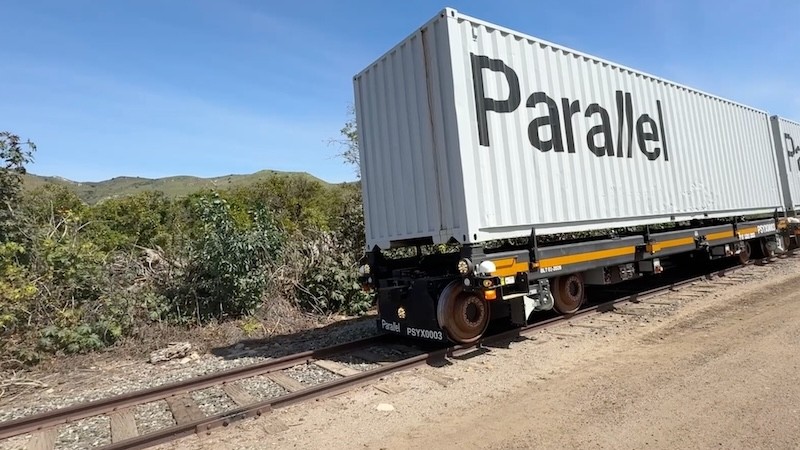
Parallel Systems designs battery-electric rail cars equipped with individual motors, lidar sensors, cameras, and onboard computers. Each vehicle uses six cameras and lidar for environmental monitoring. Unlike traditional freight trains, these vehicles operate independently or in coordinated groups under software control, eliminating the need for human engineers or conventional locomotives. According to the company, the system can stop faster than conventional trains due to multiple redundant braking systems.
“You can think of this as the Waymo of light rail.” — Matt Soule, Founder and CEO, Parallel Systems
Testing on 160 Miles of Track in Georgia
Commercial testing is currently underway on approximately 160 miles of rail track between the Port of Savannah and Cordele, Georgia. The system is being operated under oversight from the Federal Railroad Administration (FRA), making it the first autonomous freight rail system to receive such approval. Human operators monitor the trains remotely from control centers, with the long-term goal of transitioning to supervisory roles rather than manual operation.
Targeting Short-Haul Freight Dominated by Trucks
Parallel Systems identifies short-haul freight—especially drayage operations—as a key market. The US freight transportation market generates about $900 billion annually, with trucking accounting for roughly $800 billion and rail contributing approximately $80 billion. The company argues that autonomous electric rail systems could enable rail operators to economically serve shorter routes traditionally dominated by trucks, improving service frequency and reducing congestion at ports.
Industry Context and Market Position
Parallel Systems enters a logistics automation market expanding rapidly across autonomous trucks, robotic warehouses, AI-powered supply chains, and self-driving delivery systems. Despite rail’s advantages in energy efficiency and large-scale transport, autonomous rail freight remains underdeveloped compared to other autonomous transport segments. The company claims its approach enables rail operators to handle smaller freight volumes more cost-effectively and improve flexibility. Soule emphasized that the company is the only one with FRA approval for autonomous freight rail operations.
Commercialization Timeline and Manufacturing
Parallel Systems plans to begin manufacturing its third-generation autonomous rail vehicles in 2027, marking a shift toward full commercialization. The company is currently in the second-generation testing phase and aims to scale operations based on performance data from the Georgia trial. The project is being conducted in partnership with Genesee & Wyoming, a major North American short-line railroad operator.
Source: Robotics & Automation News
Compiled from international media by the SCI.AI editorial team.