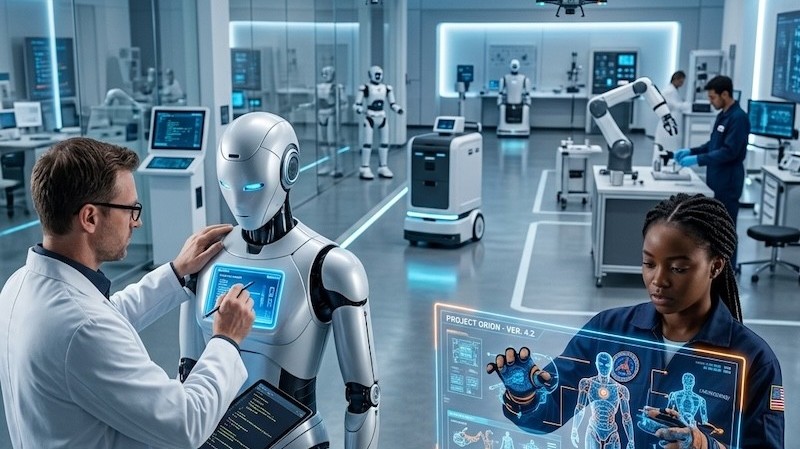
According to roboticsandautomationnews.com, humanoid robots are transitioning from prototype validation to early commercial deployment, with automotive manufacturing and logistics expected to drive demand over the next decade.
Market Growth and Cost Projections
The humanoid robot market across automotive, logistics, and home-use applications is forecast to reach approximately $25 billion by the early 2030s, according to IDTechEx, before moderating by 2036. Annual shipments are projected to approach 1.8 million units by 2036, with automotive manufacturing leading deployment, followed by logistics, and home-use remaining a long-term opportunity with limited penetration in the forecast period.
Hardware costs are declining rapidly. The average selling price of humanoid robots is expected to fall from approximately $114,700 in 2024 to around $37,000 by 2030, with further reductions anticipated into the mid-2030s. These cost reductions are supported by progress in embodied AI, improved materials, and stronger investor and OEM backing.
Operating Costs and Utilization Scenarios
Despite falling hardware prices, operating costs remain highly dependent on deployment efficiency. IDTechEx modeling incorporates high-, medium-, and low-efficiency utilization scenarios. In high-utilization industrial settings, operating costs could drop below $5 per hour by 2030, with further declines expected by 2036.
However, in medium- or low-utilization environments, cost advantages diminish even as hardware prices fall. The cost per productive hour varies significantly based on task continuity, workflow structure, and system integration quality—factors that remain variable in current deployments.
ROI and Payback Periods
IDTechEx calculations show that under favorable conditions, payback periods for humanoid robots could be as short as 6 months by 2026 in high-utilization scenarios, compared to approximately 15 months under medium utilization. As hardware prices decline and deployment experience improves, ROI feasibility is expected to expand across more industrial applications.
Nevertheless, shorter payback periods do not guarantee profitability. The core determinant of economic success is not just equipment cost, but the effective output delivered by the robot. Robots must perform economically valuable tasks consistently, reliably, and at sufficient productivity levels across different environments.
Deployment Limitations and Future Pathways
Humanoid robots remain limited in complex, variable, or safety-critical tasks. Near-term deployments are expected to focus on high-labour-intensity, repetitive, standardized, or hazardous tasks where the economic case is easier to validate.
The report emphasizes that large-scale commercialization will depend on continued advances in software capability, task generalization, system integration, and deployment efficiency—rather than hardware cost reduction alone. As of 2026, the cost advantage is becoming visible, and ROI can already be demonstrated in selected scenarios, but widespread adoption hinges on effective output.
“Humanoid robots are beginning to show cost competitiveness, particularly in high-utilization industrial scenarios. However, in medium- or low-utilization settings, the cost advantage can be significantly reduced even as hardware prices fall.” — IDTechEx, Humanoid Robots: Market, Technologies, and Opportunities 2026–2036
Source: Robotics & Automation News
Compiled from international media by the SCI.AI editorial team.