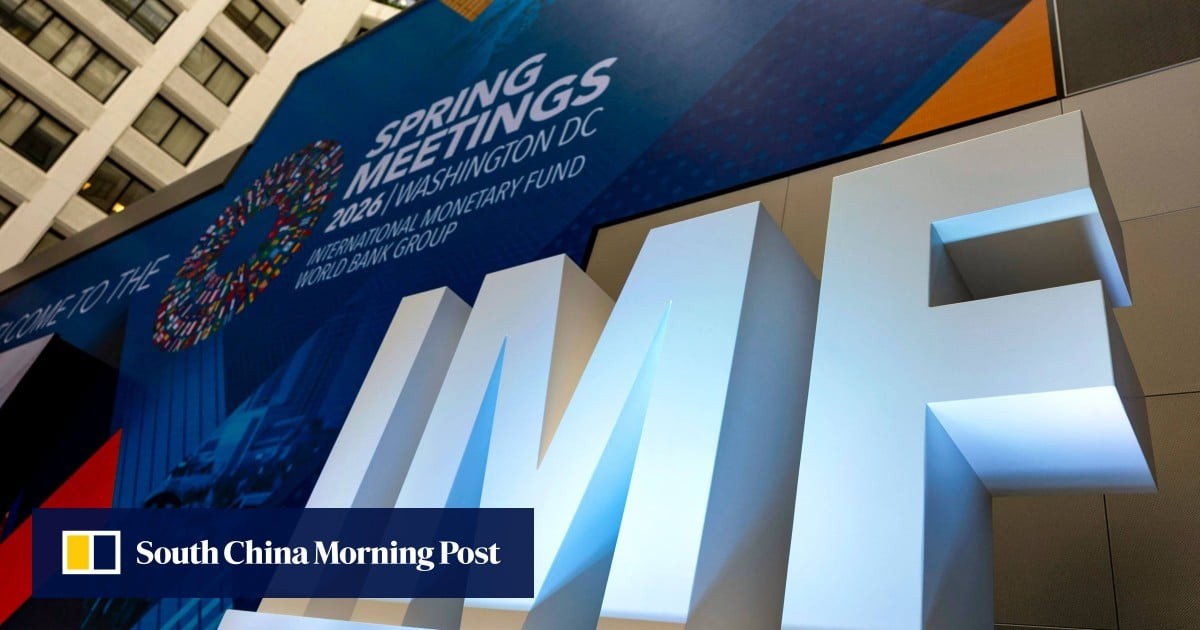
According to www.scmp.com, the International Monetary Fund (IMF) has lowered its 2026 GDP growth forecast for China to 4.4 per cent, down 0.1 percentage points from its January 2026 estimate but up from October’s 2 per cent projection.
Global and Chinese Growth Revisions
The IMF’s flagship World Economic Outlook, published on Tuesday, April 14, 2026, revised global GDP growth downward to 3.1 per cent for 2026 — a reduction of 0.2 percentage points from the January forecast. The downgrade reflects economic shocks stemming from the US-Israeli war in Iran, which the report identifies as a key destabilizing factor.
China’s official growth target remains at 4.5 to 5 per cent. The IMF attributes the shortfall to weak domestic demand — particularly in the housing sector — which continues to lag behind export performance. According to the report, “Economies around the world face repercussions through the direct impact of higher commodity prices, indirect second-order effects on inflation expectations – which tend to be especially sensitive to energy and food prices – and amplification effects coming from risk-off sentiment in financial markets.”
Offsetting Factors and Policy Response
Despite the drag from Middle East conflict spillovers, the IMF notes that two countervailing forces have improved China’s outlook since October: lower US tariff rates on Chinese imports and Beijing’s domestic stimulus measures. These factors, the source states, “would offset the negative impact of the shock induced by the Middle East conflict.”
This revision underscores how geopolitical volatility — especially in critical chokepoints like the Strait of Hormuz — is now directly factored into macroeconomic forecasting for major exporting economies. For supply chain professionals, the implications are operational: rising energy prices affect freight costs across maritime and air modes; inflation sensitivity around food and fuel commodities tightens working capital planning; and risk-off sentiment can constrain trade finance availability and delay supplier payments.
Historically, IMF growth revisions for China have closely tracked shifts in export competitiveness and property sector health. Since late 2023, over 30 major multinationals—including Apple suppliers in Guangdong and automotive component makers in Jiangsu—have reported extended lead times or inventory rebalancing linked to both domestic demand softness and regional security concerns. Concurrently, shipping lines such as COSCO and Maersk have rerouted vessels away from the Red Sea and Persian Gulf since early 2025, adding 7–12 days to Asia–Europe transit times and lifting container spot rates by up to 40 per cent year-on-year in Q1 2026, according to publicly reported Freightos Baltic Index data.
For practitioners managing end-to-end supply chains, the 4.4 per cent forecast signals continued pressure on cost structures without the buffer of robust domestic consumption growth. This reinforces the need for dual-sourcing strategies, dynamic inventory positioning near alternative ports (e.g., Ningbo-Zhoushan or Qingdao), and real-time monitoring of energy-linked input costs — especially for sectors reliant on petrochemical feedstocks or electricity-intensive manufacturing.
Source: South China Morning Post
Compiled from international media by the SCI.AI editorial team.