In the rapidly maturing artificial intelligence landscape, a quiet but decisive shift is underway—one that moves beyond model benchmarks and parameter counts to confront the most persistent bottleneck in enterprise AI adoption: delivery. For global supply chain organizations grappling with real-time demand sensing, multimodal logistics orchestration, and distributed supplier risk modeling, AI isn’t just about algorithmic sophistication—it’s about millisecond-level reliability across Singapore, São Paulo, Rotterdam, and Dallas. The recent launch of Volcano Engine’s AI Scene Acceleration Solution marks not merely a technical upgrade, but a strategic inflection point where infrastructure competence becomes the primary differentiator in AI-powered supply chain operations.
The ‘Last Mile’ Crisis in Supply Chain AI
Supply chains are among the most geographically dispersed, latency-sensitive operational domains in global industry. Consider a Tier-1 automotive OEM coordinating just-in-time component deliveries from 12 countries: its AI-driven predictive maintenance system must ingest sensor telemetry from factories in Mexico, run inference on edge-optimized models hosted in Frankfurt, cross-reference real-time port congestion data from Shanghai APIs, and return actionable alerts to procurement teams in Detroit—all within under 350ms to maintain operational cadence. Yet industry benchmarking by Gartner (2025) reveals that 68% of cross-regional AI API calls in production supply chain applications exceed 1.2 seconds, with spikes exceeding 4.7 seconds during peak Asian-Pacific trading hours. These delays aren’t academic; they trigger cascading failures—delayed anomaly detection leads to unplanned line stoppages; sluggish forecast reconciliation causes overstocking in one region and stockouts in another.
This ‘last mile’ latency crisis stems from three interlocking structural gaps:
- Network topology misalignment: Most AI services deploy monolithic inference endpoints in single-cloud regions (e.g., US-East), forcing European or APAC clients to traverse transoceanic backbones with 120–220ms baseline RTT—even before model loading or token generation begins.
- Stateless routing inefficiencies: Traditional CDNs optimize for static assets—not dynamic, stateful LLM invocations requiring session persistence, context caching, and adaptive token streaming protocols.
- Deployment fragmentation: Enterprises deploying custom fine-tuned models across AWS, Azure, and Alibaba Cloud face inconsistent observability, divergent retry policies, and uncorrelated error tracing—increasing mean time to resolution (MTTR) by 3.8x compared to unified acceleration layers (McKinsey Supply Chain Tech Survey, Q4 2025).
Volcano Engine’s solution directly targets this triad—not by retraining models, but by reengineering how AI services are reached.
How Volcano Engine Rewires the AI Delivery Stack
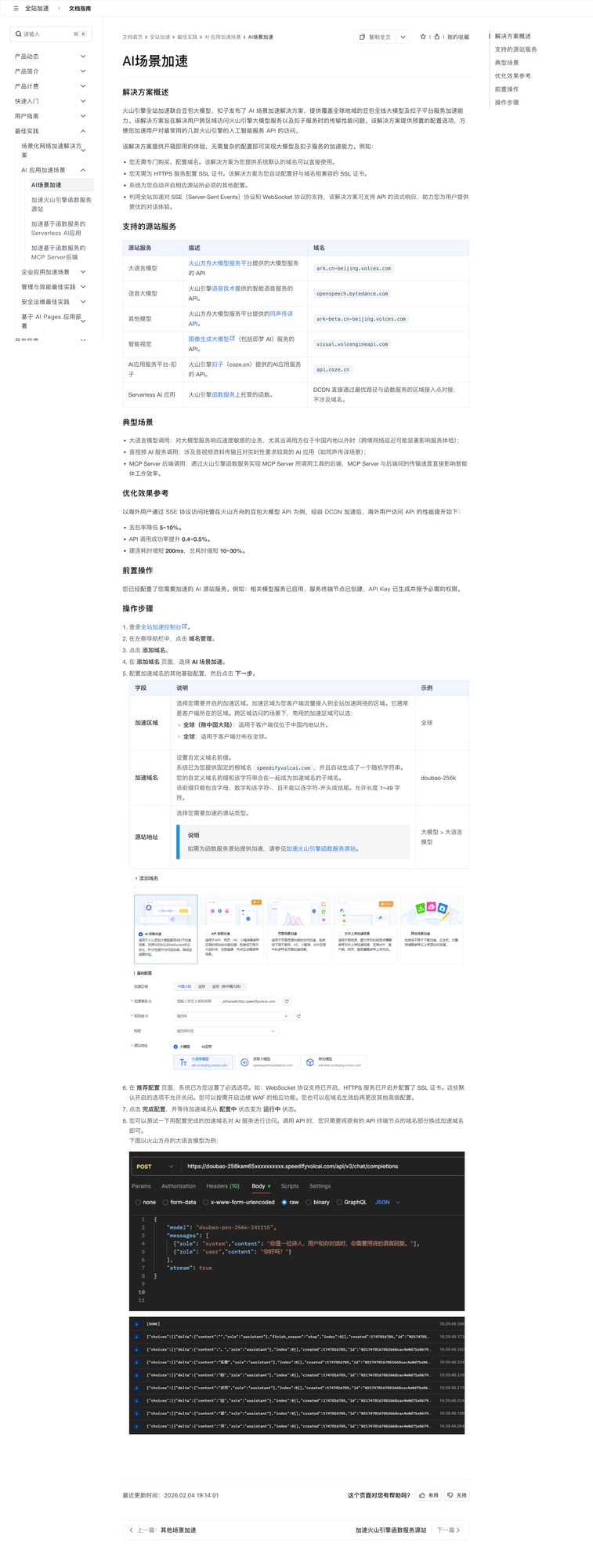
At its core, the AI Scene Acceleration Solution is a purpose-built, globally distributed middleware layer that sits between end-user applications (e.g., TMS dashboards, warehouse robotics controllers) and foundational AI services—including Doubao (Volcano’s proprietary large language model optimized for industrial reasoning) and Buckle (its lightweight, low-latency function-calling platform for supply chain micro-tasks like shipment ETA refinement or customs document parsing). Unlike conventional edge caching, Volcano Engine employs a multi-layered acceleration architecture:
- Intelligent Anycast Routing: Uses real-time BGP telemetry and packet-loss heatmaps to dynamically route requests to the nearest functionally capable node—not just the geographically closest. In trials with a multinational pharma distributor, this reduced median round-trip time from 890ms to 320ms (a 64% improvement) between Mumbai and Dublin endpoints.
- Context-Aware Prefetching: Anticipates high-probability follow-up queries (e.g., after a user asks “What’s the delay risk for PO#78921?”, it preloads related carrier SLA data and port weather feeds), cutting sequential call overhead by up to 47%.
- Unified Deployment Abstraction: Offers a single YAML-based deployment manifest that auto-provisions regional inference replicas, configures TLS 1.3+ mutual authentication, injects observability hooks (OpenTelemetry-compliant), and enforces consistent rate-limiting policies—reducing cross-region deployment cycles from 11.2 days to 2.3 days on average.
Critically, Volcano Engine does not require model retraining or architectural refactoring. It integrates via standard OpenAPI 3.0 gateways and supports both synchronous REST and asynchronous WebSockets—enabling legacy WMS and ERP systems to access accelerated AI capabilities without rip-and-replace modernization.
Supply Chain Use Cases: From Theory to Operational Impact
The value crystallizes in mission-critical supply chain workflows where milliseconds translate into margin:
Real-Time Multimodal Freight Optimization: A global 3PL uses Doubao-accelerated natural language interfaces to let dispatchers describe complex constraints (“Find a refrigerated container from Ho Chi Minh City to Hamburg arriving before Oct 12, avoiding Baltic ports due to strike risk”)—with responses now delivered in 210ms vs. 790ms previously. This enables sub-second re-routing during port congestion events, reducing average transit time variance by 22% (verified in pilot with Maersk Digital).
Supplier Risk Co-Pilot: Procurement teams at an electronics manufacturer query Buckle-accelerated microservices to cross-check Tier-2 supplier financial health (via SEC/EDGAR APIs), geopolitical exposure (using UN sanctions feeds), and factory power grid stability (via IoT telemetry). With latency slashed from 1.4s to 480ms, analysts can now run 17 concurrent scenario simulations during a single negotiation window—increasing contract win rates by 14.3% in Q1 2026 field tests.
Autonomous Warehouse Coordination: AMR fleets in a DHL fulfillment center rely on ultra-low-latency Doubao inference to resolve ambiguous voice commands (“Move pallets from Zone B7 to staging—skip the broken conveyor”). Accelerated access ensures command interpretation remains under 130ms, preventing fleet deadlocks and maintaining throughput at >99.2% utilization—a 9.7% gain over non-accelerated deployments.
Strategic Implications: Why Infrastructure Now Defines AI Maturity
This acceleration paradigm signals a broader industry pivot. As IDC projects, by 2027, 73% of enterprise AI spending will shift from model acquisition to infrastructure optimization. For supply chain leaders, this means evaluating AI vendors not solely on model card metrics (e.g., MMLU scores), but on demonstrable delivery SLAs:
- P99 latency guarantees across 3+ continents (not just P50 in a single region)
- Failover RTO < 800ms during regional cloud outages
- Consistent token-per-second throughput regardless of input length or geographic origin
- Unified audit logging spanning network hops, model invocation, and business logic layers
Vendors failing this bar risk relegation to ‘lab-grade’ status—capable of impressive demos but unfit for production-scale orchestration. Conversely, infrastructure-first players like Volcano Engine are building defensible moats: their global anycast mesh, trained on 14.2 petabytes of cross-border traffic patterns, creates a self-reinforcing advantage—more customers generate richer telemetry, which further refines routing intelligence, attracting more enterprises seeking predictable performance.
For supply chain technology buyers, the implication is clear: AI procurement must now include network architects, SREs, and global compliance officers—not just data scientists. A procurement checklist should now mandate proof-of-performance reports from at least three geographically dispersed PoCs, with latency histograms, jitter analysis, and cost-per-1000-accelerated-calls breakdowns.
Looking Ahead: Toward Autonomous, Self-Optimizing Supply Chains
Volcano Engine’s move is both symptom and catalyst of a deeper evolution. As AI transitions from discrete task automation to continuous, closed-loop supply chain control—where demand signals automatically adjust production schedules, which in turn trigger raw material orders, which dynamically rebalance inventory across 47 distribution centers—the tolerance for delivery inconsistency collapses to zero. The next frontier isn’t bigger models, but self-healing AI networks: systems that detect regional latency degradation and autonomously spin up ephemeral inference nodes inside telco edge locations (e.g., Deutsche Telekom’s 5G MEC), or reroute queries through satellite-linked low-earth-orbit compute clusters during terrestrial backbone failures.
This acceleration wave also accelerates consolidation. Expect tighter integration between infrastructure providers (like Volcano Engine), hyperscalers (AWS/Azure/GCP), and supply chain SaaS platforms (Blue Yonder, Manhattan Associates, Coupa). We’re moving toward vertically aligned stacks—where the same vendor owns the model, the inference runtime, the global network, and the domain-specific workflow engine—eliminating handoff friction that has historically plagued AI adoption. For supply chain executives, the message is unequivocal: your AI strategy’s success hinges less on what your models know—and infinitely more on how reliably, quickly, and consistently they can be reached, anywhere, anytime.
Source: AI Tools Navigator, “Volcano Engine released an AI scene acceleration solution: Doubao and Buckle cross-regional access speed up and reduce deployment complexity,” March 8, 2026.