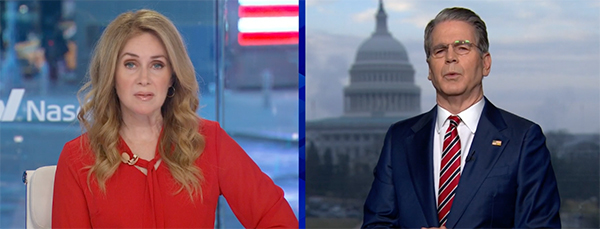
On March 4, 2026, U.S. Treasury Secretary Scott Bessent confirmed on CNBC that a 15% ad valorem tariff on all imported goods would take effect imminently — likely within the week — marking the most sweeping unilateral trade measure since the inception of the World Trade Organization. This is not an incremental adjustment but a structural reset: a deliberate, legally expedited escalation designed to buy time for the Trump administration to rebuild its tariff architecture on firmer statutory ground. The move follows the U.S. Supreme Court’s February 20 ruling that invalidated the President’s prior use of the International Emergency Economic Powers Act (IEEPA) to impose so-called ‘reciprocal tariffs.’ In response, the White House pivoted to Section 122 of the Trade Act of 1974, authorizing a 150-day, 10% global tariff — only to announce, within 24 hours, its immediate elevation to 15%. What emerges is not policy chaos, but calibrated coercion: a five-month ‘legal runway’ during which supply chain stakeholders must navigate unprecedented volatility while anticipating a second, more durable wave of protectionism.
The Legal Architecture: From Expediency to Endurance
The administration’s pivot from IEEPA to Section 122 — and its planned transition to Sections 301 and 232 — reveals a sophisticated, if aggressive, legal sequencing strategy. Section 122 permits the President to impose temporary import restrictions ‘to deal with serious injury or threat thereof to domestic industry,’ requiring only consultation (not approval) with Congress and expiring after 150 days unless renewed. By contrast, Section 301 — invoked over 400 times since 1974 and upheld in every major judicial challenge — grants broad authority to respond to ‘unfair trade practices’ by foreign governments, including intellectual property theft, forced technology transfer, and market distortions. Section 232, meanwhile, allows tariffs based on national security assessments — a tool already deployed against steel (25%) and aluminum (10%) imports in 2018 and now poised for expansion into semiconductors, critical minerals, and pharmaceutical active ingredients.
Bessent’s assertion that these statutes are ‘very comprehensive and have withstood over 4,000 legal challenges’ is factually grounded: WTO dispute panels have repeatedly ruled Section 301 actions consistent with U.S. treaty obligations when properly justified, and courts have consistently deferred to executive discretion under Section 232. Yet speed comes at a cost. While Section 122 tariffs can be imposed within days, Section 301 investigations typically require 6–12 months to conclude, and Section 232 probes average 8–10 months. The five-month window, therefore, represents a high-stakes bridge — not a reprieve. During this period, U.S. Customs and Border Protection will accelerate data collection on import volumes, origin tracing, and downstream value-chain linkages, enabling rapid targeting once new authorities activate.
Supply Chain Impact: Disruption Beyond Cost Inflation
The economic consequences extend far beyond headline tariff rates. A 15% global baseline tariff fundamentally reshapes landed cost calculations across tiers of procurement. For example, a $100 component sourced from Vietnam — previously subject to MFN rates averaging 2.8% — now incurs a $15 duty, erasing nearly half the labor-cost advantage that drove nearshoring investments post-2020. Crucially, this levy applies in addition to existing product-specific duties: EU wine faces a base rate of 12%, meaning the new 15% layer pushes effective tariffs to 27%; Brazilian soybeans, already taxed at 6.4%, jump to 21.4%. Such compounding effects destabilize multi-year commercial contracts and trigger force majeure clauses in logistics service agreements.
Port operators report cascading operational strain. Gene Seroka, Executive Director of the Port of Los Angeles, noted that container dwell times have risen 22% since early February as shippers delay unloading pending tariff clarity. Warehousing demand in inland distribution hubs has spiked 37% YoY — not for inventory building, but for ‘tariff arbitrage staging’: holding goods just inside U.S. borders until classification decisions are finalized. Meanwhile, air freight rates on transpacific lanes surged 68% in the first week of March as importers rush time-sensitive shipments ahead of anticipated customs delays.
- Automotive sector: Tier-2 suppliers face $4.2B in additional annual duties on wiring harnesses and infotainment modules, prompting Ford and GM to accelerate dual-sourcing plans in Mexico and Poland.
- Pharmaceuticals: API imports from India and China now carry 15% duties on top of existing FDA user fees, threatening delivery timelines for 127 FDA-approved generics with no U.S.-based manufacturing capacity.
- Consumer electronics: Apple’s supply chain — reliant on 92% of final assembly in China and Vietnam — faces $8.9B in incremental tariff exposure, pressuring margins despite recent price hikes.
Geopolitical Realignment: Winners, Losers, and Strategic Opportunists
Oxford Economics’ assessment that Brazil and China stand to gain — while the UK and Australia suffer most — reflects structural asymmetries in pre-existing tariff regimes. Prior to March 2026, the UK faced an average U.S. MFN tariff of 1.9%; Australia, 2.3%. Their exposure to a uniform 15% floor is thus disproportionately severe. Conversely, Brazil’s average MFN rate stood at 9.7%, and China’s at 11.2% — meaning their relative disadvantage narrows significantly. More critically, both nations benefit from deepening commodity and intermediate-goods trade with ASEAN and Africa, allowing them to re-route exports via third countries with preferential access under U.S. Generalized System of Preferences (GSP) waivers — a loophole already exploited by Chinese exporters via Malaysia and Cambodia.
Meanwhile, the EU’s suspension of trade agreement negotiations signals a broader recalibration. Brussels is now advancing the Anti-Coercion Instrument — a mechanism permitting retaliatory tariffs on up to 25% of bilateral trade value — and fast-tracking digital services tax legislation targeting U.S. tech giants. Japan, however, is pursuing a different path: Tokyo has quietly accelerated talks on a U.S.–Japan Digital Trade Pact, offering regulatory alignment on AI governance and data flows in exchange for tariff exemptions on semiconductor manufacturing equipment. This illustrates a key trend: geopolitical friction is fragmenting trade governance into issue-based coalitions rather than bloc-wide arrangements.
For supply chain planners, this means geographic diversification alone is insufficient. Success now requires jurisdictional fluency: understanding how GSP eligibility thresholds interact with Rules of Origin under USMCA, how EU carbon border adjustments intersect with U.S. Section 232 exclusions, and how digital compliance certifications (e.g., ISO/IEC 27001) can serve as de facto tariff mitigation tools in high-tech sectors.
Strategic Imperatives for Supply Chain Leaders
Faced with a five-month horizon of maximum uncertainty, forward-looking organizations are moving beyond reactive cost modeling toward proactive structural adaptation. Three imperatives dominate executive agendas:
- Dynamic Sourcing Intelligence: Leading firms are deploying AI-powered trade analytics platforms that ingest real-time CBP entry data, WTO tariff schedules, court dockets, and legislative tracking feeds. These systems now flag not just tariff changes, but litigation risk scores for specific statutes — enabling procurement teams to prioritize contracts governed by Section 301 (high legal durability) over Section 122 (expiration risk).
- Resilience Through Redundancy, Not Relocation: Rather than wholesale factory relocation — which takes 24–36 months and costs $200M+ per facility — companies like Whirlpool and Caterpillar are investing in modular production cells in Mexico and Eastern Europe. These cells can switch between U.S.-bound and EU-bound configurations within 72 hours, using standardized tooling and shared ERP modules.
- Tariff Engineering as Core Competency: Legal and supply chain teams are jointly redesigning bills of materials to exploit tariff classifications. For instance, importing lithium-ion battery packs disassembled (classified under HS 8507.60, 0% duty) versus assembled (HS 8507.80, 15%) yields 100–200 bps margin improvement — a tactic now embedded in RFPs for Tier-1 suppliers.
As Rebecca Melsky of Princess Awesome poignantly observed — her search for non-Asian suppliers yielded no viable U.S. or South American alternatives, only more Asian factories — the reality is that globalization’s architecture cannot be un-built overnight. The five-month window is not a pause button; it is a pressure test. Firms that treat it as an opportunity to embed agility into their operating DNA — not just their spreadsheets — will emerge not merely intact, but structurally advantaged.
Source: Observation Times (Guancha.cn), March 4, 2026, ‘U.S. Treasury Secretary Signals Imminent 15% Global Tariff Implementation’