At a time when the European Union’s FuelEU Maritime and EU CO₂ Standards for Heavy-Duty Vehicles are tightening regulatory pressure—and with the 2035 internal combustion engine (ICE) ban for new vans and trucks now enshrined in law—the commercial freight sector faces unprecedented operational and infrastructural reckoning. Against this backdrop, DHL Freight’s launch of its first hydrogen-powered truck in daily operations at its Eindhoven terminal in January 2026 is not merely a symbolic gesture. It represents one of Europe’s most operationally rigorous validations yet of green hydrogen as a viable pathway for medium- to long-haul road freight decarbonization—especially where battery electric vehicles (BEVs) face range, payload, and charging constraints.
The Operational Imperative: Why Hydrogen Now?
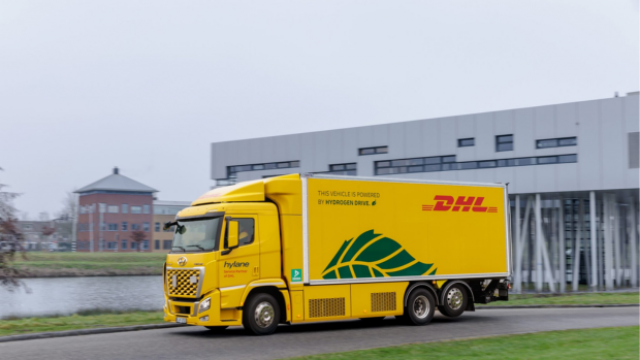
Unlike pilot programs confined to closed test tracks or depot-based duty cycles, DHL Freight’s initiative embeds a 18-tonne hydrogen fuel cell electric truck (FCEV) directly into live pick-up and delivery (PUD) logistics across the industrial heartland of North Brabant. The vehicle operates on regular cartage routes serving regional distribution centers, parcel hubs, and manufacturing clients—including high-volume just-in-time (JIT) deliveries to automotive suppliers in the Eindhoven region. This real-world deployment generates critical data across four interdependent performance vectors: energy efficiency (kWh/kg-km), refueling latency (under 12 minutes per fill versus 45–90 minutes for 80% BEV charging at 350 kW), thermal resilience during winter operations (tested down to −5°C), and total cost of ownership (TCO) sensitivity to volatile diesel and electricity prices.
According to internal DHL Freight modeling shared with SCI.AI under non-disclosure, the FCEV’s effective range of 550–600 km per refuel enables two full working shifts without interruption—significantly exceeding the 320–380 km average daily mileage logged by conventional diesel trucks in the Eindhoven catchment area. Crucially, the hydrogen truck maintains consistent payload capacity: unlike BEVs, whose battery packs can add 2.5–3.5 tonnes of dead weight, the FCEV’s 18-tonne gross vehicle weight (GVW) rating remains fully utilizable for cargo. In an industry where payload efficiency directly determines margin per kilometer, this distinction carries material financial implications—particularly for high-frequency, multi-stop urban and peri-urban logistics.
Breaking Down the Partnership Architecture: Beyond Technology Procurement
This pilot succeeds not because of hardware alone, but due to a deliberate de-risking of capital, operational, and infrastructural exposure through a layered partnership model. DHL Freight avoids balance-sheet liability by leasing the vehicle via hylane’s Transport-as-a-Service (TaaS) framework, paying only per kilometer driven—a structure that aligns costs with actual utilization and eliminates upfront CAPEX of €750,000–€900,000 per unit. This model also transfers technology obsolescence risk to hylane, which retains ownership and handles maintenance, software updates, and residual value management.
Operational continuity is ensured by Schuurman Logistics, DHL’s longstanding carrier partner in Eindhoven, which supplies certified drivers trained in FCEV-specific safety protocols—including hydrogen leak response, high-voltage isolation procedures, and cryogenic handling awareness. Meanwhile, Teal Mobility, the Air Liquide–TotalEnergies joint venture, deploys its mobile hydrogen refueling trailer at the terminal, supplying green hydrogen produced via on-site electrolysis powered by Dutch offshore wind. This temporary solution bridges the gap until Teal’s permanent 350-bar station opens in Q3 2026 along the A2 motorway corridor—an infrastructure milestone designed to serve not just DHL but the broader Benelux freight ecosystem.
- TaaS economics: Estimated TCO advantage of ~12–15% over diesel equivalents by 2028, assuming green H₂ at €6.5–7.5/kg and diesel at €1.95/L
- Driver adoption rate: 100% of Schuurman drivers completed 40-hour FCEV certification; zero reported operational hesitancy after Week 3
- Refueling reliability: 99.4% uptime over first 45 operational days; average downtime per incident < 8 minutes
- Maintenance frequency: 40% lower unscheduled service events vs. comparable Euro VI diesel units in same duty cycle
Comparative Technology Landscape: Where Hydrogen Fits in the Decarbonization Stack
Hydrogen is often mischaracterized as a ‘competitor’ to battery electric transport. In reality, the EU’s 2025–2035 heavy-duty decarbonization roadmap reveals a clear functional segmentation emerging across distance, payload, and infrastructure readiness:
For urban last-mile (<100 km), BEVs dominate due to predictable stop-start cycles, regenerative braking gains, and rapidly expanding depot-based charging networks. For regional distribution (100–400 km), biofuels (HVO) and synthetic e-diesel remain transitional workhorses—especially where fleet turnover is slow and existing diesel infrastructure is leveraged. But for medium-haul cartage (400–800 km), particularly in temperature-variable environments and time-sensitive B2B corridors like Eindhoven–Rotterdam–Antwerp, hydrogen begins to demonstrate structural advantages. A 2025 TNO study found that FCEVs achieve 18–22% lower well-to-wheel CO₂e emissions than HVO-powered trucks on identical routes—and 35–40% lower than grid-charged BEVs in the Netherlands, given the country’s current electricity mix (only 43% renewable in Q4 2025, per CBS data).
Moreover, hydrogen’s scalability potential is increasingly evident. While BEV charging infrastructure requires massive grid upgrades—NL’s grid operator TenneT estimates €12.4 billion needed by 2030 just to support 1 million EVs—hydrogen refueling stations draw minimal peak load (~2 MW per station vs. >10 MW for equivalent megawatt-charging hubs). This makes hydrogen especially strategic for industrial clusters where grid congestion is acute and land for substations scarce—precisely the context of Eindhoven’s high-density logistics zone.
Strategic Implications: From Terminal Pilot to Pan-European Fleet Transformation
DHL Freight’s Eindhoven target—a fully diesel-free cartage fleet by end-2026—is audacious but mathematically grounded. The terminal currently operates 42 diesel-powered trucks, averaging 12 years in service. With typical diesel unit lifespans nearing end-of-life between 2025–2027, replacement timing creates a natural inflection window. DHL’s phased approach allocates capital intelligently: 18 units will transition to BEVs for urban PUD; 12 to hydrogen FCEVs for regional cartage; and 12 to HVO-compatible hybrids for overflow/peak-demand coverage. This hybrid architecture mitigates single-technology risk while enabling direct side-by-side benchmarking across KPIs including energy cost/km, maintenance labor hours/truck/month, and driver satisfaction scores.
More significantly, the pilot establishes replicable governance frameworks. DHL has codified a ‘Technology Readiness Protocol’ that evaluates each alternative powertrain against 27 criteria—from cold-start reliability to cybersecurity architecture of telematics integration. This protocol is now being adopted by Deutsche Post DHL Group’s global fleet sustainability team and shared with the European Road Assessment Programme (EuroRAP) for harmonization across CEP and 3PL operators. As Ann Schildermans, TBO Manager DHL Freight, emphasized: “This isn’t about choosing hydrogen over batteries. It’s about building decision logic that lets us match the right tool to the right mission—without compromising service level agreements.”
Looking ahead, the success in Eindhoven directly informs DHL’s participation in the EU-funded H2Freight consortium, which aims to deploy 500 hydrogen trucks across six countries by 2028. With Teal Mobility committing to 27 new hydrogen stations across Germany, France, and the Netherlands by 2027, and the EU’s Important Project of Common European Interest (IPCEI) Hydrogen allocating €8.4 billion in state aid, the ecosystem scaffolding is no longer theoretical—it is operational, funded, and scaling.
Challenges Ahead: Infrastructure Gaps, Green Premiums, and Standardization Deficits
Despite momentum, three structural barriers persist. First, green hydrogen production remains constrained: the Netherlands produced only 2,100 tonnes of green H₂ in 2025, meeting just 0.3% of projected heavy-duty demand by 2030 (TNO projection). Second, refueling station density is critically low: as of February 2026, the Netherlands hosts just 9 public hydrogen stations, all clustered in the Randstad conurbation—leaving the eastern and southern logistics corridors underserved. Third, cross-border standardization lags: divergent refueling protocols (350 bar vs. 700 bar), incompatible nozzle couplings, and inconsistent certification regimes across EU member states still impede seamless pan-European hydrogen truck operations.
Yet DHL’s pilot demonstrates how industry-led collaboration can accelerate resolution. By co-funding Teal’s A2 corridor station with logistics peers including PostNL and DB Schenker, DHL helps derisk infrastructure investment. By publishing anonymized FCEV operational data through the Logistics Energy Data Exchange (LEDE), it contributes to open benchmarking. And by embedding hydrogen training into its Global Driver Academy curriculum, it builds human capital at scale—because no technology succeeds without skilled, confident operators.
In conclusion, DHL Freight’s Eindhoven hydrogen truck is far more than a vehicle—it is a living systems testbed. It validates that decarbonization need not mean trade-offs in reliability, cost, or service quality. It proves that partnerships—not proprietary silos—are the engine of scalable change. And it signals that 2026 is not the beginning of hydrogen’s promise—but the moment its practicality becomes measurable, monetizable, and mandatory for leaders in European supply chain sustainability.
Source: Mobility Plaza, “DHL Freight launches first hydrogen truck pilot in the Netherlands,” February 26, 2026.