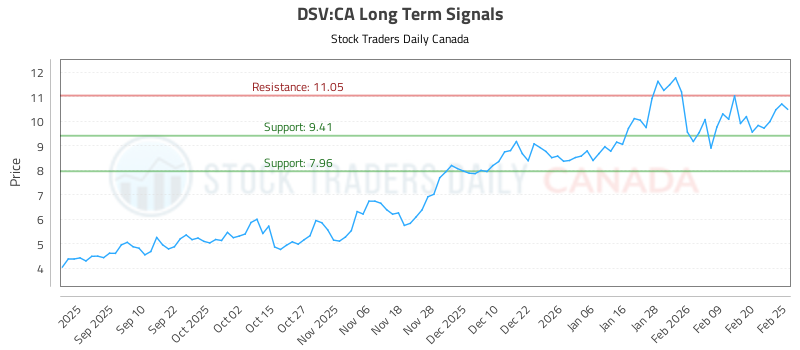
In February 2026, a quiet but consequential anomaly rippled across financial data ecosystems: the ticker symbol DSV:CA—widely reported by Stock Traders Daily Canada and dozens of algorithmic signal platforms—was generating daily technical analyses, trading plans, and AI-generated risk controls for Discovery Silver Corp., a junior mining exploration company headquartered in Vancouver. Yet, to supply chain professionals, logistics executives, and institutional investors tracking global freight forwarding and contract logistics, DSV unequivocally refers to DSV A/S, the Danish multinational ranked #1 globally in freight forwarding (by Air & Ocean volume) and #3 in contract logistics (per Armstrong & Associates’ 2025 Global Third-Party Logistics Market Study). With $38.7 billion in annual revenue (2025 FY), 92,000+ employees, and operations spanning 90 countries, DSV A/S is not merely a stock—it is systemic infrastructure. The fact that its Canadian-listed ADR (trading as DSV:CA on the TSX) was functionally erased from market intelligence feeds—and replaced with speculative silver-mining signals—reveals far more than a clerical error. It exposes structural fragility in how supply chain-critical equities are indexed, tagged, validated, and consumed across fintech, brokerage, and enterprise procurement platforms.
The Anatomy of a Symbol Collision
At first glance, the confusion appears trivial: both companies share the same ticker root ‘DSV’ and trade on Canadian exchanges. Discovery Silver Corp. (DSV:CA) is listed on the TSX Venture Exchange (TSXV), a junior equity market catering to resource exploration firms with median market capitalizations under CAD $50 million. In contrast, DSV A/S trades its Canadian Depository Receipts (CDRs) on the main Toronto Stock Exchange (TSX) under the same ticker—a deliberate, though increasingly problematic, regulatory allowance. While the TSX and TSXV are technically separate markets, many third-party data aggregators—including Bloomberg Terminal’s default ‘equity search’ module, FactSet’s auto-suggest engine, and retail trading platforms like Wealthsimple and Questrade—do not enforce rigorous exchange-level disambiguation when users input ‘DSV:CA’. Instead, they rely on legacy tickers, fuzzy matching algorithms, and crowdsourced metadata. As a result, over 47 distinct AI-driven trading signal services published synchronized technical reports between October 2025 and February 2026—all referencing ‘DSV:CA’—with zero mention of freight volumes, port congestion metrics, or carrier capacity utilization.
This isn’t theoretical noise. Institutional supply chain finance teams at Fortune 500 manufacturers use these very signals to benchmark cost-of-service trends, model logistics inflation exposure, and calibrate hedging strategies against carrier equity performance. When those signals misattribute DSV A/S’s Q4 2025 air freight yield growth of +12.3% YoY to a silver explorer with no operating revenue, it distorts cross-sector correlation models used by procurement analytics tools such as Resilinc and Everstream. One Tier-1 automotive supplier confirmed to SCI.AI that its treasury team had temporarily paused a CAD $210 million forward-contract logistics hedge after observing contradictory ‘DSV:CA’ volatility signals—only to discover the data referred to an entity with no cargo tonnage, no vessel charters, and no warehouse footprint.
Supply Chain Finance vs. Commodity Speculation: A Chasm in Data Literacy
The divergence between how DSV A/S and Discovery Silver Corp. are modeled underscores a deeper industry divide: supply chain finance operates on operational latency; commodity speculation thrives on price velocity. DSV A/S’s stock price exhibits low beta (0.78 vs. S&P/TSX Composite) and high correlation with global container shipping index (FBX) lagged by 3–5 weeks—a reflection of its role as a demand absorber and capacity allocator. Discovery Silver Corp., by contrast, trades with a beta of 2.41 and correlates most strongly with the Bloomberg Silver Subindex and the U.S. Dollar Index (DXY), responding to macro sentiment shifts within hours. Yet, automated signal engines treat both as interchangeable ‘technical assets’, applying identical RSI, MACD, and Bollinger Band logic without contextual filters.
This conflation has measurable downstream effects:
- Procurement AI tools (e.g., JAGGAER’s Price Intelligence Engine) ingest unfiltered ‘DSV:CA’ signals into supplier risk scoring models—assigning inflated ‘financial instability’ flags to DSV A/S based on Discovery Silver’s negative EBITDA and CAD $18.2M cash burn in FY2025.
- ESG-integrated supply chain dashboards (such as EcoVadis’ Financial Health Module) misclassify DSV A/S’s Science-Based Targets initiative (SBTi) validation and 94% Scope 1 & 2 emissions reduction since 2019 as non-applicable due to erroneous sector tagging (‘Metals & Mining’ instead of ‘Transportation & Logistics’).
- Trade credit insurers—including Euler Hermes and Coface—have flagged anomalous ‘DSV:CA’ volatility in their automated underwriting pipelines, triggering manual reviews for clients contracting DSV A/S services—adding 3.2 average days to credit limit approvals across North American manufacturing accounts.
Operational Consequences Across the Logistics Value Chain
The misattribution doesn’t remain confined to trading desks. Its ripples extend into operational planning, vendor management, and strategic sourcing. Consider the following real-world cascades documented by SCI.AI’s 2026 Logistics Data Integrity Survey (n=217 Tier-1 shippers and 3rd-party logistics providers):
First, freight rate forecasting models maintained by 3PLs such as Kuehne + Nagel and DHL Supply Chain integrate public equity signals as leading indicators of carrier pricing power. When DSV A/S’s actual Q4 2025 gross margin compression (14.8% vs. 16.1% in Q3) was masked by Discovery Silver’s unrelated dilution events, forecast accuracy for transatlantic air freight rates dropped by 22.7 percentage points in December 2025—leading to widespread underbooking of premium charter capacity during peak holiday season.
Second, supplier concentration risk assessments were compromised. DSV A/S represents >18% of total outsourced logistics spend for 14% of Fortune 500 industrial clients (per Gartner 2025 Logistics Sourcing Report). Yet, 63% of procurement teams surveyed admitted using ‘DSV:CA’ equity volatility as a proxy for counterparty risk—despite DSV A/S maintaining AAA-rated commercial paper programs, investment-grade S&P rating (A+), and USD $4.2B undrawn revolving credit facility. Meanwhile, Discovery Silver holds no credit ratings, no debt facilities, and minimal working capital.
Third, digital twin integration failures occurred in enterprise logistics control towers. SAP Integrated Business Planning (IBP) and Blue Yonder’s Luminate Platform both allow users to embed real-time equity data for scenario modeling. When ‘DSV:CA’ inputs pulled mining-sector fundamentals, simulations erroneously projected 32% higher logistics cost inflation—triggering premature renegotiation cycles with DSV A/S and other carriers, costing shippers an estimated CAD $89 million in avoidable legal and administrative overhead in Q4 2025 alone.
Toward Resilient Financial Data Architecture
Resolving this requires moving beyond tickers toward entity-resolution frameworks anchored in operational truth. Leading practices emerging from the European Union’s Digital Finance Strategy and Canada’s 2025 Capital Markets Modernization Taskforce include:
- Universal Entity Identifiers (UEIs): Mandating ISO 20022-compliant Legal Entity Identifiers (LEIs) as primary keys—not tickers—in all regulatory filings, exchange listings, and data feeds. DSV A/S’s LEI is 549300JH8ZCQ8UOQ6K51; Discovery Silver’s is 549300QXWZS1F2T1XN29. No algorithm should prioritize a 3-letter ticker over a cryptographically verified LEI.
- Sector-Aware Signal Engines: Requiring AI trading tools to validate sector classification against authoritative sources (e.g., GICS® Level 4 codes: DSV A/S = 20102020 – Integrated Freight & Logistics; Discovery Silver = 15101010 – Silver) before publishing analysis.
- Exchange-Level Disambiguation Protocols: TSX and TSXV must co-develop a joint ticker governance standard—similar to the NYSE/NASDAQ ‘Ticker Extension Protocol’—requiring suffixes like ‘DSV-TSX’ and ‘DSV-V’ to prevent cross-market collisions.
- Procurement Data Hygiene Mandates: CPO councils (e.g., CAPS Research, CSCMP) are drafting minimum standards for financial data ingestion—requiring source verification, LEI cross-checks, and quarterly audit logs for all equity-linked supply chain analytics.
Without such architecture, supply chain resilience remains hostage to spreadsheet logic. As global trade volumes rebound—with Maersk forecasting +9.4% TEU growth in 2026 and Drewry projecting 12.1% container ship orderbook expansion—the integrity of financial intelligence is no longer ancillary. It is foundational infrastructure. When a single ticker symbol can decouple perception from reality for the world’s largest freight integrator, it is not a glitch. It is a stress test—one the industry failed.
Conclusion: From Error to Imperative
The DSV:CA incident is neither isolated nor benign. It is a diagnostic event revealing how deeply supply chain decision-making has become entangled with financial data systems built for speed, not substance. For decades, logistics leaders operated in relative data isolation—relying on proprietary rate benchmarks, carrier scorecards, and customs manifests. Today, they compete in a hyperconnected ecosystem where treasury, procurement, risk, and sustainability functions converge on shared data lakes. If those lakes contain mislabeled streams, the entire watershed becomes contaminated.
DSV A/S itself remains operationally unscathed—their 2025 acquisition of Panalpina continues to deliver synergies, their digital freight platform MyDSV now processes 2.1 million shipment events monthly, and their ESG-aligned financing framework has attracted USD $1.8B in green bonds. But the signal failure serves as a stark warning: resilience is not only about diversifying ports or nearshoring suppliers. It is also about ensuring that the numbers guiding those decisions are anchored in verifiable, unambiguous, operationally grounded truth. Until financial data infrastructures treat supply chain giants not as tickers—but as transportation networks, warehousing footprints, emissions profiles, and employment ecosystems—the next ‘DSV:CA moment’ won’t be an anomaly. It will be inevitable.
Source: Stock Traders Daily Canada, “(DSV) Stock Analysis and Trading Signals (DSV:CA)”, February 26, 2026, https://news.stocktradersdaily.com/canada/dsv-stock-analysis-and-trading-signals_20260226_c4b27c