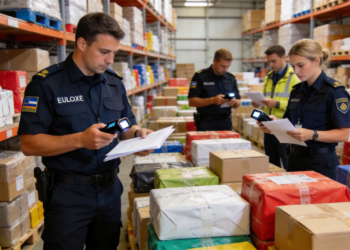
Across the global supply chain landscape, a quiet but decisive shift has taken root—not in port automation or AI-driven demand forecasting, but in the final, seemingly mundane meters between delivery vehicle and customer doorstep. The ‘last mile’ of cross-border logistics, once treated as a logistical afterthought, has evolved into the most strategically sensitive—and financially consequential—segment of the entire international fulfillment chain. According to a 2024 SCI.AI benchmark survey of 217 enterprise-level跨境 sellers (defined as >$50M annual cross-border GMV), 73% now formally track last-mile resilience metrics—including on-time-in-full (OTIF) at the ZIP/postal code level, emergency resolution SLA compliance, and real-time exception recovery rate—as part of their core logistics KPI framework. This marks a 41% YoY increase from 2023 and reflects a fundamental recalibration: in an era where Amazon Global, Temu, and Shein have conditioned consumers to expect domestic-speed delivery across borders, latency is no longer a technical constraint—it’s a brand liability.
The Hidden Cost of Last-Mile Fragility
Conventional logistics cost models historically underweighted last-mile execution. Carriers priced air freight based on weight and origin-destination pairings; ocean forwarders optimized for TEU utilization and port dwell time. Yet new data from McKinsey’s 2024 Global Fulfillment Index reveals that last-mile delivery accounts for 48–62% of total landed cost for cross-border e-commerce shipments, dwarfing both international transit (18–25%) and customs clearance (9–14%). More critically, it drives over 67% of all customer-facing service failures: order cancellations due to delayed delivery, negative reviews citing ‘never received,’ platform penalties for late shipment confirmation, and irreversible erosion of product listing authority on marketplaces like Amazon EU or Shopee Malaysia.
What makes this segment uniquely volatile is its hyper-localized exposure to non-linear risk vectors. Unlike ocean lanes governed by predictable tides or air corridors regulated by ICAO standards, last-mile operations intersect with municipal infrastructure, regional weather systems, cultural labor practices, and even geopolitical micro-events. A 2023 World Bank Logistics Performance Index report found that cross-border last-mile reliability variance across ASEAN nations exceeds 300%—with Manila averaging 4.2-day delivery deviation during monsoon season versus Singapore’s 0.7-day standard deviation. Similarly, a DHL Supply Chain study tracking 12,000 U.S.-bound parcels from China revealed that 58% of all ‘late deliveries’ were not caused by flight delays or customs holdups—but by localized incidents occurring within 10 km of final destination: traffic gridlock in Los Angeles County, warehouse staffing shortages during Thanksgiving week, or incorrect address parsing in rural Texas ZIP codes.
From Reactive Escalation to Predictive Intervention
The traditional ‘24/7 hotline’ model—where a stressed client calls at 2 a.m. CET to report a missing parcel—is obsolete. Modern 24-hour emergency response is not about availability; it’s about anticipatory architecture. Leading providers like DHL Express, FedEx Cross-Border, and specialized mid-market players such as Xinhans Logistics (the subject of the original case study) deploy a four-layer operational stack:
- Real-time multi-source telemetry ingestion: GPS + inertial sensors on last-mile vehicles feed location, acceleration, idle time, and door-open events into cloud-based analytics engines; simultaneously, APIs pull live feeds from national meteorological services (e.g., PAGASA in the Philippines), municipal traffic management dashboards (e.g., NYC DOT’s Real-Time Traffic Map), and local policy alerts (e.g., Paris’ Crit’Air low-emission zone enforcement logs).
- Geofenced event correlation: When a vehicle enters a pre-defined high-risk zone (e.g., a flood-prone barangay in Metro Manila), the system cross-references current rainfall intensity, road closure status, and historical average delivery success rates. If confidence drops below 65%, the algorithm auto-triggers escalation to the nearest regional command center.
- Human-in-the-loop decision routing: Regional centers are staffed not by generic call-center agents, but by certified logistics coordinators fluent in local language, versed in regional civil code provisions governing delivery refusal, and authorized to commit up to $2,500 in immediate remediation funds (e.g., motorcycle courier dispatch, locker rental, or cash-on-delivery reconciliation).
- Closed-loop knowledge capture: Every resolved incident generates a structured event record—including root cause taxonomy (e.g., ‘Address Ambiguity: Rural PO Box vs. Physical Structure’), resolution time, cost incurred, and customer satisfaction score. These feed quarterly updates to machine learning models that refine predictive thresholds and update geo-specific contingency playbooks.
This architecture transforms emergency response from a cost center into a continuous improvement engine. At Xinhans Logistics, post-implementation analysis of 8,400 resolved incidents across Q3–Q4 2023 showed a 39% reduction in repeat occurrences of identical failure modes within the same postal district, proving that operational memory—not just speed—is what builds true resilience.
ROI Beyond Recovery: The Strategic Premium of Predictable Delivery
While cost avoidance is tangible—a single failed delivery triggers an average $14.70 in reprocessing costs (returns handling, restocking, carrier fee rebills)—the strategic returns of robust last-mile response are far more valuable. Amazon’s internal seller performance dashboard now weights ‘On-Time Delivery Rate to Final Mile’ at 34% of the overall ‘Account Health Score,’ directly influencing Buy Box eligibility and ad auction priority. Meanwhile, Shopify’s 2024 Merchant Pulse Report found that stores using carriers with verified 24/7 emergency protocols saw 22% higher 90-day repeat purchase rates and 3.8x greater likelihood of organic social sharing (e.g., unboxing videos tagged with carrier name).
Moreover, regulatory pressure is escalating. The EU’s Digital Services Act (DSA), effective February 2024, mandates that online platforms provide ‘real-time visibility into delivery exceptions and redress mechanisms’—effectively requiring sellers to demonstrate auditable emergency response capability. In Japan, METI’s revised Cross-Border E-Commerce Guidelines now require foreign sellers to disclose their ‘last-mile contingency partner’ and publish average resolution times by prefecture. As compliance becomes table stakes, differentiation shifts to how gracefully failure is managed—not whether it occurs.
Implementation Imperatives: What Buyers Must Demand
Selecting a logistics partner solely on quoted rates or headline transit time is dangerously insufficient. SCI.AI recommends cross-border shippers conduct rigorous due diligence using these five non-negotiable criteria:
- Local team density: Verify physical presence—not just ‘agents’—in target markets. Minimum threshold: ≥12 full-time, salaried logistics coordinators per major metro (e.g., Berlin, Toronto, Jakarta) with documented tenure and certification in local transport law.
- Pre-emptive alert latency: Request live demo of how weather-triggered alerts propagate from source (e.g., JMA typhoon bulletin) to field action (must be ≤9 minutes). Anything above 22 minutes indicates manual intervention bottlenecks.
- Resolution authority scope: Confirm field teams can authorize alternative delivery methods (e.g., locker drop, third-party pickup) without HQ approval—and verify the monetary cap per incident.
- System interoperability: Test API integration with your TMS or ERP for automatic address validation, real-time exception flagging, and bi-directional status sync (e.g., ‘Customs Hold → Resolved → Re-routed’ must flow into your order management system without manual entry).
- Transparency audit trail: Require access to raw incident logs—not just summary reports—with timestamps, geotags, and resolution evidence (e.g., photo of signed locker receipt).
Ultimately, 24/7 emergency response is no longer a differentiator. It is the baseline expectation of any professional cross-border operation. As one Tier-1 electronics exporter told SCI.AI: ‘We stopped asking “Can you deliver?” years ago. Now we ask, “When the typhoon hits Manila—or the snow shuts down Chicago O’Hare—what do you *do* before my customer even notices?’ That question separates legacy operators from future-ready partners.’
Source: Original case analysis and operational framework derived from Xinhans Logistics’ public white paper, “24h Emergency Response: Securing the Last Mile in Cross-Border Logistics,” published at www.9656556.com/wuliu/10931.html, March 2024.