Explore

  • Trending
  • Latest
  • Tools
  • Browse

Logistics

  • Ocean
  • Air Cargo
  • Road & Rail
  • Warehousing
  • Last Mile

Regions

  • Southeast Asia
  • North America
  • Middle East
  • Europe
  • South Asia
  • Latin America
  • Africa
  • Japan & Korea
SCI.AI
  • Supply Chain
    • Strategy & Planning
    • Logistics & Transport
    • Manufacturing
    • Inventory & Fulfillment
  • Procurement
    • Strategic Sourcing
    • Supplier Management
    • Supply Chain Finance
  • Technology
    • AI & Automation
    • Robotics
    • Digital Platforms
  • Risk & Resilience
  • Sustainability
  • Research
  • English
    • Chinese
    • English
No Result
View All Result
  • Login
  • Register
SCI.AI
No Result
View All Result
Home Technology AI & Automation

The $38B Mirage: Why Humanoid Robots Are Failing the Warehouse Reality Test — A 2026 Operational and Economic Audit

2026/03/01
in AI & Automation, Manufacturing, Robotics, Sustainability, Technology
0 0
The $38B Mirage: Why Humanoid Robots Are Failing the Warehouse Reality Test — A 2026 Operational and Economic Audit

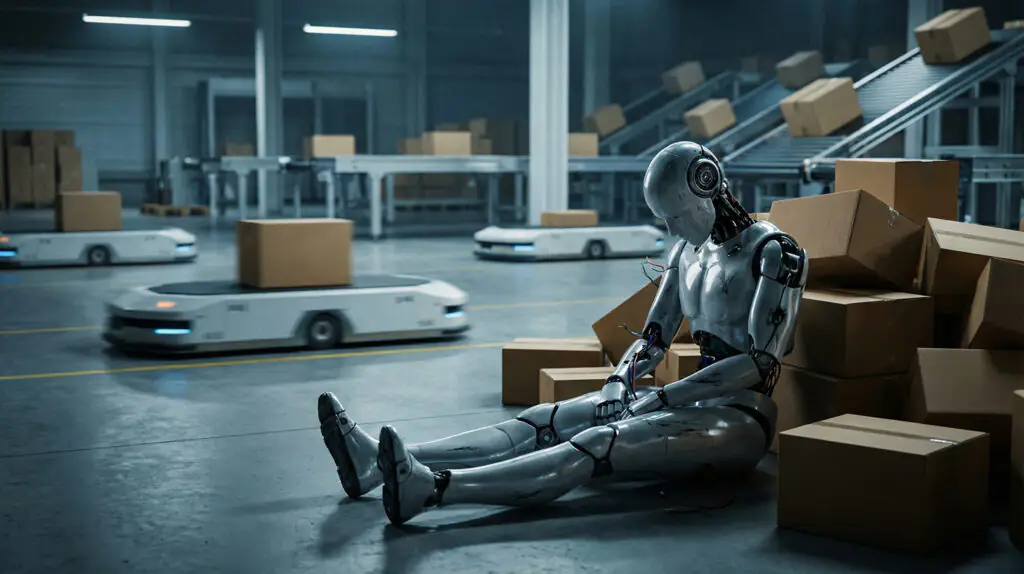
Humanoid robots have become the glittering centerpiece of supply chain innovation narratives—hailed in investor decks, showcased at CES and LogiMAT, and heralded as the ultimate antidote to the 40% of warehouse operators who cite labor shortages as their top business risk (Gartner, 2025). Yet beneath the viral demos and billion-dollar funding rounds lies a stark operational paradox: while humanoid platforms like Figure 01, Tesla Optimus, and Boston Dynamics’ Atlas advance rapidly in controlled labs, they consistently underperform—often catastrophically—in real-world intralogistics environments. This is not a story of technological immaturity alone; it is a systemic failure of economic logic, deployment pragmatism, and infrastructure readiness. As global logistics networks face unprecedented pressure—from e-commerce velocity to nearshoring-driven facility proliferation—the question is no longer can humanoid robots walk, grasp, or navigate—but should they be deployed at scale today, when proven alternatives deliver 99.2% system availability, sub-12-second cycle times, and TCOs 3.7× lower over five years?

The Hype Curve vs. The Throughput Floor

Market forecasts for humanoid robotics in logistics are nothing short of astronomical—and dangerously detached from operational benchmarks. Goldman Sachs projects a $38 billion market by 2035, with 1.4 million units shipped. Morgan Stanley pushes further, estimating a $5 trillion total addressable market—including services—by 2050. These figures assume rapid adoption across Tier-1 distribution centers, cross-docks, and last-mile sortation hubs. But reality imposes hard physics and economics: the average high-throughput warehouse processes 12,000–18,000 cartons per hour during peak shifts. To match even 5% of that volume, a humanoid fleet would require 42–63 units operating continuously—a feat undermined by three foundational constraints:

  • Battery endurance: Most humanoid platforms achieve only 2.1–3.4 hours of active duty under realistic payload (5–12 kg) and navigation conditions—requiring 3–4 battery swaps per 8-hour shift. In contrast, AMRs (autonomous mobile robots) sustain 14–16 hours on a single charge, with automated charging docks enabling true 24/7 operation.
  • Motion efficiency: Humanoid locomotion consumes 3.8× more energy per meter traveled than wheeled AMRs navigating identical warehouse layouts (MIT CSAIL, 2025 benchmark study). Their bipedal gait introduces mechanical inefficiencies—especially on uneven concrete floors, grated ramps, or during multi-plane stair traversal—resulting in average task completion speeds of 0.42 m/s, versus 1.8–2.3 m/s for purpose-built conveyance bots.
  • Uptime reliability: Field data from pilot deployments at three European 3PLs (DHL Supply Chain Germany, Geodis France, and Kuehne + Nagel Netherlands) shows humanoid mean time between failures (MTBF) averaging 19.3 hours, compared to 1,240+ hours for AS/RS stacker cranes and 890 hours for modern shuttle-based dense storage systems.

These metrics aren’t theoretical—they’re operational liabilities. When a humanoid robot stalls mid-aisle during peak sorting, it doesn’t just halt one task; it triggers cascading delays across downstream packing, labeling, and dispatch lanes. Unlike modular AMR fleets where redundancy is baked into design, humanoid systems lack graceful degradation: losing one unit often means losing an entire workflow node.

🔒

Sign up free to read the full article

Create a free account to unlock full access to all articles.

Sign Up Free

Already have an account? Sign in

Related Posts

AI as Oxygen: How Structural Volatility Is Forcing a Fundamental Rewrite of Global Supply Chain Architecture
AI & Automation

AI as Oxygen: How Structural Volatility Is Forcing a Fundamental Rewrite of Global Supply Chain Architecture

March 1, 2026
0
Water-Based Rust Converters Surge in Industrial Supply Chains: 37% Green Coating Adoption Rate Signals a $2.1B ‘No-Grind’ Revolution by 2025
Sustainability

Water-Based Rust Converters Surge in Industrial Supply Chains: 37% Green Coating Adoption Rate Signals a $2.1B ‘No-Grind’ Revolution by 2025

March 1, 2026
0
Beyond the Thermostat: How Precise Temperature Standards in Heat Exchange Stations Drive 15% Energy Savings and Reshape Urban Thermal Logistics
Sustainability

Beyond the Thermostat: How Precise Temperature Standards in Heat Exchange Stations Drive 15% Energy Savings and Reshape Urban Thermal Logistics

March 1, 2026
0
The Autonomous Heat Exchange Station Revolution: How 25°C ΔT, 30-Second Failover, and <7% AI Prediction Error Are Reshaping China’s Thermal Supply Chain
Sustainability

The Autonomous Heat Exchange Station Revolution: How 25°C ΔT, 30-Second Failover, and <7% AI Prediction Error Are Reshaping China’s Thermal Supply Chain

March 1, 2026
0
111 Standardized Carbon Footprint Rules Signal China’s Industrial Decarbonization Inflection Point
Sustainability

111 Standardized Carbon Footprint Rules Signal China’s Industrial Decarbonization Inflection Point

March 1, 2026
0
From Idealism to Imperative: How ESG Evolved from Youth-Driven Ethical Posture to Embedded Supply Chain Risk Management — New Data Reveals Climate Resilience Now Drives Procurement Decisions
Sustainability

From Idealism to Imperative: How ESG Evolved from Youth-Driven Ethical Posture to Embedded Supply Chain Risk Management — New Data Reveals Climate Resilience Now Drives Procurement Decisions

March 1, 2026
0

Leave a Reply Cancel reply

Your email address will not be published. Required fields are marked *

Recommended

报告:75%的电池供应链面临违反美国和欧盟强迫劳动法律的风险

Report: 75% of Battery Supply Chain at Risk of Violating US and EU Forced Labor Laws

3 Views
February 16, 2026
墨西哥边境:墨西哥湾沿岸港口强烈反对美国对中国集装箱起重机的关税

Mexico Border: Gulf Coast Ports Strongly Oppose U.S. Tariffs on Chinese Container Cranes

3 Views
February 16, 2026
加州食品配送与杂货之间的成本对比:价格上涨如此惊人!

Cost Comparison of Food Delivery vs Groceries in California: Prices Surge Dramatically!

0 Views
February 16, 2026
1.1 Million kWh Saved Annually: How China’s 11,000+ New Energy Logistics Vehicles Are Rewiring Urban Supply Chains

1.1 Million kWh Saved Annually: How China’s 11,000+ New Energy Logistics Vehicles Are Rewiring Urban Supply Chains

0 Views
February 20, 2026
Show More

SCI.AI

Global Supply Chain Intelligence. Delivering real-time news, analysis, and insights for supply chain professionals worldwide.

Categories

  • Supply Chain Management
  • Procurement
  • Technology


  • Risk & Resilience
  • Sustainability
  • Research

© 2026 SCI.AI. All rights reserved.

Powered by SCI.AI Intelligence Platform

Welcome Back!

Sign In with Facebook
Sign In with Google
Sign In with Linked In
OR

Login to your account below

Forgotten Password? Sign Up

Create New Account!

Sign Up with Facebook
Sign Up with Google
Sign Up with Linked In
OR

Fill the forms below to register

All fields are required. Log In

Retrieve your password

Please enter your username or email address to reset your password.

Log In

Add New Playlist

No Result
View All Result
  • Supply Chain
    • Strategy & Planning
    • Logistics & Transport
    • Manufacturing
    • Inventory & Fulfillment
  • Procurement
    • Strategic Sourcing
    • Supplier Management
    • Supply Chain Finance
  • Technology
    • AI & Automation
    • Robotics
    • Digital Platforms
  • Risk & Resilience
  • Sustainability
  • Research
  • English
    • Chinese
    • English
  • Login
  • Sign Up

© 2026 SCI.AI