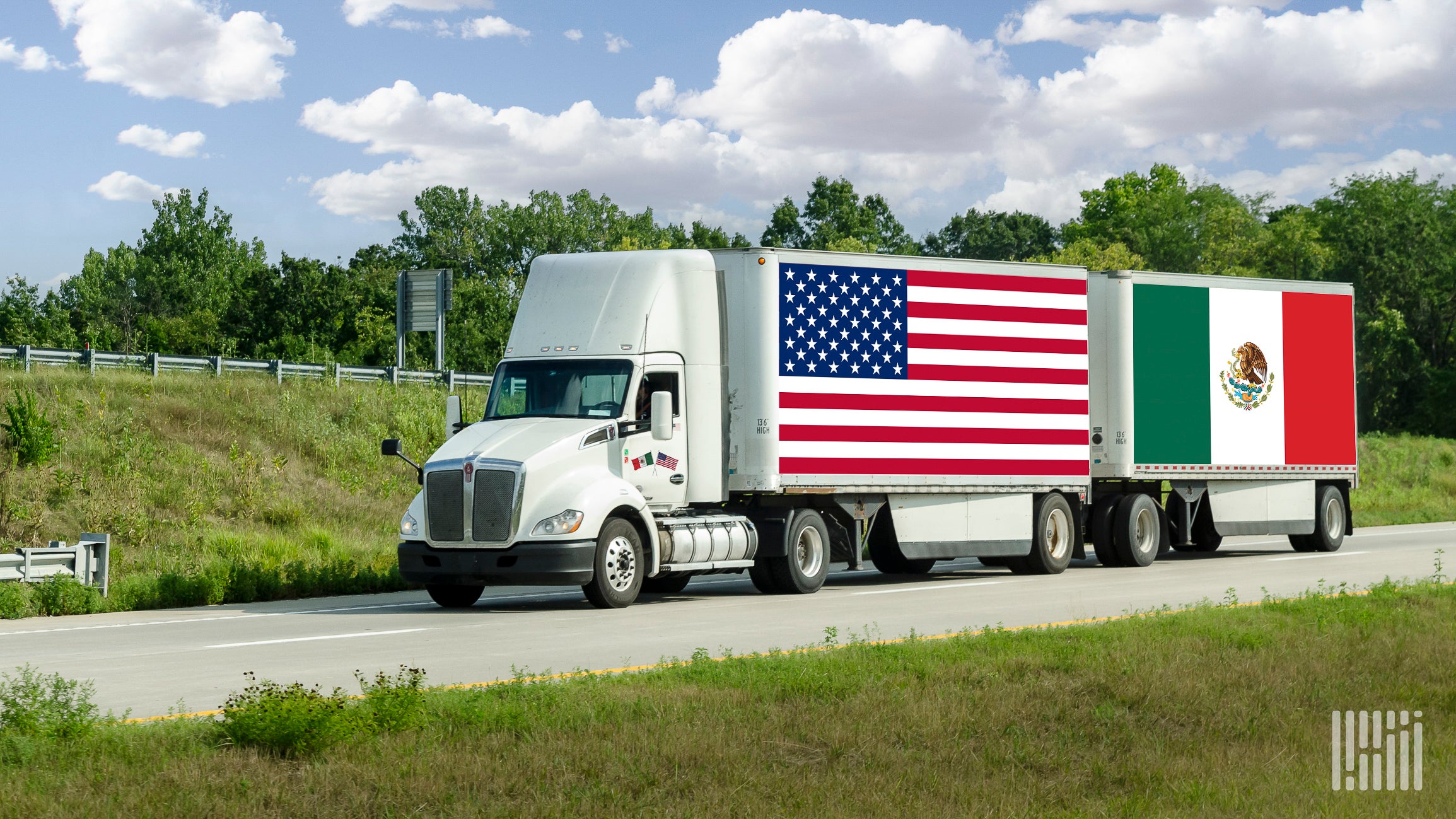
With the continuous growth in trade volume between Mexico and the United States, Cargado’s CEO and co-founder Matt Silver launched a pioneering invitation-only freight platform on Monday, specifically handling shipments entering and leaving Mexico.
Silver stated that customers can use Cargado to book freight faster and more transparently as the entire negotiation process takes place on the platform.
“We are thrilled to finally share the fact that we have been building an invitation-only cross-border freight platform,” Silver told FreightWaves. “Our goal is to create a system that allows people to collaborate, communicate, and do business together. We want people to rethink the concept of freight platforms introduced by Cargado into the market. It is purely for cross-border freight.”
Cargado’s platform already has over 50 logistics customers (including freight forwarders, third-party logistics providers, and brokers) who can post their cross-border shipments and receive bids from more than 300 cross-border trucking companies.
Freight forwarders can publish Mexican cross-border shipments on the Cargado platform, whether it’s from Mexico to the U.S., Mexico to Canada, or vice versa.
“Whenever Mexico is involved, freight forwarders can post their loads. Invited trucking companies bid on these loads through personal networks or recommendations and then negotiate via the platform,” Silver said. “Once matched, freight forwarders return to their TMS systems, send rate confirmations, and continue with standard compliance checks. However, this experience is quite different from what people are accustomed to in terms of tech interactions.”
Customers can post spot loads and ongoing opportunities such as requests for quotes or small bids from Canada and the U.S. to Mexico, which are referred to as freight lanes on Cargado.
Freight forwarders, third-party logistics providers, or brokers can register on Cargado’s website to join the waitlist and receive a demonstration of the freight platform.
Once approved and onboarded onto the Cargado platform, logistics operators pay $500 per month per person to post shipment information.
Cargado’s carrier network includes approximately 300 U.S.-based trucking companies with 44,000 trucks and 130,000 trailers. The network comprises dry vans, refrigerated units, flatbeds, step-decks, detachable goose-neck trailers, double drops, and support vans.
Most of the trucking companies on Cargado have Customs-Trade Partnership Against Terrorism (C-TPAT) certification or have partnering carriers in Mexico that are certified with either C-TPAT or OEA (the Mexican version of C-TPAT).
Silver was previously CEO of Forager, a Freighttech startup founded in 2018 focusing on整车跨境货运匹配 between the U.S., Mexico, and Canada. He sold Forager to Arrive Logistics in 2022.
He grew up working at Coyote Logistics, a freight brokerage company his father Jeff Silver founded in 2006 and later sold to UPS in 2015.
Cargado was founded by Silver and Rylan Hawkins in January without revealing specific details on how it operates in the cross-border sector.
Hawkins is Cargado’s Chief Technology Officer. He was one of Convoy’s founding engineers and served as General Manager for Convoy Go and Convoy for Brokers.
On April 1, Cargado launched its first version of the freight platform product to a select group of trucking companies and logistics suppliers.
“I believe the industry is ready for better technology,” Silver said. “We can thank companies like Convoy for pushing the industry forward and getting carriers to use technology more effectively.” Another factor is nearshoring, which is booming; when freight forwarders try to diversify their business, one consideration is entering the Mexican market.”
Silver noted that Cargado will eventually be more than just a Mexico freight platform.
“We see huge potential for growth. We envision a more interconnected North American freight market and hope to drive industry progress,” Silver said. “In five years, our goal is for every freight broker to use or benefit from Cargado in some way, particularly in cross-border freight.”
—
Source: FreightWaves