Skip to content

Strategy & Planning · Supply Chain

Nanorobotics Market to Hit $31.4B by 2034 at 14.9% CAGR

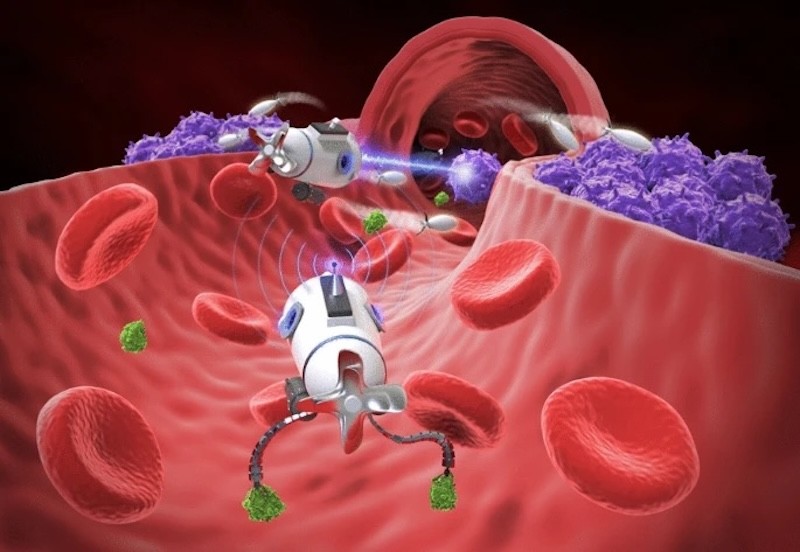
The global nanorobotics market is projected to grow from $9 billion in 2025 to $31.44 billion by 2034, expanding at a compound annual growth rate of 14.9%. Drug delivery dominates current applications, supported by preclinical advances—including a 70% tumor growth reduction using Karolinska Institute’s DNA-based nanorobots and up to 90% bladder tumor reduction achieved by IBEC’s autonomous systems. The report cites Polaris Market Research and highlights validation milestones published as of August 21, 2026.

Original source: Source information pending

Nanorobotics Market to Hit $31.4B by 2034 at 14.9% CAGR

According to Robotics & Automation News, the global nanorobotics market is forecast to reach $31.44 billion by 2034, expanding from an estimated $9 billion in 2025 at a compound annual growth rate of 14.9 percent.

Primary Growth Drivers

Targeted drug delivery remains the largest commercial application for nanorobotics, with research increasingly focused on delivering therapeutics directly to diseased cells while minimizing off-target effects on healthy tissue. This precision capability underpins demand across oncology, regenerative medicine, and diagnostics.

The market expansion reflects accelerating translational progress: Polaris Market Research, cited in the report, attributes growth to validated preclinical outcomes and rising investment in clinical pathway development. The firm’s analysis covers regional adoption patterns, material innovations, and regulatory engagement timelines across North America, Europe, and Asia-Pacific.

Preclinical Validation Milestones

Researchers at Sweden’s Karolinska Institute have developed a DNA-based nanorobot that activates specifically within the tumor microenvironment, achieving a 70 percent reduction in tumor growth in preclinical models. Similarly, scientists at the Institute for Bioengineering of Catalonia (IBEC) demonstrated autonomous therapeutic nanorobots that reduced bladder tumors by up to 90 percent in controlled studies.

These results reinforce the technology’s therapeutic specificity and support ongoing efforts to scale manufacturing processes and meet Good Manufacturing Practice (GMP) standards. The studies were conducted between 2025 and 2026, with peer-reviewed publications released as of August 21, 2026.

Source: Robotics & Automation News

Compiled from international media by the SCI.AI editorial team.

Ask SCI.AI Finished reading? Continue with SCI.AI. Explore the related policy, route, company and historical context. Continue asking
Walmart fast delivery fuels 24% e-commerce sales growth
AI & Automation

Walmart fast delivery fuels 24% e-commerce sales growth

Walmart’s fast delivery initiatives drove a 24% increase in e-commerce sales, supported by expansion to 3,500 stores with same-day/next-day capability, deployment of 1,200 dedicated delivery vans, and a 42% year-over-year rise in micro-fulfillment centers to 197 facilities. Average delivery time fell from 2.8 to 1.3 days, while e-commerce gross margin improved to 29.4% from 27.1%. Fiscal year 2025 capital expenditures for e-commerce logistics totaled $2.1 billion.

Maersk inks UK logistics deal for Columbia Sportswear, handles 1.6M units/year
AI & Automation

Maersk inks UK logistics deal for Columbia Sportswear, handles 1.6M units/year

A.P. Moller – Maersk has signed a new agreement with Columbia Sportswear to manage its UK and Ireland Pick & Pack operations from a dedicated 8,000-square-metre facility in Tamworth, UK. The five-year contract replaces Columbia’s prior France-based distribution setup in Cambrai. The hub will handle 1.6 million inbound units annually, process 1.5 million B2B and 340,000 B2C outbound units, and maintain over one million units on hand across 25,000 SKUs. Maersk will also deliver customs handling, cross-docking, and final-mile delivery.

India launches $1.2B scheme to cut China machinery imports
Manufacturing

India launches $1.2B scheme to cut China machinery imports

India has launched a $1.2 billion incentive scheme to spur domestic manufacturing of tunnel boring machines, elevators, and fire-fighting systems — targeting a $1.8 billion investment over 7 years. Imports of tunnelling machinery from China plunged from $18 million in 2022–23 to $500,000 in 2024–25 amid post-2020 geopolitical tensions and 2024 export delays. Bharat Earth Movers Limited, Larsen & Toubro, and Johnson Lifts are among potential beneficiaries. The plan seeks full indigenisation — not just assembly — of high-tech components. India’s infrastructure equipment market is valued at Rs 1 lakh crore ($10.4 billion).

Welcome Back!

Login to your account below

Create New Account!

Fill the forms below to register

Retrieve your password

Please enter your username or email address to reset your password.

Scan to share via WeChat

Open WeChat and scan the QR code to share

QR Code

Add New Playlist