Skip to content

Geopolitics · Risk & Resilience · Trade & Tariffs

Trump imposes up to 100% tariff on drones

US President Donald Trump has signed a proclamation imposing tariffs of up to 100% on imported drones and specific drone components, citing national security risks and the need to boost domestic manufacturing. The new tariff regime targets large and thermal-imaging drones heavily, while lower duties apply to smaller drones and less sensitive components. The White House stated that the 100% ad valorem tariff applies to drones with a maximum takeoff weight of more than 25 kg, as well as drones with thermal imaging capabilities, their docking stations, and certain critical components. For smaller drones that lack capabilities considered particularly sensitive to national security, the proclamation imposes a 25% ad valorem tariff. This lower rate also applies to other drone components that are not deemed critical for national security purposes. The administration has structured the tariffs to favor specific allies, provided that the hardware, software, and technology originate from within those countries and the United States. Drones and components from the European Union, Japan, Liechtenstein, the Republic of Korea, Switzerland, and Taiwan will attract a reduced tariff rate of 15%. The United Kingdom will face an even lower tariff rate of 10%, contingent upon the same origin requirements for hardware and software. The new tariffs will take effect 21 days after the proclamation was signed. However, tariffs on non-sensitive drone components will take effect after a longer window of 180 days. Products and components approved by the Department of War for exemption from the Federal Communications Commission's Covered List within 20 days of signing will also face tariffs after the 180-day period. The proclamation authorizes the Commerce Secretary to establish an onshoring programme for companies making new investments in US drone and component manufacturing. The administration highlighted that commercial and military drones rely heavily on foreign sources for critical Unmanned Aircraft System (UAS) components, creating significant risks to US national security and cybersecurity vulnerabilities.

Original source: Source information pending

Trump imposes up to 100% tariff on drones

According to Fortune India, US President Donald Trump has signed a proclamation imposing tariffs of up to 100% on imported drones and specific drone components, citing national security risks and the need to boost domestic manufacturing.

Tariff Breakdown by Drone Size and Capability

The new tariff regime targets large and thermal-imaging drones heavily, while lower duties apply to smaller drones and less sensitive components. The White House stated that the 100% ad valorem tariff applies to drones with a maximum takeoff weight of more than 25 kg, as well as drones with thermal imaging capabilities, their docking stations, and certain critical components.

For smaller drones that lack capabilities considered particularly sensitive to national security, the proclamation imposes a 25% ad valorem tariff. This lower rate also applies to other drone components that are not deemed critical for national security purposes.

Exemptions for Key Trading Partners

The administration has structured the tariffs to favor specific allies, provided that the hardware, software, and technology originate from within those countries and the United States. Drones and components from the European Union, Japan, Liechtenstein, the Republic of Korea, Switzerland, and Taiwan will attract a reduced tariff rate of 15%.

The United Kingdom will face an even lower tariff rate of 10%, contingent upon the same origin requirements for hardware and software. This tiered approach aims to protect US industries while maintaining strong trade relationships with key security partners.

Implementation Timeline and Exemptions

The White House announced that the new tariffs will take effect 21 days after the proclamation was signed. However, tariffs on non-sensitive drone components will take effect after a longer window of 180 days.

Products and components approved by the Department of War for exemption from the Federal Communications Commission’s Covered List within 20 days of signing will also face tariffs after the 180-day period. This timeline allows companies to adjust their supply chains and seek necessary exemptions.

Focus on Domestic Manufacturing and National Security

The proclamation authorizes the Commerce Secretary to establish an onshoring programme for companies making new investments in US drone and component manufacturing. The White House emphasized that drones are a key technology in modern armed conflict and critical for present and future US military operations.

The administration highlighted that commercial and military drones rely heavily on foreign sources for critical Unmanned Aircraft System (UAS) components, creating significant risks to US national security and cybersecurity vulnerabilities. The move builds on Trump’s broader use of Section 232 tariffs to protect industries considered critical to US national security, including steel, aluminum, copper, trucks, automobiles, timber, lumber, and pharmaceuticals.

The administration stated that US drone production needs to be expanded rapidly to strengthen national and economic security and support jobs in the country’s defense and defense-adjacent industrial base.

Source: fortuneindia.com

Compiled from international media by the SCI.AI editorial team.

Ask SCI.AI Finished reading? Continue with SCI.AI. Explore the related policy, route, company and historical context. Continue asking
Singapore climate envoy: climate is ‘mother’ of supply chain disruption
Disruptions

Singapore climate envoy: climate is ‘mother’ of supply chain disruption

Singapore's climate action ambassador Ravi Menon called climate change the "mother of all" supply chain disruptions at the Bloomberg Sustainable Business Summit 2026. Using El Niño as an example, he explained how climate events cascade through food systems, hydroelectric power, and energy supply chains. Menon also highlighted grid infrastructure and battery storage as key investment opportunities, arguing that private capital must complement public and philanthropic funding to drive climate action.

BHP faces A$120M/day loss as 48-hour Port Hedland strike looms
Disruptions

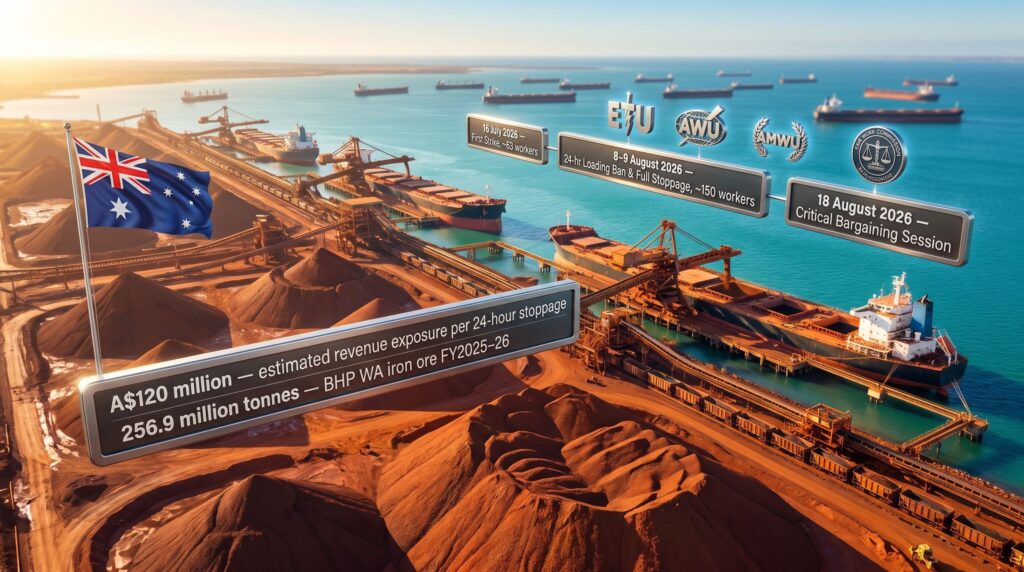
BHP faces A$120M/day loss as 48-hour Port Hedland strike looms

BHP faces a A$120 million per day revenue loss as a 48-hour strike at Port Hedland, the world's largest iron ore export terminal, begins August 8, 2026. The two-phase action by the Combined Ports Unions involves ~150 workers, targeting ship-loading and full operations. With 256.9 million tonnes exported in FY2026, the disruption tests supply chain resilience.

China’s exports rise 14%, imports up 22% amid trade war resilience
Supply Chain

China’s exports rise 14%, imports up 22% amid trade war resilience

China’s foreign trade rose 17.3% to ¥30.13 trillion in the first seven months of 2026, with exports up 14% and imports surging 22%. High-tech exports jumped over 50% in July, accounting for nearly 60% of monthly export growth. U.S.-China trade fell 1.6%, while ties with over 180 countries—including ASEAN and the EU—expanded. Green exports like EVs and lithium batteries posted double-digit growth for the 17th straight month. China also applies zero tariffs to imports from 63 countries.

Welcome Back!

Login to your account below

Create New Account!

Fill the forms below to register

Retrieve your password

Please enter your username or email address to reset your password.

Scan to share via WeChat

Open WeChat and scan the QR code to share

QR Code

Add New Playlist