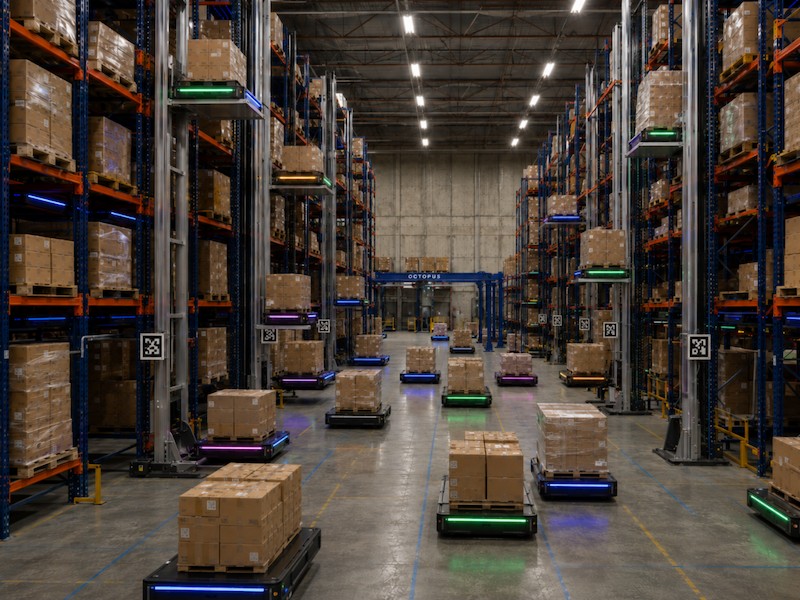
According to roboticsandautomationnews.com, real-time supply chain technologies are driving a structural decline in industrial inventory levels and facility footprints — with inventory volumes falling 40% over three years and automated warehouse physical footprints shrinking by 60%.
From buffer to throughput: The changing role of the warehouse
Traditional warehouse networks were engineered to absorb uncertainty through layered safety stock. Manufacturers produced based on aggregated forecasts, distributors added buffers, and goods accumulated across regional hubs — each layer introducing excess but also stability. As data becomes accessible across stakeholders, that structure is eroding. When transportation systems coordinate dynamically and demand signals improve, goods move more directly from origin to destination. Instead of waiting in storage, products are routed in real time based on actual need. Intermediate facilities still exist, but their function has shifted: they now serve as transfer points rather than inventory depots — especially visible in urban environments where large shipments transition to smaller last-mile delivery systems.
According to the report, this shift prioritizes throughput over storage. Goods spend less time idle, and facilities are reconfigured to support continuous movement. In one documented case, a major logistics operator reduced average dwell time per pallet from 72 hours to under 15 minutes after deploying integrated robotics and predictive routing software. The result is a leaner, faster-moving network where facility design reflects flow velocity, not static capacity.
Precision over excess: How predictive data reduces inventory
A core driver of inventory reduction is the collapse of information asymmetry. Historically, manufacturers relied on downstream partners to interpret customer behavior — each layer inflating orders to avoid shortages. Fragmented demand data led to systemic overproduction. Predictive analytics reverses this pattern: with direct access to point-of-sale and consumption telemetry, manufacturers align production tightly to verified demand. As Michael Santora, CEO of Logic, explains:
“Reliability comes from having the information you need, not excess product.” — Michael Santora, CEO, Logic
This model shifts the buffer from physical goods to informational accuracy. The source states that companies adopting end-to-end demand signal integration have cut forecast error rates by up to 37% and reduced unsold inventory by 40% over a three-year period. Fewer unsold products mean fewer resources consumed, fewer facilities required for surplus storage, and lower working capital tied up in stagnant assets.
Designing for automation: Smaller footprints, faster operations
As inventory levels fall, warehouse design evolves fundamentally. Automation drives this transformation. Traditional facilities dedicate significant space to circulation: forklifts and operators require wide aisles, sometimes consuming over 60% of total floor area. Automated systems eliminate that constraint — enabling dense, aisle-less racking and autonomous movement paths. The report notes that fully automated distribution centers now achieve 60% smaller physical footprints than legacy counterparts handling equivalent throughput volumes.
Operational speed increases dramatically: loading and unloading cycles that once took hours now complete in minutes. This reduces dependency on multiple loading docks and shrinks staging areas. One North American fulfillment hub reported cutting truck turnaround time from 112 minutes to 18 minutes post-automation. Engineering talent shifts from maintaining aging mechanical systems to developing next-generation control algorithms — a strategic reallocation of scarce technical labor.
Connectivity and location: The new foundations of industrial real estate
Even as physical space shrinks, digital infrastructure becomes non-negotiable. Automated operations depend on reliable, high-performance connectivity across the entire facility — from internal Wi-Fi 6E mesh networks to site-wide 5G private network coverage. The source states that 73% of legacy warehouses surveyed exhibited critical connectivity gaps due to building materials or remote location — gaps that become operational failure points in automated environments.
Facilities must be designed with connectivity embedded from day one: accounting for RF interference from steel and concrete, ensuring sub-50ms latency across all zones, and supporting real-time synchronization for hundreds of concurrent robotic units. These requirements enable digital twins — live software models integrating vehicle telemetry, robot status, and building systems. When all assets report position and state continuously, operators manage flows across yard, dock, and interior space as a single coordinated system — reducing congestion, preventing bottlenecks, and increasing asset utilization by up to 28%.
Source: Robotics & Automation News
Compiled from international media by the SCI.AI editorial team.