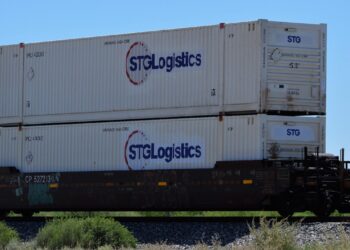
According to www.kavout.com, Amazon.com, Inc. officially launched its Amazon Supply Chain Services (ASCS) in May 2026 — a unified enterprise offering that opens its logistics infrastructure to third-party businesses, directly challenging FedEx and UPS.
The Fourth Integrator Arrives
Amazon’s ASCS became fully operational with its Less-Than-Truckload (LTL) freight offering in June 2026, marking the formal entry of the e-commerce giant as the “fourth integrator” in the U.S. parcel market. The move triggered immediate market reactions: on May 4, 2026, FedEx shares slid 9%, while UPS stock plunged 10%, erasing weeks of gains for both carriers. In contrast, Amazon’s stock rose 1%, building on a 27% rally in April driven by strength in Amazon Web Services (AWS).
Amazon’s strategic rationale centers on monetizing over a decade of infrastructure investment. Since 2020, the company has spent more than $30 billion to build a network comprising over 200 fulfillment centers, spanning more than 200 million square feet, supported by over 200,000 operations staff and a fleet of more than 100 aircraft. Peter Larsen, vice president of Amazon Supply Chain Services, stated:
“Amazon is bringing the infrastructure, intelligence, and scale of its supply chain services — proven over decades — to businesses everywhere, much like Amazon Web Services did for cloud computing.” — Peter Larsen, vice president of Amazon Supply Chain Services
The Numbers: A Shifting Parcel Landscape
The competitive landscape is defined by stark financial asymmetries. As of 2026-07-09, Amazon’s market capitalization stood at $2.66 trillion, dwarfing FedEx’s $74.17 billion and UPS’s $82.68 billion. Operationally, Amazon Logistics handled 6.1 billion packages annually in 2024, surpassing FedEx’s 3.4 billion. Yet Amazon’s U.S. parcel market share was 15% in 2024, trailing USPS (31%), UPS (24%), and FedEx (19%).
Revenue share diverged further: Amazon captured 12% of U.S. parcel revenue in 2024, versus UPS’s 37% and FedEx’s 33%. This gap reflects FedEx’s premium service positioning and higher revenue per package. Financially, FedEx reported robust Q3 FY2026 revenue of $24.0 billion, an 8% increase year-over-year, with U.S. domestic package volume up 5%. Its total fiscal year 2026 revenue reached $94.7 billion, also up 8%. Meanwhile, UPS posted a 4% net income margin for Q1 2026, and its U.S. domestic average daily volumes fell 8% — an intentional reduction tied to scaling back Amazon-related work.
From Customer to Competitor
Amazon’s evolution from top customer to direct competitor unfolded over years. It began embedding logistics operations inside customer warehouses in 2013 and launched freight brokerage services in 2019. The ASCS launch in May 2026 bundled warehousing, freight forwarding, customs brokerage, transportation, and last-mile delivery — powered by AI and machine learning for demand forecasting and inventory optimization. Cathy Morrow Roberson, founder and head analyst at Logistics Trends & Insights, noted:
“Amazon will bundle services and start offering them at a nice and attractive rate that UPS and FedEx are not able to offer,” — Cathy Morrow Roberson, founder and head analyst at Logistics Trends & Insights
Amazon’s aggressive pricing reportedly delivers up to 30% savings on shipping costs — aided by significantly fewer surcharges than incumbents. Early enterprise clients include Procter & Gamble, for which Amazon moves raw materials to production facilities, and 3M, whose finished goods it ships across distribution networks.
Incumbents’ Strategic Pivot
The launch accelerated structural shifts at both FedEx and UPS. UPS CEO Carol Tomé declared that 2026 would be “an inflection point” upon completion of the “Amazon glide-down.” To execute this pivot, UPS eliminated roughly 48,000 positions and closed 93 facilities in 2025. Both carriers are now intensifying focus on higher-margin verticals — especially healthcare logistics. While FedEx projects an 11% year-over-year volume increase in its next fiscal year, it too is shifting toward value-added services rather than volume alone.
Source: kavout.com
Compiled from international media by the SCI.AI editorial team.