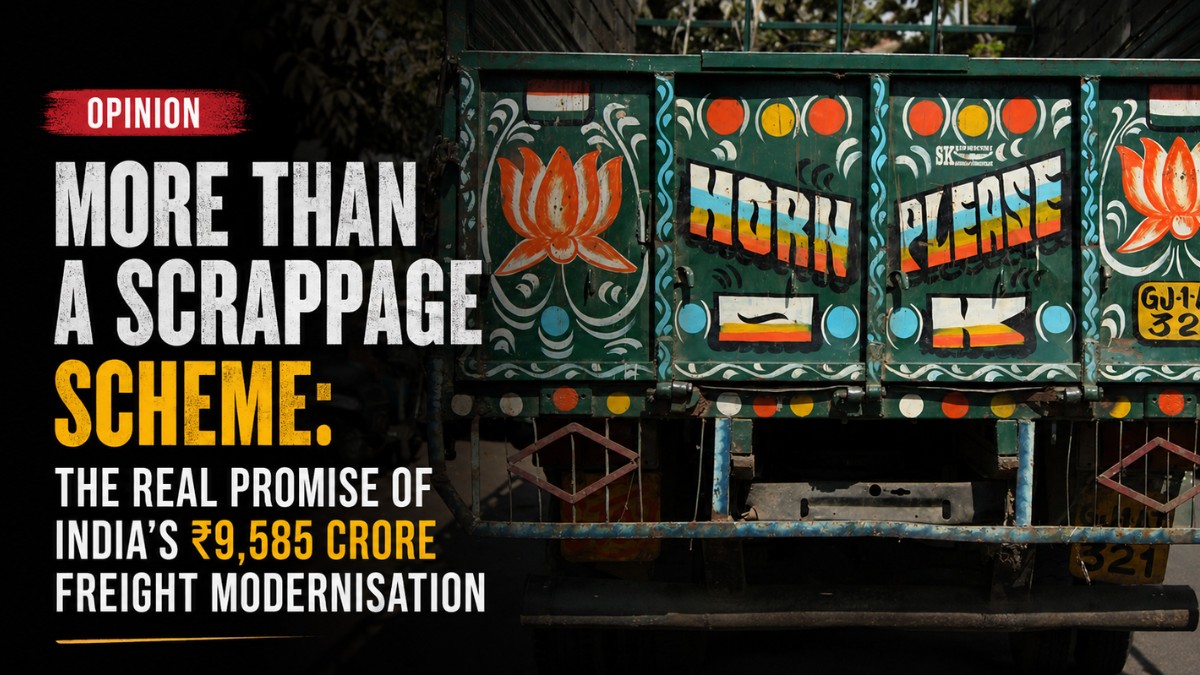
According to www.logisticsinsider.in, India’s Union Cabinet has approved a ₹9,585 crore scheme to modernise commercial road freight in the Delhi-National Capital Region (Delhi-NCR), targeting the replacement of over two lakh ageing trucks and buses.
Not Just Scrappage — A Systemic Modernisation Push
The initiative—officially launched on July 6, 2026—goes beyond conventional vehicle scrappage by integrating interest subvention, tax incentives, fuel vouchers, and manufacturer discounts to accelerate adoption of Bharat Stage VI (BS-VI) and zero-emission technologies, including electric trucks. As freight transport contributes roughly 10% of global CO₂ emissions—with road freight accounting for the majority—the policy directly addresses one of Delhi-NCR’s most visible urban emission sources.
This marks a strategic pivot toward strengthening India’s logistics backbone while delivering measurable environmental outcomes in high-density economic corridors. The scheme reflects national decarbonisation priorities aligned with India’s net-zero target for 2070 and its commitment under the Paris Agreement.
The Financing Gap: The Real Bottleneck
While vehicle replacement is incentivised, the transition’s scalability hinges on financing architecture—not technology. Electric trucks carry 2–3x higher upfront capital costs than diesel equivalents, despite becoming cost-competitive over 4–8 years in high-utilisation, closed-loop operations. This creates a critical short-term affordability gap.
Compounding this challenge is India’s fragmented freight sector: 75% of the market consists of small owner-operators owning up to five trucks, with limited balance sheet strength and restricted access to long-tenure credit. As noted by Smart Freight Centre (SFC) India, “the scheme’s success will be determined not by OEM discounts or scrappage incentives, but by whether these small operators can make the business case to upgrade.”
Building Bankability for Zero-Emission Freight
SFC India is catalysing structural change by advancing bankable freight decarbonisation models. Its work focuses on identifying high-efficiency corridors—defined by predictable routes, depot-based charging, and high utilisation—to convert early pilots into credible investment opportunities. Risk redistribution across the value chain is equally vital: shippers, logistics providers, OEMs, and financiers must share contractual risk through long-term cargo commitments, offtake visibility, and uptime guarantees.
Manufacturers that succeed will be those offering integrated solutions—not just vehicles, but financing, charging partnerships, and fleet-transition support. Financial innovation—including extended loan tenures, improved residual value assessment frameworks, and collateral structures reflecting lifecycle economics—is essential to lower the cost of capital.
Policy Momentum Meets Market Readiness
The Delhi-NCR scheme serves as a demand-side catalyst, lowering entry barriers and signalling policy direction to industry stakeholders. Yet policy alone cannot deliver scale. Adoption depends on complementary enablers: charging infrastructure, data transparency on electric truck performance, and financial institution readiness.
Efforts to build lender awareness, standardise operational metrics, and de-risk pilot deployments are shifting electric freight from “perceived risk” to a measurable asset class. Without parallel progress in finance and infrastructure, vehicle replacement remains isolated—rather than systemic transformation.
From Replacement to Structural Transformation
India’s freight sector is undergoing structural change driven by economic growth, logistics expansion, and decarbonisation imperatives. The ₹9,585 crore scheme accelerates fleet renewal and improves urban air quality—but the next frontier lies in enabling systemic adoption. That requires aligning policy incentives with financial innovation and ecosystem coordination so clean freight transitions are economically viable for all stakeholders, especially the two lakh small operators at the heart of India’s road freight economy.
Source: logisticsinsider.in
Compiled from international media by the SCI.AI editorial team.