According to www.logisticsinsider.in, A.P. Moller – Maersk has launched its new FI2 ocean service to strengthen maritime connectivity between China and India’s western coastline, beginning with its first westbound sailing from Shanghai on June 4, 2026.
New Weekly Service Targets Key Industrial Corridors
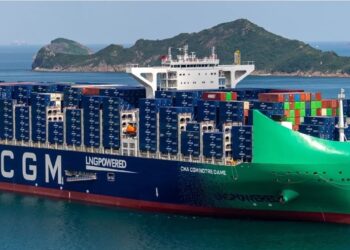
The FI2 is a dedicated weekly ocean service operating with a fleet of six vessels, each with a nominal carrying capacity of 4,500 TEU. Its port rotation includes Shanghai, Ningbo, Nansha, Tanjung Pelepas, Nhava Sheva, Pipavav, and Port Qasim — linking manufacturing clusters in Southern and Eastern China directly with industrial and consumption hubs across western and northern India. This routing creates the first high-frequency, end-to-end ocean-rail corridor specifically engineered for time-sensitive cargo flows.
Multimodal Integration via Dedicated Freight Corridor
A defining feature of the FI2 service is its inland extension through Pipavav Port in Gujarat, which connects directly to India’s Dedicated Freight Corridor (DFC) network. This integration enables rail movement of containers into the National Capital Region and adjacent industrial centres including Delhi, Gurugram, and Noida — reducing overland transit time by an estimated 30–40% compared to conventional road transport, according to industry benchmarks cited in related infrastructure reports. The DFC’s electrified, double-stack freight capability supports average speeds of 70 km/h for container trains, significantly compressing door-to-door lead times.
Customer Demand Drives Dual-Service Strategy
The launch follows sustained growth in bilateral trade: India’s imports from China reached $71.9 billion in FY2024, with machinery, electronics components, and chemical intermediates accounting for 62% of total import value (Ministry of Commerce & Industry, Government of India). To meet this demand, Maersk now operates two direct Far East–India services — FI2 and the existing FI3 — increasing weekly capacity on the corridor by at least 27,000 TEU (6 vessels × 4,500 TEU). Thomas Theeuwes, Maersk’s Regional Managing Director for Asia, confirmed the strategic rationale:
“The FI2 is a direct response to what our customers want: more capacity, consistency, and connectivity on the China-India route. By combining the weekly ocean service with our rail solution via the DFC, we are going a step further and giving our customers the true integrated logistics experience.” — Thomas Theeuwes, Regional Managing Director, Asia, Maersk
Broader Industry Context and Infrastructure Momentum
This expansion aligns with parallel developments across India’s logistics ecosystem. The Indian government has allocated ₹1.14 trillion (US$13.7 billion) for logistics infrastructure under the PM Gati Shakti National Master Plan as of FY2025. Concurrently, PSA India signed a rail pact with CONCOR in May 2026 to integrate Mumbai Port with the DFC, while Adani Logistics acquired ICD Tumb for INR 835 crore ($100.5 million) in August 2022 — underscoring sector-wide capital deployment toward multimodal efficiency. For supply chain professionals, the FI2’s fixed-day weekly schedule and DFC-linked rail legs offer predictable transit windows — critical for just-in-time automotive suppliers and retail inventory planners managing lean stock buffers across the India-China sourcing loop.
Source: www.logisticsinsider.in
Compiled from international media by the SCI.AI editorial team.