Skip to content

Japan & Korea Supply Chain

Analysis

Japan–South Korea Semiconductor Materials Dispute: 3 Export Controls, $6B Market Impact — www.cambridge.org

Japan’s 2019 export controls on fluorinated polyimide, photoresists, and hydrogen fluoride triggered a $6.03 billion trade shock for South Korea’s semiconductor industry. The measures—implemented 15 days after announcement—removed South Korea from Japan’s white list of 27 trusted partners. At the time, Japan supplied 94% of global fluorinated polyimide and 89% of photoresists exported to Korea. Samsung and SK Hynix responded with $268M+ in localization R&D, while Korean firms raised domestic material self-sufficiency from 3.1% to 18% by 2022. Procurement protocols now mandate 8-week buffer stocks for high-concentration materials.

Original source: Source information pending

Japan–South Korea Semiconductor Materials Dispute: 3 Export Controls, $6B Market Impact — www.cambridge.org

According to www.cambridge.org, Japan imposed export controls on three critical semiconductor materials—fluorinated polyimide, photoresists, and hydrogen fluoride—in July 2019, directly targeting South Korea’s high-technology supply chain.

Export Restrictions and Immediate Fallout

The Japanese government removed South Korea from its ‘white list’ of trusted trading partners on August 28, 2019, a status previously held by only 27 countries. This decision required individual licensing for exports of 1,147 controlled items, including the three materials essential for OLED display and memory chip production. According to the report, Japan’s Ministry of Economy, Trade and Industry (METI) cited ‘concerns over export control compliance’ as the official justification—though South Korean officials contested the evidence behind the claim. The controls took effect just 15 days after METI’s announcement, compressing lead times for Korean firms reliant on Japanese suppliers.

Market-Scale Impact on Key Materials

South Korea imported $6.03 billion worth of materials, parts, and equipment (MPE) from Japan in 2018—the year before the dispute erupted. Of that total, fluorinated polyimide accounted for 94% of global supply, with Japan’s Sumitomo Chemical and Shin-Etsu Chemical dominating production. Photoresists represented 89% of Japan’s $1.2 billion annual MPE exports to South Korea in 2018, while ultra-pure hydrogen fluoride—used in silicon wafer etching—was supplied almost exclusively by Stella Chemifa and Kanto Chemical. The source states that South Korea’s domestic capacity for these materials stood at less than 5% of national demand at the time of the controls’ implementation.

Corporate and Industrial Response

Samsung Electronics and SK Hynix—two firms responsible for 72% of global DRAM output and 50% of NAND flash production—faced immediate inventory pressure. Samsung reported a 12.4% year-on-year decline in operating profit for Q3 2019, partly attributed to procurement uncertainty. According to the report, both companies accelerated R&D investment into local alternatives: SK Hynix allocated ₩320 billion ($268 million) toward domestic material qualification between 2019 and 2021, while Samsung partnered with Korean firms including ENF Technology and SFA Engineering to co-develop hydrogen fluoride purification systems. A senior executive at a Korean display manufacturer stated:

“We had to hold 12 weeks of buffer stock for fluorinated polyimide—up from our standard 4-week safety margin—just to avoid line stoppages.” — Park Min-jae, Procurement Director, LG Display

Broader Supply Chain Implications

The dispute catalyzed structural shifts across East Asia’s tech supply chain. By 2022, South Korea’s domestic share of fluorinated polyimide usage rose to 18%, up from 3.1% in 2018. Meanwhile, Japan’s MPE exports to South Korea fell 21.7% year-on-year in 2020, dropping to $4.72 billion. Industry data cited in the article shows that 27 Korean firms received government-backed R&D grants totaling ₩1.1 trillion ($920 million) between 2019 and 2022 to localize MPE production. From a practitioner perspective, procurement teams at tier-1 electronics manufacturers now routinely conduct dual-sourcing audits for all Class-A critical materials—and require minimum 8-week onshore buffer inventories for any item with >70% single-country supply concentration.

Source: www.cambridge.org

Compiled from international media by the SCI.AI editorial team.
Ask SCI.AI Finished reading? Continue with SCI.AI. Explore the related policy, route, company and historical context. Continue asking
India, Japan Ink Next-Gen Pact Targeting JPY 10 Trillion Investment
Japan & Korea Supply Chain

India, Japan Ink Next-Gen Pact Targeting JPY 10 Trillion Investment

Union Commerce and Industry Minister Piyush Goyal concluded a four-day Japan visit on August 27, advancing the India-Japan Next Generation Economic Partnership. The initiative targets JPY 10 trillion in Japanese private investment in India over the next decade, as set during PM Modi’s 2025 Japan visit. Goyal’s delegation — nearly 200 strong — engaged over 200 industry participants across Tokyo, Osaka, and a third city, yielding early outcomes including a robotics firm’s commitment to invest in and manufacture in India. Discussions emphasized semiconductors, AI, clean energy, defence-linked manufacturing, space, and robotics for ageing societies — all under the framework of resilient supply chains and economic security.

South Korea, Brazil Ink Deal to Restart Mercosur FTA Talks
Japan & Korea Supply Chain

South Korea, Brazil Ink Deal to Restart Mercosur FTA Talks

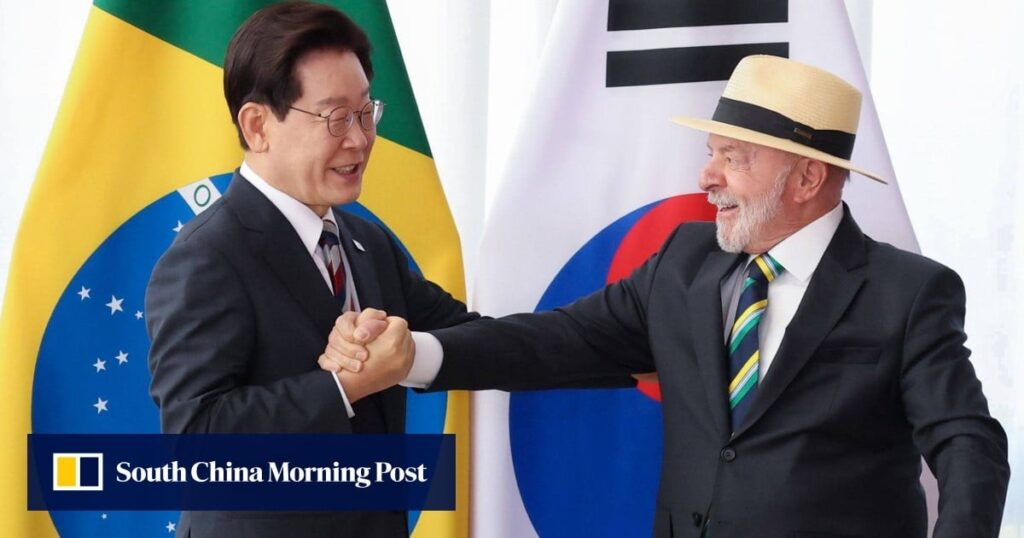
South Korean President Lee Jae Myung and Brazilian President Luiz Inacio Lula da Silva agreed on 29 July 2026 to restart free-trade negotiations with Mercosur — the South American bloc of Argentina, Brazil, Paraguay, Uruguay, and Bolivia. A joint working group will prepare a formal declaration for the Mercosur summit in December 2026. Talks, launched in 2018, stalled in late 2021 amid manufacturing-sector concerns. Analysts say Seoul must back diplomacy with real investment and technology transfer. Mercosur’s $3.5 trillion GDP and 270 million consumers make it a high-stakes opportunity for Korean exporters and supply chain planners.

Nissan to export US-built Murano to Japan in early 2027
Japan & Korea Supply Chain

Nissan to export US-built Murano to Japan in early 2027

Nissan will begin exporting the U.S.-built Murano SUV from its Smyrna, Tennessee plant to Japan in early 2027 — enabled by a September 2025 U.S.-Japan trade agreement that lowered U.S. tariffs on Japanese vehicles from 25% to 15% and allowed U.S. safety certification to satisfy Japanese regulatory requirements. The move follows similar announcements by Toyota and Honda to export U.S.-assembled models to Japan. Nissan sold 42,747 Muranos in the U.S. in 2025 (+121% YoY), while U.S. imports from Japan fell 17.4% to 113,094 units.

Welcome Back!

Login to your account below

Create New Account!

Fill the forms below to register

Retrieve your password

Please enter your username or email address to reset your password.

Scan to share via WeChat

Open WeChat and scan the QR code to share

QR Code

Add New Playlist