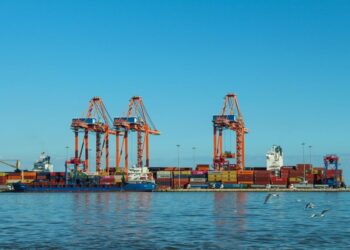
According to www.propnewstime.com, India’s ports are undergoing a strategic transformation from traditional cargo gateways into integrated logistics and industrial hubs — a shift underpinned by rapid capacity expansion, policy reforms, and increased private sector participation.
Cargo Capacity Expansion & Targets
India’s cargo handling capacity has more than doubled over the past decade, rising from around 1,400 million tonnes per annum (MTPA) in 2013–14 to 2,771 MTPA currently. The government has set an ambitious target of 3,500 MTPA by 2030 and 10,000 MTPA by 2047. In FY 2025–26, major ports handled over 915 million tonnes of cargo — the highest throughput on record.
Strategic Shift: From Gateways to Ecosystems
The Shipping Secretary outlined this evolution while addressing investors in Singapore, emphasizing that ports are now being positioned as anchors for industrial clusters, warehousing, and value-added services — not standalone cargo facilities. According to the report, this reflects a broader strategy of port-led industrialisation and supply chain integration.
“India’s ports are transitioning into integrated logistics and industrial hubs, supported by capacity expansion, policy reforms and private sector participation.” — Shipping Secretary, addressing investors in Singapore
Enabling Initiatives
The transformation is being accelerated through several complementary efforts:
- Public-private partnerships (PPPs) and adoption of global best practices
- Creation of a national container line
- Expansion of an energy fleet via joint ventures
- Implementation of ship financing mechanisms at GIFT City
- Green port development and alternative fuel production
- Strengthening domestic shipbuilding, with a goal to rank among the top five shipbuilding nations globally by 2047
Supply Chain Implications for Global Practitioners
For global supply chain professionals, this port modernisation signals tangible shifts in India’s trade infrastructure: reduced logistics costs, improved end-to-end efficiency, and enhanced multimodal connectivity between inland production centres and export gateways. As logistics parks, industrial zones, and ancillary infrastructure are co-developed alongside port expansions — particularly in coastal states — practitioners should anticipate revised lead times, new inland container depot (ICD) capacities, and evolving requirements for bonded warehousing and customs-compliant value-added services. The emphasis on green port development also aligns with growing global expectations for ESG-compliant logistics platforms, especially for multinationals managing Scope 3 emissions across maritime transport legs.
Industry Context
This port-led industrialisation mirrors parallel strategies elsewhere: Vietnam’s deep-water port investments in Lach Huyen and Van Phong Bay support its rise as a manufacturing alternative; Saudi Arabia’s NEOM and King Abdullah Port integrate logistics, industry, and renewables under Vision 2030; and the EU’s TEN-T programme prioritises multimodal terminals linking seaports with rail and inland waterways. India’s scale-up — backed by measurable targets and cross-sectoral coordination — positions it as an increasingly coherent node in global supply networks, particularly for nearshoring and China-plus-one sourcing strategies.
Source: www.propnewstime.com
Compiled from international media by the SCI.AI editorial team.