According to www.dcvelocity.com, robotics and automation supplier FANUC America showcased five robotic systems at MODEX 2026 that streamline box handling, scanning, picking, palletizing, depalletizing, and autonomous material movement — all enabled by artificial intelligence (AI)-enhanced vision and intelligent perception tools.
Flexible, Code-Free Operation Across Platforms
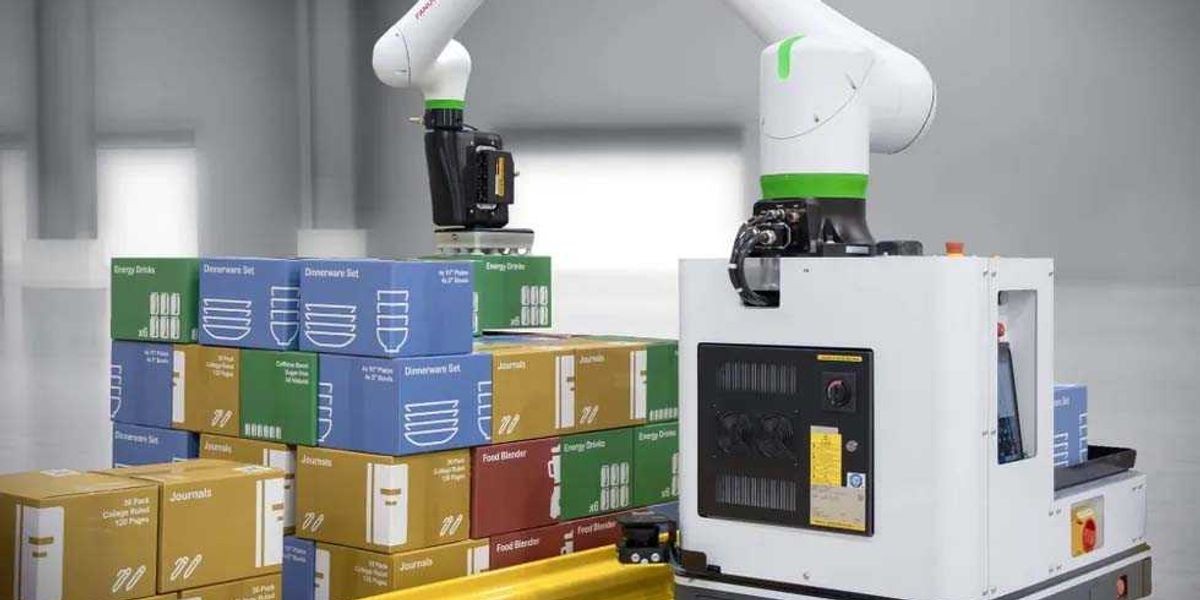
The systems are designed to identify products, adapt to mixed workloads, and make real-time decisions in dynamic warehouse environments. One demonstration featured a high-payload CRX-30iA collaborative robot arm mounted on an OTTO 600 autonomous mobile robot (AMR), performing end-to-end tasks including picking, weighing, transporting, palletizing, and sorting boxes. Another used the CRX-10iA collaborative robot, trained directly on the warehouse floor — without any computer code — for label inspection and barcode reading using a 3DV/200 vision sensor.
Multi-Sensor Integration for Precision Handling
A third setup deployed an M-10/12-14D industrial robot arm equipped with 2D iRVision cameras to read bin barcodes, a 3DV/600 sensor to locate pickable items, and an integrated radio-frequency identification (RFID) reader to identify items, execute pick-and-place operations, and consolidate totes. A fourth system used an M-710/50-26D robot arm for palletizing and depalletizing, leveraging a 3DV/1600 3D vision sensor and FANUC’s iPC Box, which powers the company’s AI Box Locator for precise box detection and location.
Broader Industry Context for Supply Chain Practitioners
These demonstrations arrive amid sustained industry-wide demand for warehouse robotics, driven by persistent labor shortages and strategic automation initiatives. As noted in the source, Roboteon — another MODEX 2026 exhibitor — introduced a vendor-independent simulation tool to quantify robotics ROI using real-world inputs like warehouse layout, order profiles, and operational assumptions; its analysis takes 2–3 weeks to complete. Similarly, Linde Material Handling unveiled myLinde, a cloud-based fleet management platform offering visibility into safety metrics, service schedules, equipment utilization, and energy performance — reinforcing how hardware and software integration is becoming table stakes for modern material handling. For supply chain professionals, these developments signal a shift toward plug-and-play flexibility: robots no longer require extensive programming or static environments, but instead learn, perceive, and adapt in situ — reducing deployment time, expanding use-case coverage, and lowering the barrier to scalable automation.
Source: DC Velocity
Compiled from international media by the SCI.AI editorial team.