Explore

  • Trending
  • Latest
  • Tools
  • Browse
  • Subscription Feed

Logistics

  • Ocean
  • Air Cargo
  • Road & Rail
  • Warehousing
  • Last Mile

Regions

  • Southeast Asia
  • South Asia
  • Central Asia
  • Japan & Korea
  • Middle East
  • Europe
  • Russia
  • Africa
  • North America
  • Latin America
  • Australia
SCI.AI
  • Supply Chain
    • Strategy & Planning
    • Logistics & Transport
    • Manufacturing
    • Inventory & Fulfillment
  • Procurement
    • Strategic Sourcing
    • Supplier Management
    • Supply Chain Finance
  • Technology
    • AI & Automation
    • Robotics
    • Digital Platforms
  • Risk & Resilience
  • Sustainability
  • Research
  • Expert Columns
  • English
    • Chinese
    • English
No Result
View All Result
  • Login
  • Register
SCI.AI
No Result
View All Result
Home Supply Chain Manufacturing

Fastenal Digital Pivot: 66% Revenue via Digital Channels, 2,000+ Onsite Sites

2026/04/14
in Manufacturing, Supply Chain
0 0
Fastenal Digital Pivot: 66% Revenue via Digital Channels, 2,000+ Onsite Sites

According to markets.financialcontent.com, Fastenal Company (NASDAQ: FAST) generated over 66% of its revenue through digital channels by early 2026 — up from just 10% a decade ago — as part of a strategic shift toward embedded supply chain services. This transformation coincides with the company operating more than 2,000 Onsite locations, which now outnumber its traditional public branches, and reporting $8.20 billion in record net sales for fiscal year 2025, an 8.7% year-over-year increase.

From Fastener Shop to Embedded Supply Chain Partner

Founded in 1967 in Winona, Minnesota, by Bob Kierlin and four partners — the “Fastenal Five” — the company began with a $30,000 investment and a 1,000-square-foot storefront. Though its original vision centered on custom vending machines, hardware limitations forced a pivot to high-turn local inventory and rapid service. Fastenal went public on August 1, 1987, at $9 per share, and expanded aggressively across small-town North America. The pivotal modern evolution began in 2008 and 2014 with the launch of the Onsite program — moving Fastenal’s operations directly into customer facilities.

Three-Pillar Business Model

Fastenal’s current model rests on three interlocking pillars:

  • Onsite Locations: Dedicated, facility-embedded branches serving single large customers; over 2,000 active as of late 2024
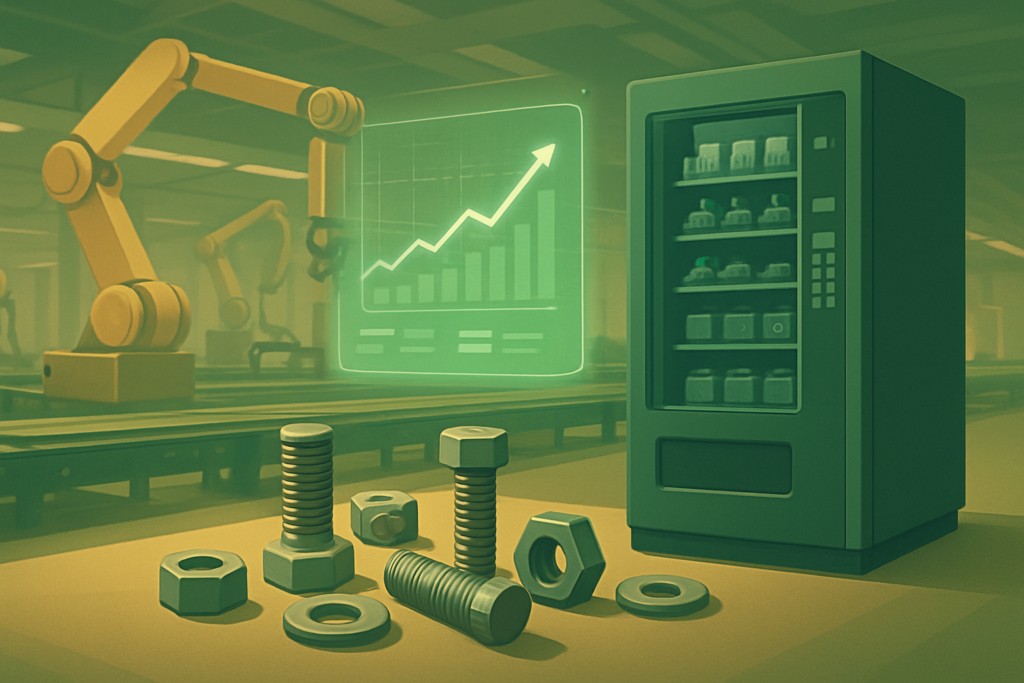
  • Fastenal Managed Inventory (FMI): Includes FASTVend industrial vending machines and FASTBin smart bins using infrared/RFID to track usage in real time and automate replenishment — reducing customer consumption by 20–30%
  • Digital Footprint: Encompasses e-commerce, EDI, and FMI technology; accounts for 66% of revenue as of early 2026

Financial Discipline and Market Positioning

For Q1 2026, Fastenal reported revenue of $2.20 billion, a 12.4% surge year-over-year, with operating margins holding at 20.3%. Gross margins stood at 44.6%, slightly compressed due to higher-volume National Account business, but offset by lower operating expenses from branch consolidation. The company maintains a debt-to-equity ratio of just 3.2% and a Return on Invested Capital (ROIC) of 31.0%. It recently raised its quarterly dividend to $0.24 per share, marking 13 consecutive years of increases.

Leadership Transition and Strategic Continuity

In December 2025, the board announced that CEO Daniel Florness — who joined in 1996 and assumed the role in 2016 — will step down on July 16, 2026. He will be succeeded by Jeffery Watts, President and Chief Sales Officer and a 30-year Fastenal veteran. According to the report, investors view this internal promotion as confirmation that Fastenal’s trajectory toward Onsites and automation “will remain unchanged.”

Technology and Competitive Differentiation

While fasteners still represent about 25% of sales, Fastenal has diversified across MRO supplies, safety equipment, and metalworking tools. Its innovation pipeline includes “Edge AI” in vending machines capable of predicting tool failure by analyzing usage patterns. Within its 15 North American distribution centers, Fastenal has deployed native case-handling robotics to accelerate pallet-to-bin replenishment — reinforcing its advantage in local delivery speed.

Industry Context and Supply Chain Implications

The “U.S. Manufacturing Renaissance” — driven by policies like the “One Big Beautiful Bill Act” (OBBBA) and over $3 trillion in reshoring investments — is accelerating demand for embedded, responsive supply chain infrastructure. Fastenal’s physical proximity inside factories gives it a structural advantage: competitors are effectively locked out of the most critical daily transactions. In contrast, W.W. Grainger leads in broad-line MRO digital efficiency; Amazon Business dominates unplanned “tail-spend” but lacks on-the-ground technical service; and MSC Industrial Direct excels in metalworking expertise but lacks Fastenal’s scale of vending deployment. For global supply chain professionals, Fastenal’s model signals a broader industry shift — where inventory management is no longer transactional but operational, embedded, and predictive. Its success underscores that resilience increasingly depends not just on visibility or speed, but on physical presence integrated with real-time data and autonomous replenishment.

Source: markets.financialcontent.com

Compiled from international media by the SCI.AI editorial team.

More on This Topic

  • AI Logistics Trends 2026: 5 Key Shifts for Supply Chains (Apr 15, 2026)
  • AI Logistics Race: Amazon & Walmart Drive One-Hour Delivery (Apr 15, 2026)
  • Last Mile Delivery to Hit $250B by Early 2030s: AI and Robots Reshape Retail Logistics (Apr 15, 2026)
  • U.S. Navy to Boost Maritime Industrial Base with Allies: $65.8B Shipbuilding Budget (Apr 15, 2026)
  • 5 Transportation Tech Trends Reshaping Supply Chains in 2026 (Apr 15, 2026)
ShareTweet

Related Posts

AI Logistics Trends 2026: 5 Key Shifts for Supply Chains
Inventory & Fulfillment

AI Logistics Trends 2026: 5 Key Shifts for Supply Chains

April 15, 2026
1
AI Logistics Race: Amazon & Walmart Drive One-Hour Delivery
Last Mile

AI Logistics Race: Amazon & Walmart Drive One-Hour Delivery

April 15, 2026
1
Last Mile Delivery to Hit $250B by Early 2030s: AI and Robots Reshape Retail Logistics
Last Mile

Last Mile Delivery to Hit $250B by Early 2030s: AI and Robots Reshape Retail Logistics

April 15, 2026
1
U.S. Navy to Boost Maritime Industrial Base with Allies: $65.8B Shipbuilding Budget
Logistics & Transport

U.S. Navy to Boost Maritime Industrial Base with Allies: $65.8B Shipbuilding Budget

April 15, 2026
1
5 Transportation Tech Trends Reshaping Supply Chains in 2026
Logistics & Transport

5 Transportation Tech Trends Reshaping Supply Chains in 2026

April 15, 2026
0
Forecasting Methods for Supply Chain Optimization: 5 Key Approaches
Strategy & Planning

Forecasting Methods for Supply Chain Optimization: 5 Key Approaches

April 14, 2026
2

Leave a Reply Cancel reply

Your email address will not be published. Required fields are marked *

Recommended

EU Omnibus I Slashes CSRD Scope by 90%: New €450M Threshold Reshapes Supply Chain Compliance in 2026

EU Omnibus I Slashes CSRD Scope by 90%: New €450M Threshold Reshapes Supply Chain Compliance in 2026

35 Views
March 8, 2026
CBAM’s First Month Triggers 84% Collapse in EU Fertiliser Imports: Carbon Border Pricing Ignites Global Agricultural Supply Chain Crisis

CBAM’s First Month Triggers 84% Collapse in EU Fertiliser Imports: Carbon Border Pricing Ignites Global Agricultural Supply Chain Crisis

32 Views
February 21, 2026
Lio Secures $30M from Andreessen Horowitz to Automate 75% of Enterprise Procurement in 2026

Lio Secures $30M from Andreessen Horowitz to Automate 75% of Enterprise Procurement in 2026

23 Views
March 8, 2026
The Perpetual Disruption Imperative: How AI, Regulatory Fractures, and Parcel Economics Are Rewriting Global Supply Chain Strategy in 2026

The Perpetual Disruption Imperative: How AI, Regulatory Fractures, and Parcel Economics Are Rewriting Global Supply Chain Strategy in 2026

5 Views
March 22, 2026
Show More

SCI.AI

Global Supply Chain Intelligence. Delivering real-time news, analysis, and insights for supply chain professionals worldwide.

Categories

  • Supply Chain Management
  • Procurement
  • Technology


  • Risk & Resilience
  • Sustainability
  • Research

© 2026 SCI.AI. All rights reserved.

Powered by SCI.AI Intelligence Platform

Welcome Back!

Sign In with Facebook
Sign In with Google
Sign In with Linked In
OR

Login to your account below

Forgotten Password? Sign Up

Create New Account!

Sign Up with Facebook
Sign Up with Google
Sign Up with Linked In
OR

Fill the forms below to register

All fields are required. Log In

Retrieve your password

Please enter your username or email address to reset your password.

Log In

Scan to share via WeChat

Open WeChat and scan the QR code to share

QR Code

Add New Playlist

No Result
View All Result
  • Supply Chain
    • Strategy & Planning
    • Logistics & Transport
    • Manufacturing
    • Inventory & Fulfillment
  • Procurement
    • Strategic Sourcing
    • Supplier Management
    • Supply Chain Finance
  • Technology
    • AI & Automation
    • Robotics
    • Digital Platforms
  • Risk & Resilience
  • Sustainability
  • Research
  • Expert Columns
  • English
    • Chinese
    • English
  • Login
  • Sign Up

© 2026 SCI.AI