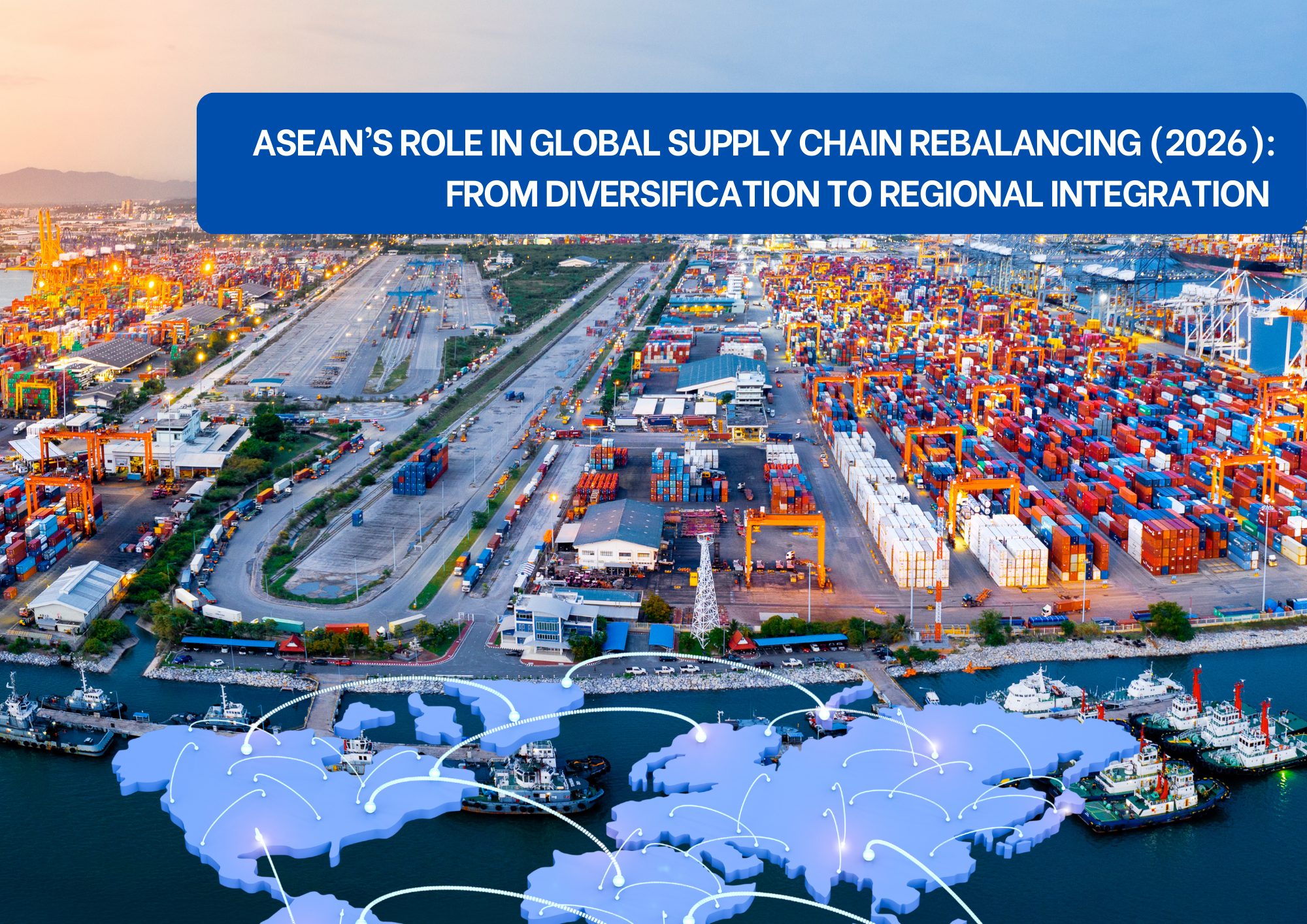
According to www.sourceofasia.com, ASEAN has evolved from a secondary sourcing option into a strategic manufacturing hub central to global supply chain rebalancing — particularly within US–ASEAN industrial realignment.
What Supply Chain Rebalancing Really Means
Supply chain rebalancing is a structural shift: it spreads production, sourcing, and logistics across multiple countries to reduce concentration risk and improve long-term flexibility. It is not full relocation or decoupling. Rather, it means reducing heavy dependence on a single location while maintaining operational continuity elsewhere. Unlike diversification — which adds backup suppliers — rebalancing changes how much production each country carries.
Why Rebalancing Accelerated After 2018
According to the International Monetary Fund, US–China trade tensions prompted immediate effects, with rising import duties forcing companies dependent on Chinese production to reevaluate their risks. This was compounded by pandemic disruptions that halted operations — factories paused, ports slowed, and deliveries became uncertain — highlighting that efficiency alone wasn’t sufficient without flexibility. As a response, the China Plus One strategy gained traction, with firms adding production sites in Southeast Asia to reduce risk and manage tariff pressure — not abandoning China entirely.
How Rebalancing Differs from Decoupling
- Rebalancing is about spreading risk: adjusting where companies produce and source to avoid overdependence on one country.
- Decoupling implies a clear break — separating supply chains for political or strategic reasons.
- In practice, most multinational firms are not leaving China entirely; they are reducing exposure, not cutting ties.
- ASEAN functions as a complement rather than a replacement: components may still move between China and Southeast Asia before final assembly.
ASEAN’s Strategic Position
As reported by CNBC, Southeast Asia has become a top choice for companies diversifying supply chains away from China under the China Plus One strategy. Several countries play distinct roles:
- Vietnam: expanded into electronics assembly and consumer goods.
- Thailand: continues to anchor regional automotive production.
- Indonesia: moving into battery materials and EV-related industries.
ASEAN is no longer seen as a low-cost assembly base. Growth is visible in higher-value sectors such as Semiconductor packaging and testing, precision components, EV supply chains, and battery materials. Industrial parks support this upgrade with ready-built infrastructure, stable utilities, and cluster networks — backed by government incentives including tax breaks, land access, and investment programs.
Practical Implications for Supply Chain Professionals
Success depends on disciplined execution: supplier validation, compliance oversight, and alignment with long-term strategy. Regional integration and trade agreements make cross-border production more efficient, but infrastructure gaps and talent shortages still require attention. Companies must treat ASEAN not as a stopgap but as an integrated node — one enabling layered, flexible supply chains that balance cost, tariff exposure, and continuity.
Source: www.sourceofasia.com
Compiled from international media by the SCI.AI editorial team.