According to www.oxmaint.com, autonomous mobile robots (AMRs) are now actively embedded in maintenance operations — not merely as transport tools but as integrated intelligence-generating assets that deliver measurable safety, efficiency, and data fidelity gains across global facilities.
Operational Reality, Not Future Vision
At a distribution centre in Ohio, 42 AMRs operated unattended from 2:17 AM to 6:00 AM, navigating 180,000 square feet, delivering 847 parts kits, completing 14 equipment check patrol routes, and identifying 3 thermal anomalies on conveyor motor housings — all before the first technician arrived. This is documented 2026 operational reality, not simulation or pilot testing.
Market Scale and Adoption Momentum
The global AMR market reached $5.18 billion in 2026 and is projected to grow to $10.56 billion by 2031 at a 15.3% CAGR. Over 80% of large warehouses are now implementing automation solutions, with AMRs at the core of deployment. Industry-wide, 70% of mobile robots in logistics are projected to utilise IoT by 2026 for enhanced performance — enabling richer telemetry integration into maintenance systems.
Safety and Efficiency Gains
Deployments have yielded quantifiable human-factor improvements: Locus Robotics documented an 80% reduction in worker injuries post-AMR implementation. Crucially, AMRs eliminate up to 30–40% of technician travel time per shift by delivering parts directly to repair locations — a figure aligned with longstanding industry studies on non-value-added movement in maintenance workflows.
AMRs as Active Maintenance Assets
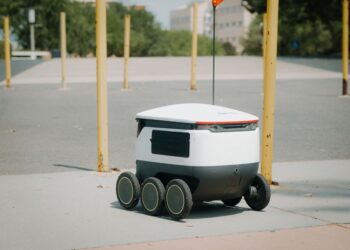
Modern AMRs use onboard LiDAR, vision cameras, SLAM navigation, and AI processing to operate independently — moving parts, conducting patrols, monitoring equipment condition during transit, and completing repeatable tasks 24/7. In maintenance, they function as mobile sensor platforms, autonomous inspection agents, and parts delivery systems that generate real-time facility intelligence. When connected to a CMMS, they become the most consistent and scalable data collection layer available to maintenance programmes.
Eight Operational Use Cases in 2026
- Inspection: Autonomous facility patrol using thermal cameras, vibration sensors, and visual AI to flag anomalies, temperature deviations, and fluid leaks on scheduled or on-demand routes.
- Logistics: Parts delivery to technicians — retrieving items from inventory and staging them at the point of work before technician arrival.
- Monitoring: Equipment condition monitoring via passive data capture (thermal signatures, vibration, visual status) during routine AMR transit — building trend data without installing dedicated sensors on every asset.
- Inventory: Spare parts inventory auditing using barcode scanners or RFID readers — replacing manual cycle counts that consume 8–12 hours monthly and providing real-time availability to the CMMS.
- Safety: Hazard and leak detection via gas sensors, visual AI, and thermal imaging — triggering immediate alerts and work orders before incidents escalate.
- Compliance: Digital inspection documentation with timestamped, geolocated logs automatically tied to asset records — replacing paper-based or manual digital trails.
- Workflow Integration: AMR-generated anomaly data feeds directly into automated maintenance workflows and work order management — closing the loop between robotic intelligence and human action.
- Scalable Data Collection: AMRs serve as a distributed, mobile sensor network — enabling continuous, low-cost condition assessment across vast facility footprints where fixed-sensor coverage remains economically or logistically impractical.
Source: www.oxmaint.com
Compiled from international media by the SCI.AI editorial team.