March 30, 2026 – Global logistics technology company Flexport has released a new report indicating that the ongoing escalation of military conflict in the Middle East has caused systemic shocks to global ocean and air freight networks. Since the outbreak of the conflict on February 28, the closure of the Strait of Hormuz, suspension of Suez Canal transits, and comprehensive airspace closures across Gulf states are triggering the most severe global supply chain crisis since the COVID-19 pandemic.
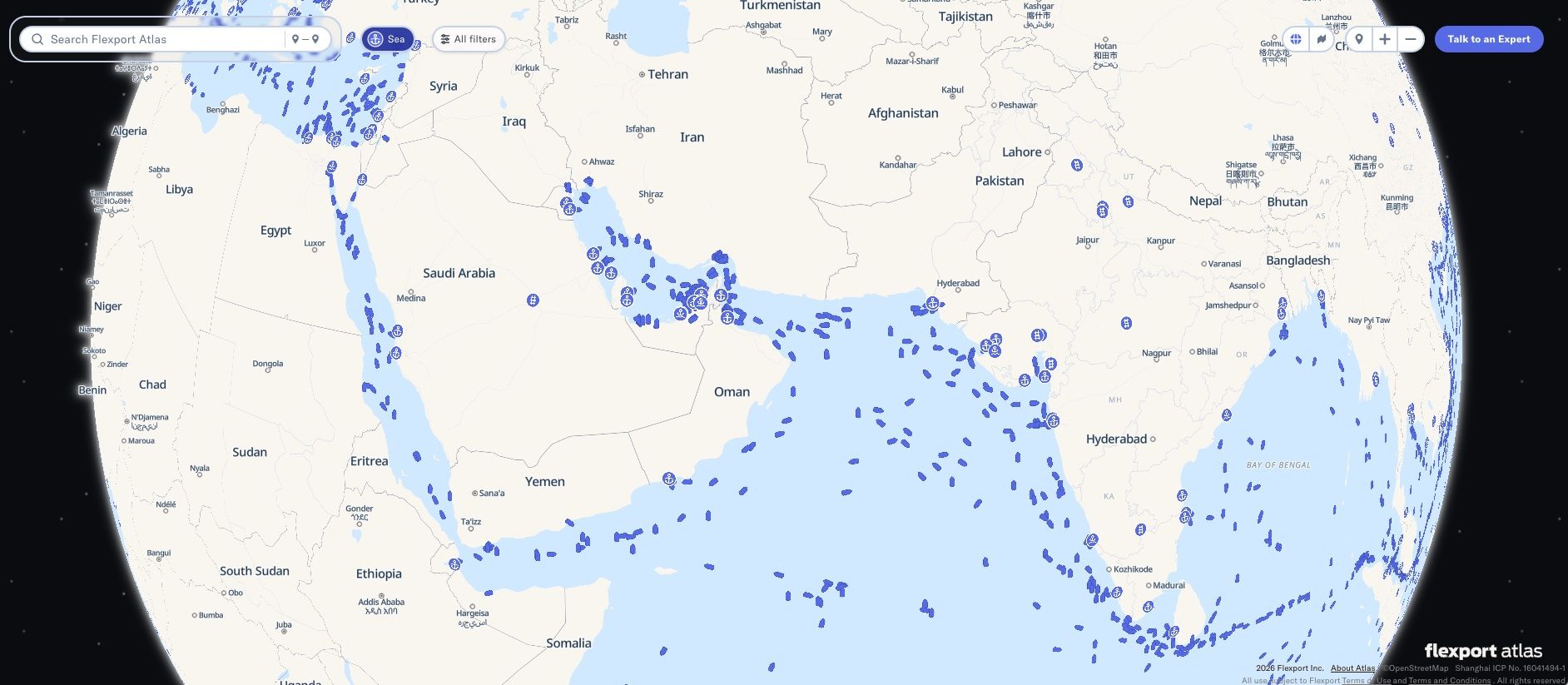
Strait of Hormuz: The Global Energy and Trade Chokepoint Paralyzed
As the world’s most critical maritime energy corridor, the Strait of Hormuz handles approximately 20% of global oil trade. Since the conflict began, the strait has been closed to all major container shipping lines.
Alphaliner data shows that as of March 2, 138 container ships were trapped in the Persian Gulf, with a total capacity of 470,000 TEUs. Among them, Mediterranean Shipping Company (MSC) and CMA CGM have 109,000 TEUs and 70,000 TEUs of capacity trapped respectively.
On March 30, COSCO’s two ultra-large container vessels, CSCL Indian Ocean and CSCL Arctic Ocean, successfully transited the Strait of Hormuz, becoming the first non-Iranian flagged vessels to leave the Persian Gulf since the conflict began. However, just three days earlier on March 27, these same vessels attempted passage but were forced to turn back. This incident highlights the extreme uncertainty of navigation conditions in the region.
Ocean Networks: Massive Route Diversions, Freight Rates Soar 80%
With the closure of the Strait of Hormuz and suspension of Suez Canal transits, major global shipping alliances have been forced to implement large-scale route adjustments. Asia-Europe route vessels are all being diverted around the Cape of Good Hope, extending voyage times by 10-14 days. This change not only increases fuel consumption but also exacerbates global container equipment shortages.
Regarding freight rates, the Shanghai Containerized Freight Index (SCFI) Comprehensive Index rose 12% in the week following the conflict outbreak, while normally rates would be declining during this period. More severely, cargo destined for Persian Gulf ports faces mandatory surcharges of up to $800 per container, with shippers also responsible for additional discharge, handling, and storage expenses.
Air Freight Crisis: Gulf Airspace Completely Closed, Capacity Plummets 36%
The situation in air freight is equally severe. Airspace over Iran, Iraq, Kuwait, Bahrain, and Saudi Arabia’s Dammam region remains completely closed. While the UAE and Qatar have partially opened their airspace, they maintain only limited commercial flight schedules. Major global hubs including Dubai International Airport (DXB), Abu Dhabi International Airport (AUH), and Doha Hamad International Airport (DOH) are all operating under restricted conditions.
Data shows Emirates has restored capacity to 65%, Etihad Airways to just 15%, and Qatar Airways also maintaining only 15% capacity. All major EU and US airlines (Lufthansa, Cargolux, United, Air France-KLM Group, etc.) continue to implement cargo embargoes to and from the region, effective until March 28.
Fuel Prices: Jet Fuel Spikes 58% in One Week, Marine Fuel Costs Double
Soaring fuel prices caused by the conflict are intensifying the supply chain crisis. Jet fuel prices rose 58% in one week, forcing airlines like Oman Air to implement weekly fuel and war risk surcharges starting tomorrow. For marine fuel, Singapore very low sulphur fuel oil (VLSFO) prices doubled in a week, with average VLSFO prices across the top 20 global bunkering ports rising over 80% since the effective closure of the Strait of Hormuz.
To cope with rising operational costs, major shipping lines are leveraging their scrubber-equipped vessels (representing about 45% of their fleets) to achieve 10-15% cost savings by burning cheaper IFO380 fuel instead of VLSFO.
Flexport Emergency Solution: Launches 27-Day Sea-Air Express Service
Facing increasingly severe supply chain disruptions, Flexport has launched a multimodal solution called “Sea-Air Express.” This service can transport cargo from Asia to Europe in as few as 27 days, with rates up to 41% below pure air freight. This innovative solution aims to provide shippers with alternative routes bypassing Middle East disruption zones.
Flexport’s report indicates that the current Middle East conflict directly impacts 10.7% of the global container fleet by TEU capacity. A total of 124 container liner services encompassing 520 vessels call at least one Persian Gulf port in their pro forma rotations. Geographically, MSC leads the top 10 ocean carriers in TEUs deployed to the Persian Gulf, while Yang Ming leads in the percentage of its vessel fleet calling at Persian Gulf ports.
Global Impact: Supply Chain Domino Effect Taking Shape
The impact of Middle East supply chain disruptions is spreading globally. Vietnam has begun experiencing fuel shortages, with narrow-body aircraft being the first affected. STARLUX Airlines has suspended all cargo loading at Hanoi’s Noi Bai International Airport (HAN) due to fuel shortages effective tomorrow, while China Airlines was also forced to offload three main deck shipments at HAN yesterday due to the same issue.
Massive flight cancellations in South Asia have delayed deliveries for many major clothing retailers. Manufacturers in Bangladesh and India report shipments being left behind at airports as airlines adjust routes. General cargo rates for Cambodia, India, Bangladesh, Sri Lanka, and Pakistan have increased more than $1/kg since last Friday.
As the Middle East situation continues to escalate, global supply chains face their most severe test since the 2020 COVID-19 pandemic. Businesses need to develop comprehensive contingency plans, including identifying alternative routes, increasing inventory buffers, and working closely with logistics providers to navigate supply chain disruptions that could last for months.
Source: Flexport – Middle East Escalation Disrupts Global Ocean and Air Freight Networks
Compiled from international media by the SCI.AI editorial team.