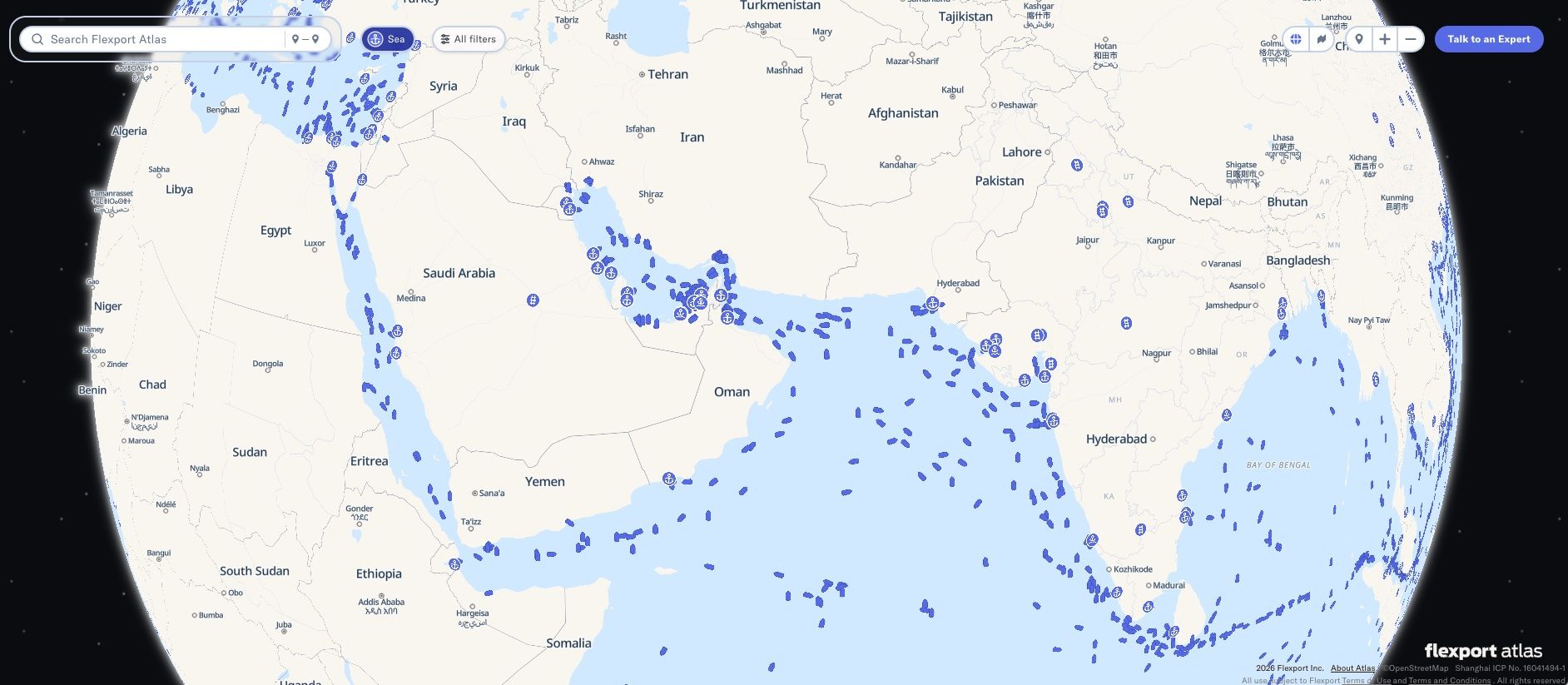
March 2026 has witnessed a dramatic escalation in Middle East tensions, creating unprecedented dual disruptions to global ocean and air freight networks. The functional closure of the Strait of Hormuz, persistent risks in Red Sea shipping lanes, and comprehensive airspace controls across multiple nations are reshaping global supply chain dynamics, testing corporate emergency response capabilities and supply chain resilience.
1. Strait of Hormuz: The World’s Energy and Trade Chokepoint Faces Closure
The Strait of Hormuz remains the world’s most critical oil transit corridor, with approximately 21 million barrels of oil passing through daily—representing about 30% of global seaborne oil trade. On March 27, 2026, two COSCO ultra-large container vessels, CSCL Indian Ocean and CSCL Arctic Ocean, were forced to abort their attempted transit through the strait, marking the first attempted passage by a major shipping line since the conflict began.
This incident signifies the functional closure of the Strait of Hormuz. Just two days earlier, on March 25, COSCO had announced the resumption of Asia-Gulf bookings, only to suspend them again. The immediate consequence has been soaring fuel prices: since the effective closure of the Strait of Hormuz, average very low sulphur fuel oil (VLSFO) prices at the world’s top 20 ports have surged over 80%, while IFO380 fuel prices for scrubber-equipped vessels have risen more than 70%.
The deeper impact involves global trade flow reconfiguration. Saudi Arabia’s Red Sea port of Jeddah is emerging as a supply chain lifeline for the Persian Gulf region, providing alternative routes for cargo unable to transit Hormuz. However, this rerouting increases transit times and costs, posing severe challenges for time-sensitive commodities.
2. Air Freight Network: Regional Paralysis and Global Cascading Effects
The Middle East air freight network has suffered more direct impacts. As of March 20, 2026, airspace remains completely closed over Iran, Israel, Iraq, Kuwait, Bahrain, and Saudi Arabia’s Dammam region. The UAE and Qatar have only partially opened airspace, implementing limited commercial flight schedules under constant security monitoring.
Major global hub operations are severely constrained: Emirates at Dubai International Airport (DXB) operates at 65% capacity, Etihad at Abu Dhabi Airport (AUH) at just 15%, and Qatar Airways at Doha Airport (DOH) also at 15%. All major EU and U.S. carriers (Lufthansa, Cargolux, United, Air France-KLM, etc.) continue cargo embargoes to and from the region until March 28.
Jet fuel prices have doubled since the conflict began, with a 58% spike in a single week. Carriers like Oman Air are implementing weekly fuel and war risk surcharges starting tomorrow. To maintain cargo movement, airlines are adding “technical stops” in locations like Jeddah to bypass restricted zones, increasing both time and cost per mile.
3. Supply Chain Disruption: From Regional Crisis to Global Impact
The Middle East situation’s effects have extended far beyond the region, creating cascading impacts across global supply chains. Global air cargo capacity has been squeezed by 12% this week, with an even sharper 36% decline in the Middle East and South Asia.
Freight rates from India to Europe are expected to increase by approximately 80%, while Hong Kong to Europe rates have already surpassed $5.15/kg. Over 25,000 regional flights have been canceled, creating significant cargo backlogs.
Fuel shortages have begun emerging in Vietnam, initially affecting narrow-body aircraft. STARLUX Airlines at Hanoi’s Noi Bai International Airport (HAN) will suspend all cargo loading due to fuel shortages effective tomorrow, while China Airlines was forced to offload three main decks at HAN yesterday for the same reason.
4. Corporate Response Strategies: Innovative Logistics Solutions and Supply Chain Resilience Building
Facing Middle East challenges, logistics providers and shippers are developing innovative solutions. Flexport has launched Sea-Air Express, a multimodal solution delivering cargo from Asia to Europe in as few as 27 days at rates up to 41% below pure air freight.
Saudi Arabia has announced new GCC logistics enhancement initiatives, including extending truck lifespans to 22 years, allowing empty GCC trucks to enter Saudi Arabia for outbound goods, and supporting refrigerated cargo transport. A new storage and redistribution zone at King Abdulaziz Port will improve container handling and supply chain flexibility, offering up to 60-day fee exemptions for GCC trade.
Companies are adopting multiple crisis response strategies: leveraging hubs in Oman and Saudi Arabia as primary alternatives for UAE-origin freight; utilizing road feeder services through Saudi Arabia to bypass flight cancellations when full air transport isn’t necessary; and building diversified supply chains to reduce dependence on single regions.
“We seek partners who can help us rationalize our logistics network. We chose Flexport because they can deploy across multiple sites in a short timeframe and provide scalable solutions that continue to adapt as our business evolves.”—Global logistics company executive
5. Long-term Implications: Reshaping Global Supply Chain Architecture
The Middle East escalation is accelerating the reshaping of global supply chain architecture. Companies are reassessing supply chain strategies, reducing dependence on high-risk regions, and increasing supply chain diversity and resilience.
Regional logistics hub importance is being redistributed. Saudi Arabia is strengthening its position as a global logistics hub through its GCC logistics enhancement plan, while traditional hubs like Oman’s Salalah port face security challenges.
Demand for multimodal solutions is growing. Innovative logistics products like Flexport’s Sea-Air Express represent the future direction of supply chain solutions—flexible, resilient, and cost-effective.
6. Future Outlook: New Paradigms for Supply Chain Management in Uncertainty
The Middle East situation remains highly volatile, potentially changing hour by hour. This uncertainty demands new supply chain management paradigms: more agile, more data-driven, and more focused on risk management.
Real-time monitoring and data analytics have become critical. Companies require technological solutions that can track cargo locations in real time, predict delays, and quickly adjust logistics plans.
Supply chain resilience is no longer optional but a core competency. Companies investing in supply chain visibility, risk management, and contingency planning will perform better during this crisis and gain competitive advantages afterward.
The Middle East escalation represents the greatest supply chain test of 2026. This crisis has exposed global supply chain vulnerabilities while simultaneously driving innovation and transformation. Businesses, governments, and logistics providers must collaborate to build more resilient, sustainable, and efficient global supply chain systems.
Source: https://www.flexport.com/blog/middle-east-escalation-disrupts-global-ocean-and-air-freight-networks/
Additional source: https://www.cbnme.com/logistics-news/saudi-arabia-unveils-gcc-logistics-boost-plan/
Additional source: https://www.tbsnews.net/world/hormuz-closure-disrupts-key-global-supply-chains-1394976
This article is compiled and analyzed based on international media reports by the SCI.AI editorial team.